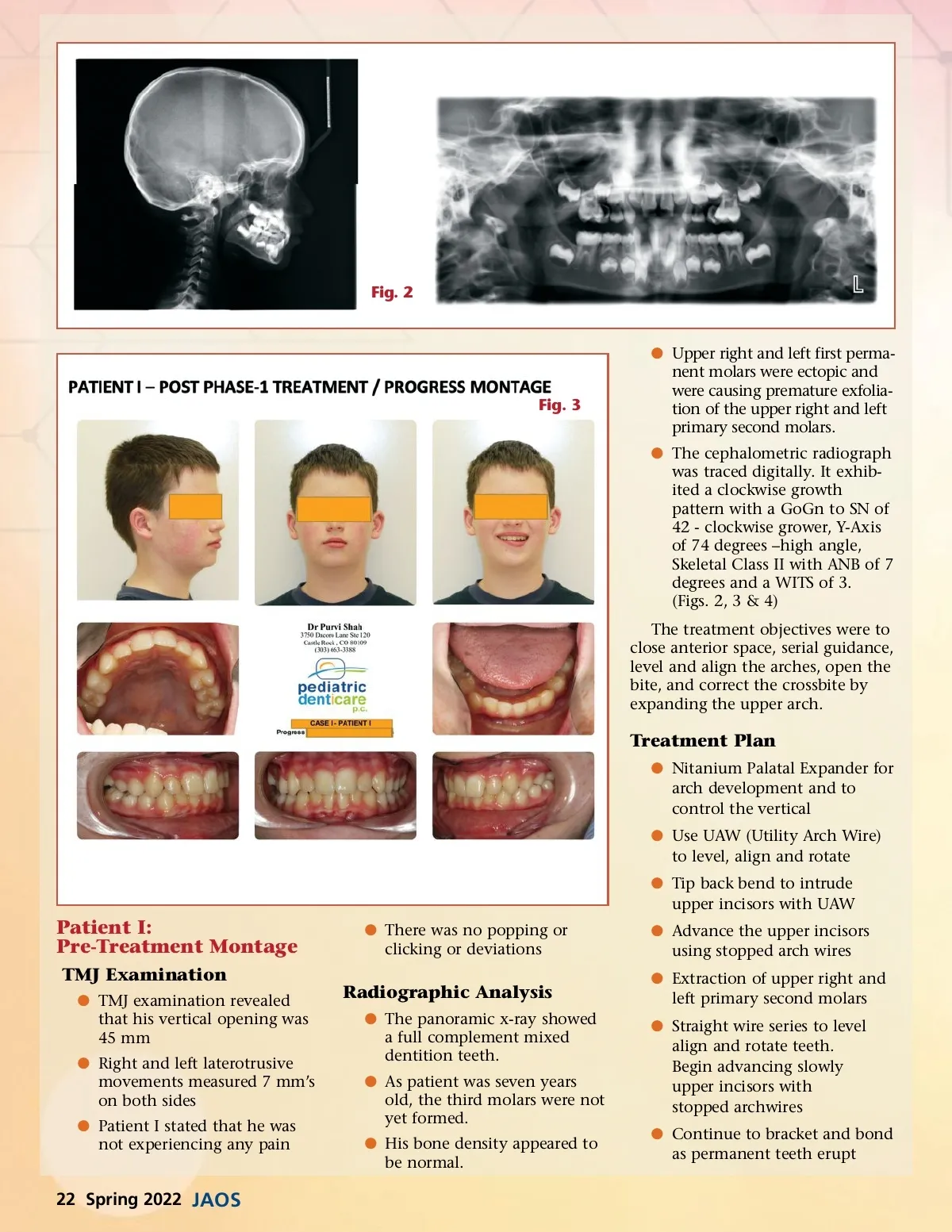
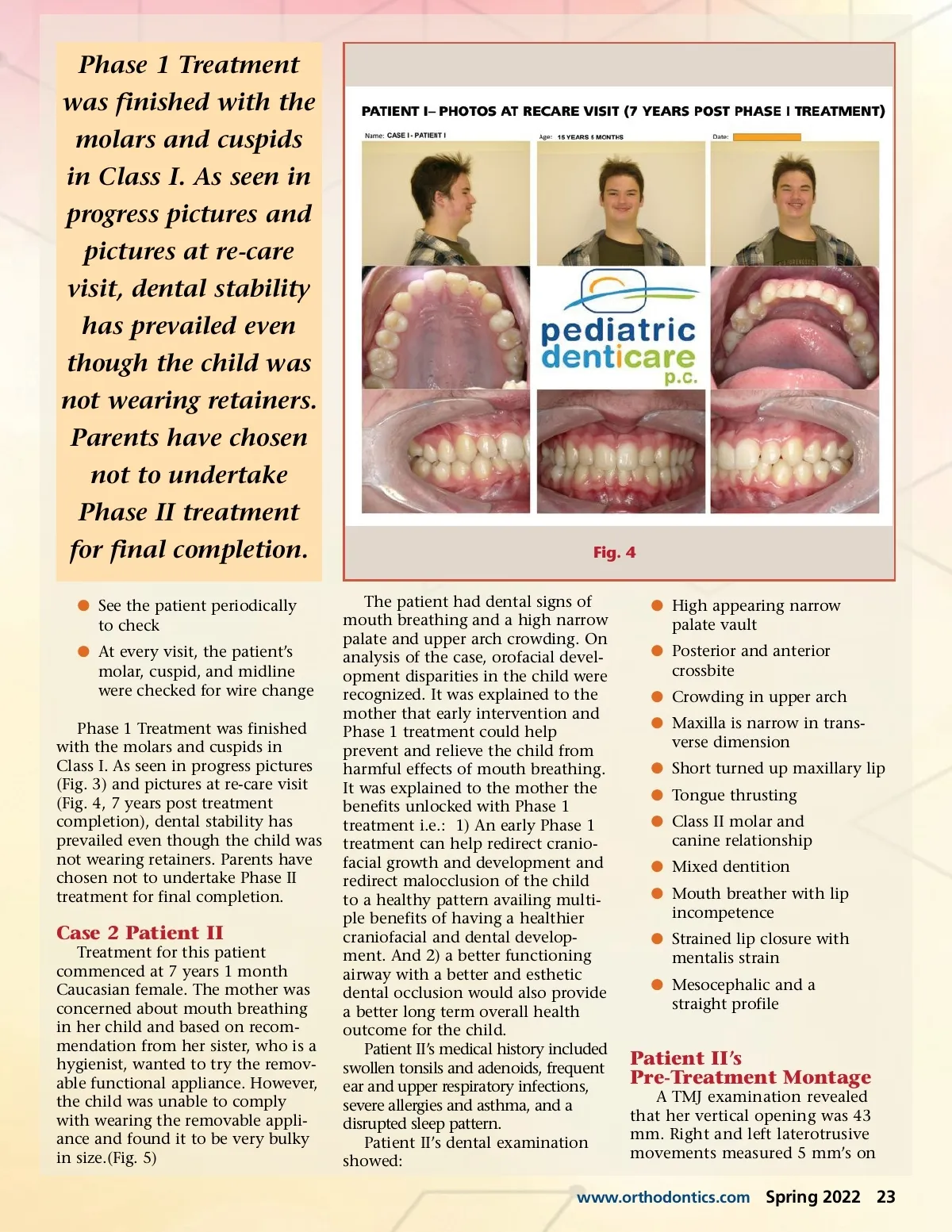
Phase 1 Treatment was finished with the molars and cuspids in Class I. As seen in progress pictures and pictures at re-care visit, dental stability has prevailed even though the child was not wearing retainers. Parents have chosen not to undertake Phase II treatment for final completion. b See the patient periodically to check b At every visit, the patient’s molar, cuspid, and midline were checked for wire change Phase 1 Treatment was finished with the molars and cuspids in Class I. As seen in progress pictures (Fig. 3) and pictures at re-care visit (Fig. 4, 7 years post treatment completion), dental stability has prevailed even though the child was not wearing retainers. Parents have chosen not to undertake Phase II treatment for final completion. Fig. 4 The patient had dental signs of mouth breathing and a high narrow palate and upper arch crowding. On analysis of the case, orofacial devel-opment disparities in the child were recognized. It was explained to the mother that early intervention and Phase 1 treatment could help prevent and relieve the child from harmful effects of mouth breathing. It was explained to the mother the benefits unlocked with Phase 1 treatment i.e.: 1) An early Phase 1 treatment can help redirect cranio-facial growth and development and redirect malocclusion of the child to a healthy pattern availing multi-ple benefits of having a healthier craniofacial and dental develop-ment. And 2) a better functioning airway with a better and esthetic dental occlusion would also provide a better long term overall health outcome for the child. Patient II’s medical history included swollen tonsils and adenoids, frequent ear and upper respiratory infections, severe allergies and asthma, and a disrupted sleep pattern. Patient II’s dental examination showed: b High appearing narrow palate vault b Posterior and anterior crossbite b Crowding in upper arch b Maxilla is narrow in trans-verse dimension b Short turned up maxillary lip b Tongue thrusting b Class II molar and canine relationship b Mixed dentition b Mouth breather with lip incompetence b Strained lip closure with mentalis strain b Mesocephalic and a straight profile Case 2 Patient II Treatment for this patient commenced at 7 years 1 month Caucasian female. The mother was concerned about mouth breathing in her child and based on recom-mendation from her sister, who is a hygienist, wanted to try the remov-able functional appliance. However, the child was unable to comply with wearing the removable appli-ance and found it to be very bulky in size.(Fig. 5) Patient II’s Pre-Treatment Montage A TMJ examination revealed that her vertical opening was 43 mm. Right and left laterotrusive movements measured 5 mm’s on www.orthodontics.com Spring 2022 23
Journal of the American Orthodontic Society Spring 2022: Page 23