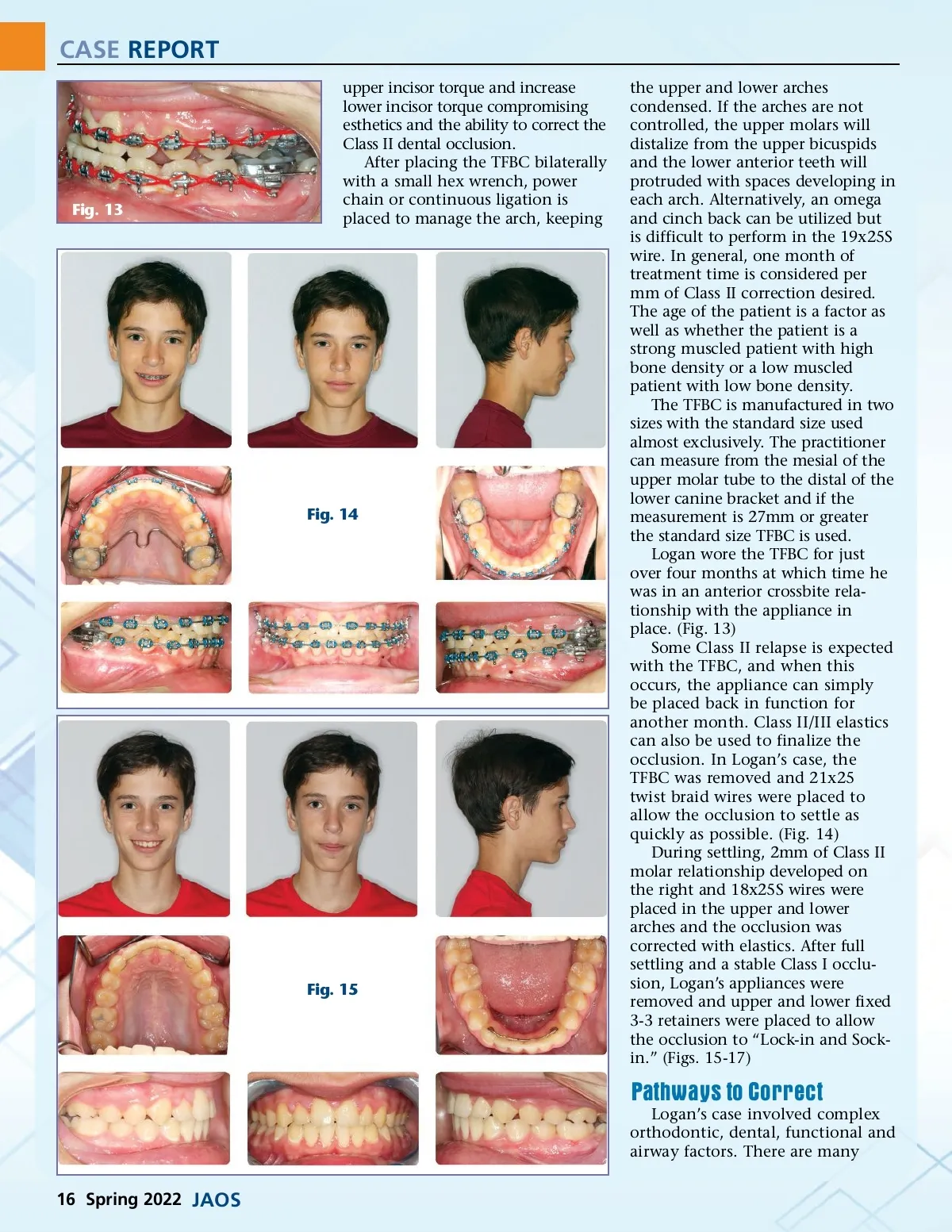
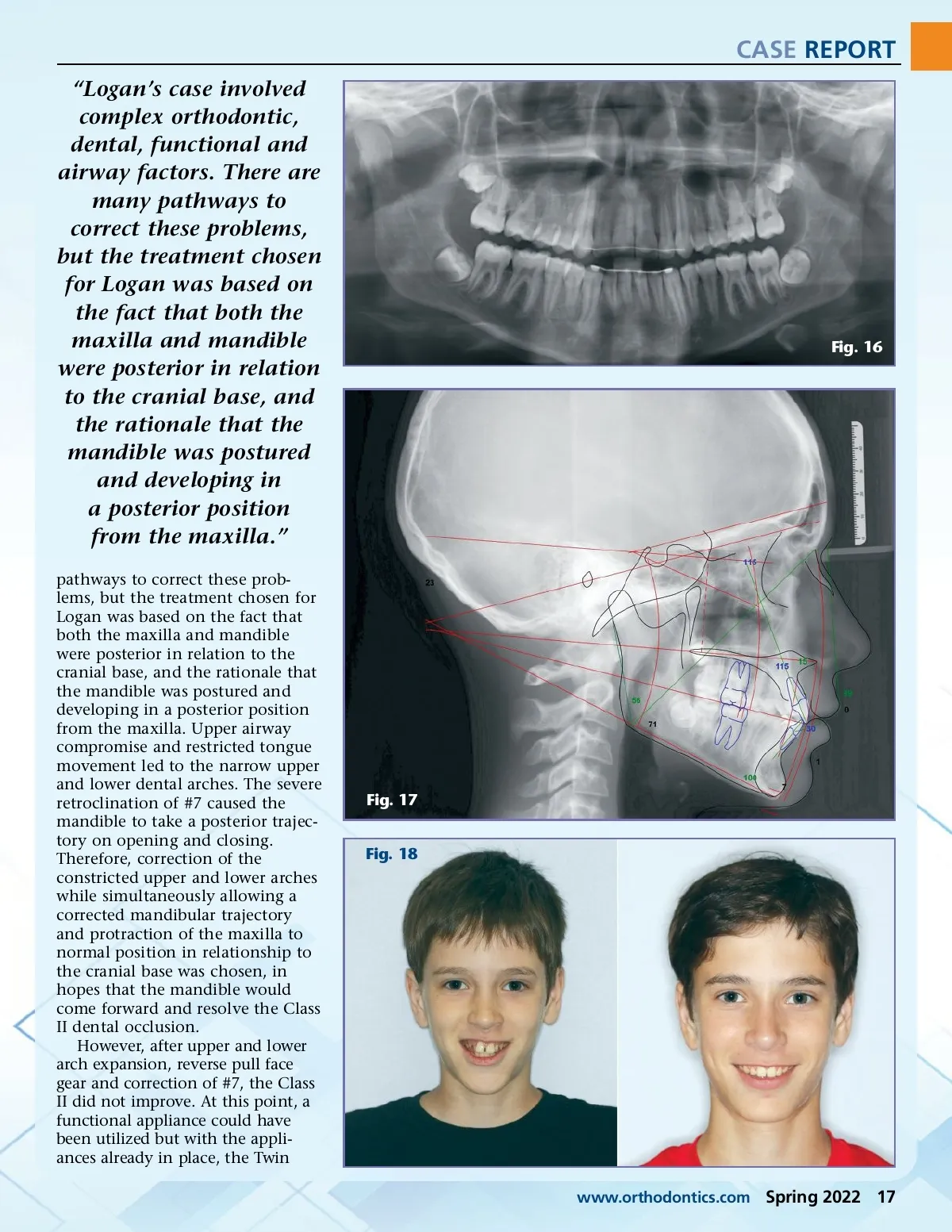
CASE REPORT upper incisor torque and increase lower incisor torque compromising esthetics and the ability to correct the Class II dental occlusion. After placing the TFBC bilaterally with a small hex wrench, power chain or continuous ligation is placed to manage the arch, keeping the upper and lower arches condensed. If the arches are not controlled, the upper molars will distalize from the upper bicuspids and the lower anterior teeth will protruded with spaces developing in each arch. Alternatively, an omega and cinch back can be utilized but is difficult to perform in the 19x25S wire. In general, one month of treatment time is considered per mm of Class II correction desired. The age of the patient is a factor as well as whether the patient is a strong muscled patient with high bone density or a low muscled patient with low bone density. The TFBC is manufactured in two sizes with the standard size used almost exclusively. The practitioner can measure from the mesial of the upper molar tube to the distal of the lower canine bracket and if the measurement is 27mm or greater the standard size TFBC is used. Logan wore the TFBC for just over four months at which time he was in an anterior crossbite rela-tionship with the appliance in place. (Fig. 13) Some Class II relapse is expected with the TFBC, and when this occurs, the appliance can simply be placed back in function for another month. Class II/III elastics can also be used to finalize the occlusion. In Logan’s case, the TFBC was removed and 21x25 twist braid wires were placed to allow the occlusion to settle as quickly as possible. (Fig. 14) During settling, 2mm of Class II molar relationship developed on the right and 18x25S wires were placed in the upper and lower arches and the occlusion was corrected with elastics. After full settling and a stable Class I occlu-sion, Logan’s appliances were removed and upper and lower fixed 3-3 retainers were placed to allow the occlusion to “Lock-in and Sock-in.” (Figs. 15-17) Fig. 13 Fig. 14 Fig. 15 Pathways to Correct Logan’s case involved complex orthodontic, dental, functional and airway factors. There are many 16 Spring 2022 JAOS
Journal of the American Orthodontic Society Spring 2022: Page 16