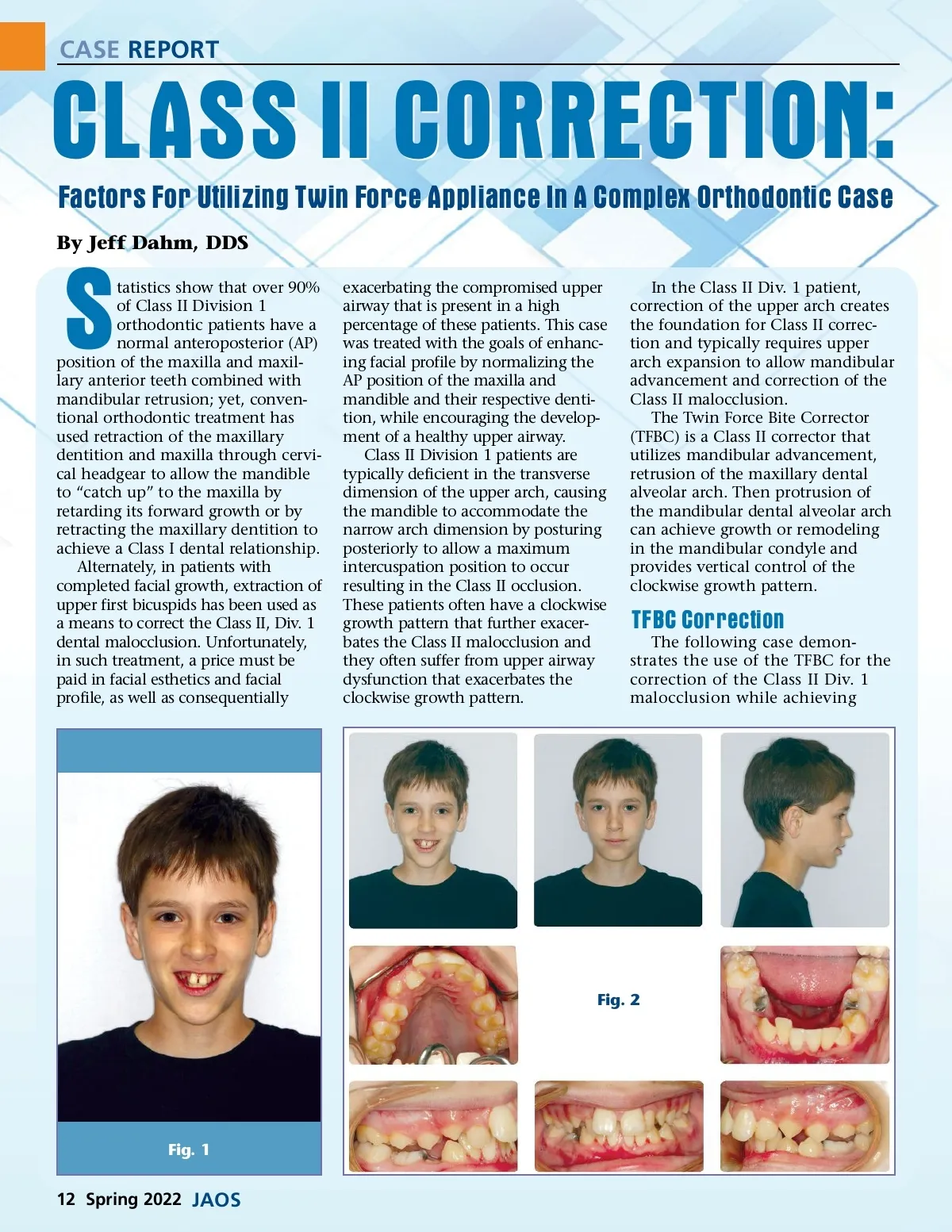
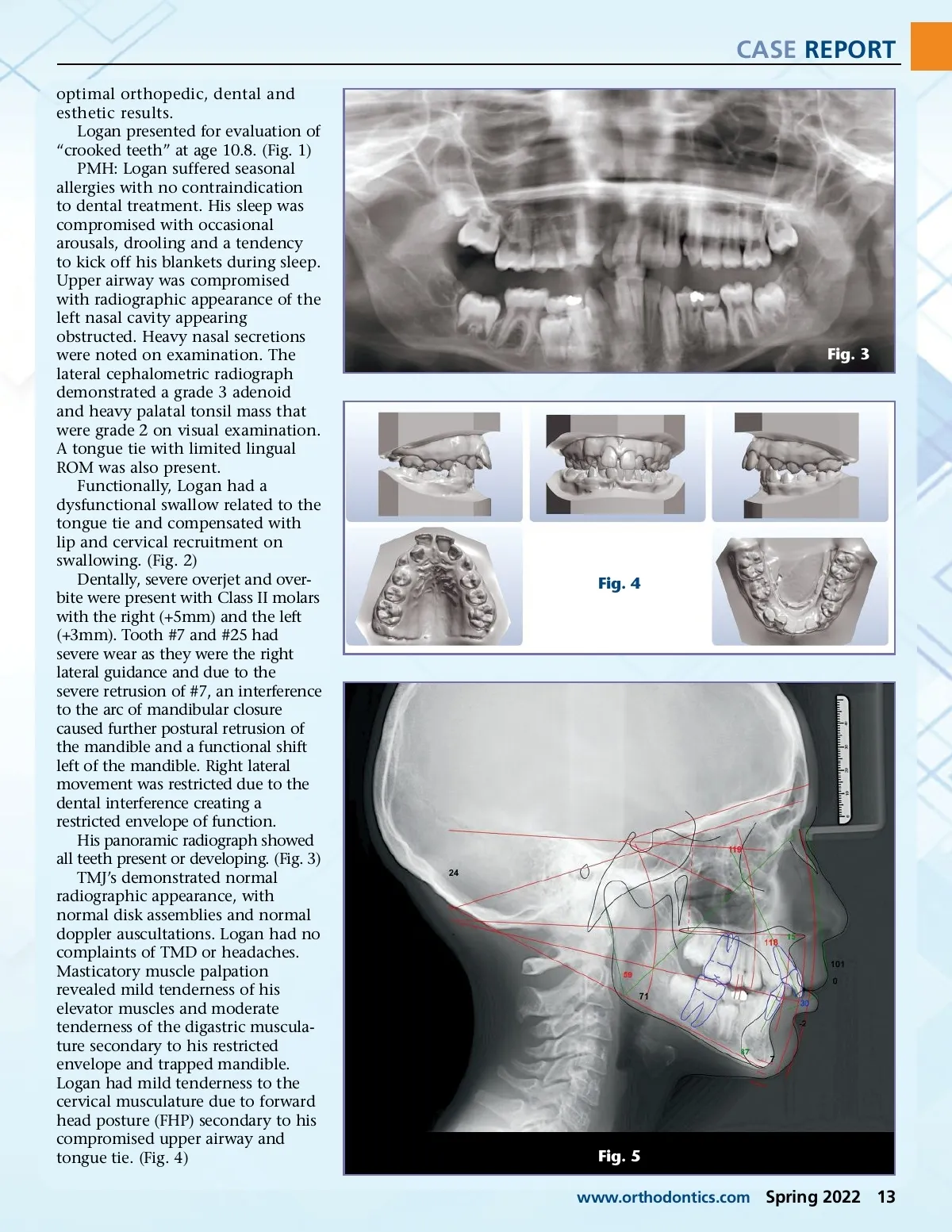
CASE REPORT CLASS II CORRECTION: Factors For Utilizing Twin Force Appliance In A Complex Orthodontic Case By Jeff Dahm, DDS S tatistics show that over 90% of Class II Division 1 orthodontic patients have a normal anteroposterior (AP) position of the maxilla and maxil-lary anterior teeth combined with mandibular retrusion; yet, conven-tional orthodontic treatment has used retraction of the maxillary dentition and maxilla through cervi-cal headgear to allow the mandible to “catch up” to the maxilla by retarding its forward growth or by retracting the maxillary dentition to achieve a Class I dental relationship. Alternately, in patients with completed facial growth, extraction of upper first bicuspids has been used as a means to correct the Class II, Div. 1 dental malocclusion. Unfortunately, in such treatment, a price must be paid in facial esthetics and facial profile, as well as consequentially exacerbating the compromised upper airway that is present in a high percentage of these patients. This case was treated with the goals of enhanc-ing facial profile by normalizing the AP position of the maxilla and mandible and their respective denti-tion, while encouraging the develop-ment of a healthy upper airway. Class II Division 1 patients are typically deficient in the transverse dimension of the upper arch, causing the mandible to accommodate the narrow arch dimension by posturing posteriorly to allow a maximum intercuspation position to occur resulting in the Class II occlusion. These patients often have a clockwise growth pattern that further exacer-bates the Class II malocclusion and they often suffer from upper airway dysfunction that exacerbates the clockwise growth pattern. In the Class II Div. 1 patient, correction of the upper arch creates the foundation for Class II correc-tion and typically requires upper arch expansion to allow mandibular advancement and correction of the Class II malocclusion. The Twin Force Bite Corrector (TFBC) is a Class II corrector that utilizes mandibular advancement, retrusion of the maxillary dental alveolar arch. Then protrusion of the mandibular dental alveolar arch can achieve growth or remodeling in the mandibular condyle and provides vertical control of the clockwise growth pattern. TFBC Correction The following case demon-strates the use of the TFBC for the correction of the Class II Div. 1 malocclusion while achieving Fig. 2 Fig. 1 12 Spring 2022 JAOS
Journal of the American Orthodontic Society Spring 2022: Page 12