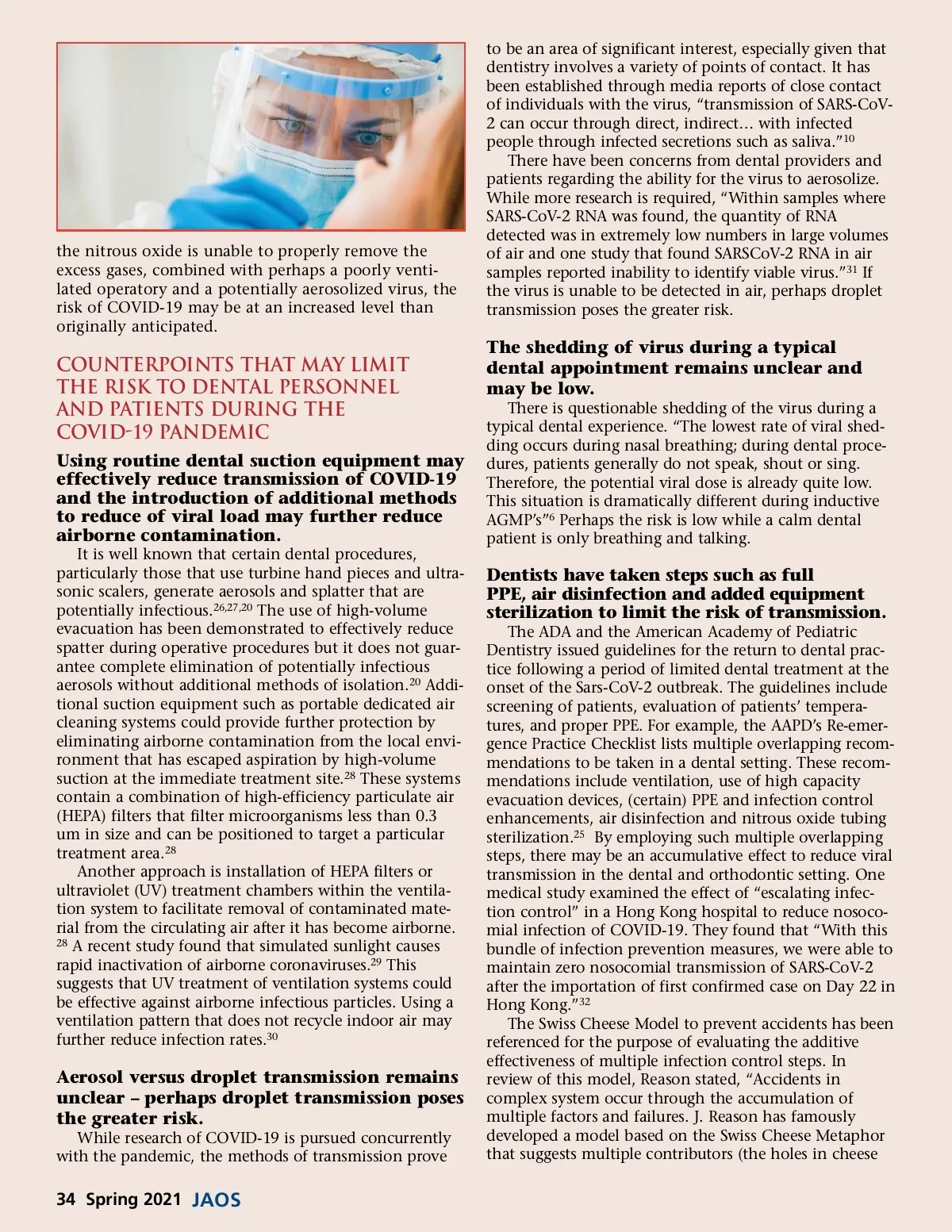
the nitrous oxide is unable to properly remove the excess gases, combined with perhaps a poorly venti-lated operatory and a potentially aerosolized virus, the risk of COVID-19 may be at an increased level than originally anticipated. to be an area of significant interest, especially given that dentistry involves a variety of points of contact. It has been established through media reports of close contact of individuals with the virus, “transmission of SARS-CoV-2 can occur through direct, indirect… with infected people through infected secretions such as saliva.” 10 There have been concerns from dental providers and patients regarding the ability for the virus to aerosolize. While more research is required, “Within samples where SARS-CoV-2 RNA was found, the quantity of RNA detected was in extremely low numbers in large volumes of air and one study that found SARSCoV-2 RNA in air samples reported inability to identify viable virus.” 31 If the virus is unable to be detected in air, perhaps droplet transmission poses the greater risk. Counterpoints that may limit the risk to dental personnel and patients during the COVID-19 pandemic Using routine dental suction equipment may effectively reduce transmission of COVID-19 and the introduction of additional methods to reduce of viral load may further reduce airborne contamination. It is well known that certain dental procedures, particularly those that use turbine hand pieces and ultra-sonic scalers, generate aerosols and splatter that are potentially infectious. 26,27,20 The use of high-volume evacuation has been demonstrated to effectively reduce spatter during operative procedures but it does not guar-antee complete elimination of potentially infectious aerosols without additional methods of isolation. 20 Addi-tional suction equipment such as portable dedicated air cleaning systems could provide further protection by eliminating airborne contamination from the local envi-ronment that has escaped aspiration by high-volume suction at the immediate treatment site. 28 These systems contain a combination of high-efficiency particulate air (HEPA) filters that filter microorganisms less than 0.3 um in size and can be positioned to target a particular treatment area. 28 Another approach is installation of HEPA filters or ultraviolet (UV) treatment chambers within the ventila-tion system to facilitate removal of contaminated mate-rial from the circulating air after it has become airborne. 28 A recent study found that simulated sunlight causes rapid inactivation of airborne coronaviruses. 29 This suggests that UV treatment of ventilation systems could be effective against airborne infectious particles. Using a ventilation pattern that does not recycle indoor air may further reduce infection rates. 30 The shedding of virus during a typical dental appointment remains unclear and may be low. There is questionable shedding of the virus during a typical dental experience. “The lowest rate of viral shed-ding occurs during nasal breathing; during dental proce-dures, patients generally do not speak, shout or sing. Therefore, the potential viral dose is already quite low. This situation is dramatically different during inductive AGMP’s” 6 Perhaps the risk is low while a calm dental patient is only breathing and talking. Dentists have taken steps such as full PPE, air disinfection and added equipment sterilization to limit the risk of transmission. The ADA and the American Academy of Pediatric Dentistry issued guidelines for the return to dental prac-tice following a period of limited dental treatment at the onset of the Sars-CoV-2 outbreak. The guidelines include screening of patients, evaluation of patients’ tempera-tures, and proper PPE. For example, the AAPD’s Re-emer-gence Practice Checklist lists multiple overlapping recom-mendations to be taken in a dental setting. These recom-mendations include ventilation, use of high capacity evacuation devices, (certain) PPE and infection control enhancements, air disinfection and nitrous oxide tubing sterilization. 25 By employing such multiple overlapping steps, there may be an accumulative effect to reduce viral transmission in the dental and orthodontic setting. One medical study examined the effect of “escalating infec-tion control” in a Hong Kong hospital to reduce nosoco-mial infection of COVID-19. They found that “With this bundle of infection prevention measures, we were able to maintain zero nosocomial transmission of SARS-CoV-2 after the importation of first confirmed case on Day 22 in Hong Kong.” 32 The Swiss Cheese Model to prevent accidents has been referenced for the purpose of evaluating the additive effectiveness of multiple infection control steps. In review of this model, Reason stated, “Accidents in complex system occur through the accumulation of multiple factors and failures. J. Reason has famously developed a model based on the Swiss Cheese Metaphor that suggests multiple contributors (the holes in cheese Aerosol versus droplet transmission remains unclear – perhaps droplet transmission poses the greater risk. While research of COVID-19 is pursued concurrently with the pandemic, the methods of transmission prove 34 Spring 2021 JAOS
Journal of the American Orthodontic Society Spring 2021: Page 34