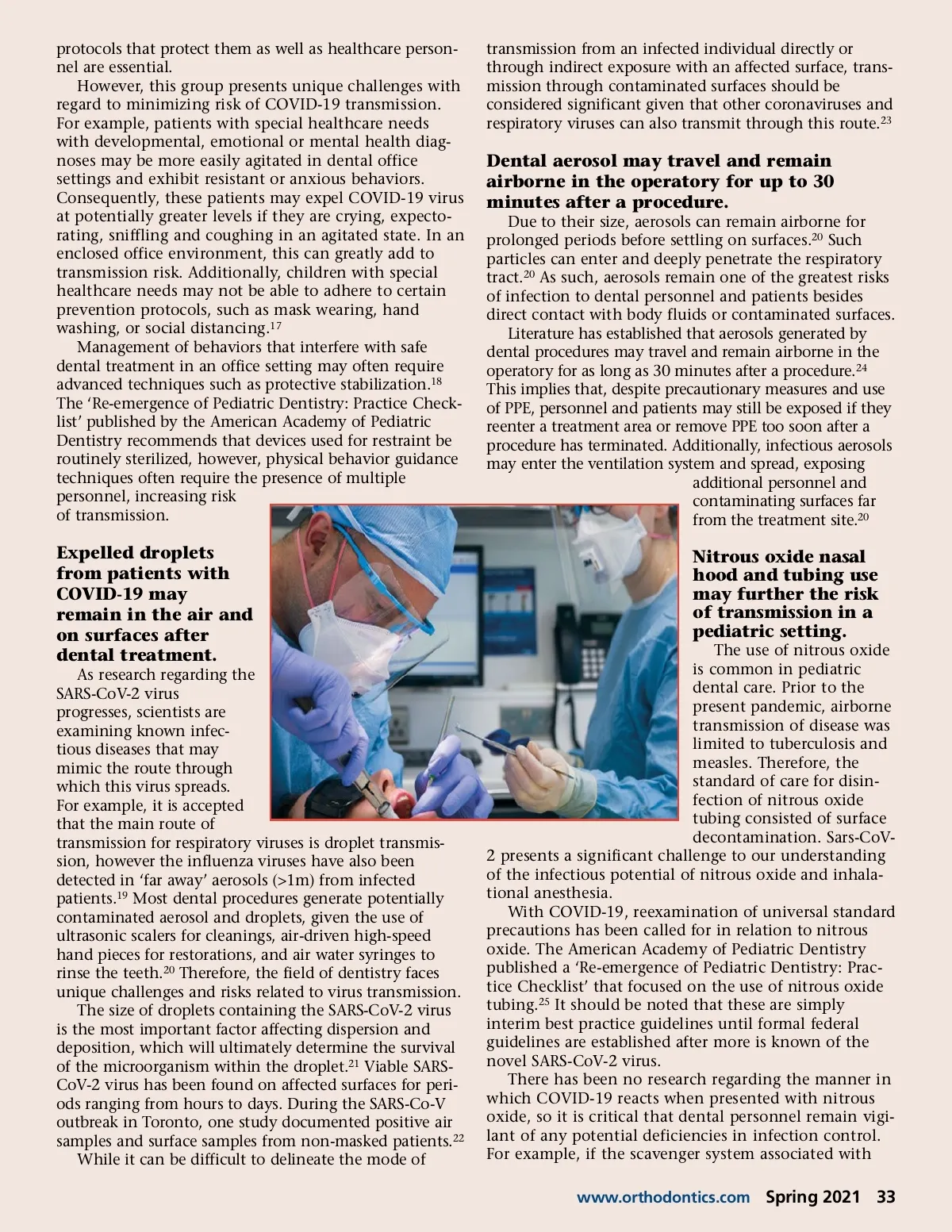
protocols that protect them as well as healthcare person-nel are essential. However, this group presents unique challenges with regard to minimizing risk of COVID-19 transmission. For example, patients with special healthcare needs with developmental, emotional or mental health diag-noses may be more easily agitated in dental office settings and exhibit resistant or anxious behaviors. Consequently, these patients may expel COVID-19 virus at potentially greater levels if they are crying, expecto-rating, sniffling and coughing in an agitated state. In an enclosed office environment, this can greatly add to transmission risk. Additionally, children with special healthcare needs may not be able to adhere to certain prevention protocols, such as mask wearing, hand washing, or social distancing. 17 Management of behaviors that interfere with safe dental treatment in an office setting may often require advanced techniques such as protective stabilization. 18 The ‘Re-emergence of Pediatric Dentistry: Practice Check-list’ published by the American Academy of Pediatric Dentistry recommends that devices used for restraint be routinely sterilized, however, physical behavior guidance techniques often require the presence of multiple personnel, increasing risk of transmission. transmission from an infected individual directly or through indirect exposure with an affected surface, trans-mission through contaminated surfaces should be considered significant given that other coronaviruses and respiratory viruses can also transmit through this route. 23 Dental aerosol may travel and remain airborne in the operatory for up to 30 minutes after a procedure. Due to their size, aerosols can remain airborne for prolonged periods before settling on surfaces. 20 Such particles can enter and deeply penetrate the respiratory tract. 20 As such, aerosols remain one of the greatest risks of infection to dental personnel and patients besides direct contact with body fluids or contaminated surfaces. Literature has established that aerosols generated by dental procedures may travel and remain airborne in the operatory for as long as 30 minutes after a procedure. 24 This implies that, despite precautionary measures and use of PPE, personnel and patients may still be exposed if they reenter a treatment area or remove PPE too soon after a procedure has terminated. Additionally, infectious aerosols may enter the ventilation system and spread, exposing additional personnel and contaminating surfaces far from the treatment site. 20 Expelled droplets from patients with COVID-19 may remain in the air and on surfaces after dental treatment. As research regarding the SARS-CoV-2 virus progresses, scientists are examining known infec-tious diseases that may mimic the route through which this virus spreads. For example, it is accepted that the main route of transmission for respiratory viruses is droplet transmis-sion, however the influenza viruses have also been detected in ‘far away’ aerosols (>1m) from infected patients. 19 Most dental procedures generate potentially contaminated aerosol and droplets, given the use of ultrasonic scalers for cleanings, air-driven high-speed hand pieces for restorations, and air water syringes to rinse the teeth. 20 Therefore, the field of dentistry faces unique challenges and risks related to virus transmission. The size of droplets containing the SARS-CoV-2 virus is the most important factor affecting dispersion and deposition, which will ultimately determine the survival of the microorganism within the droplet. 21 Viable SARS-CoV-2 virus has been found on affected surfaces for peri-ods ranging from hours to days. During the SARS-Co-V outbreak in Toronto, one study documented positive air samples and surface samples from non-masked patients. 22 While it can be difficult to delineate the mode of Nitrous oxide nasal hood and tubing use may further the risk of transmission in a pediatric setting. The use of nitrous oxide is common in pediatric dental care. Prior to the present pandemic, airborne transmission of disease was limited to tuberculosis and measles. Therefore, the standard of care for disin-fection of nitrous oxide tubing consisted of surface decontamination. Sars-CoV-2 presents a significant challenge to our understanding of the infectious potential of nitrous oxide and inhala-tional anesthesia. With COVID-19, reexamination of universal standard precautions has been called for in relation to nitrous oxide. The American Academy of Pediatric Dentistry published a ‘Re-emergence of Pediatric Dentistry: Prac-tice Checklist’ that focused on the use of nitrous oxide tubing. 25 It should be noted that these are simply interim best practice guidelines until formal federal guidelines are established after more is known of the novel SARS-CoV-2 virus. There has been no research regarding the manner in which COVID-19 reacts when presented with nitrous oxide, so it is critical that dental personnel remain vigi-lant of any potential deficiencies in infection control. For example, if the scavenger system associated with www.orthodontics.com Spring 2021 33
Journal of the American Orthodontic Society Spring 2021: Page 33