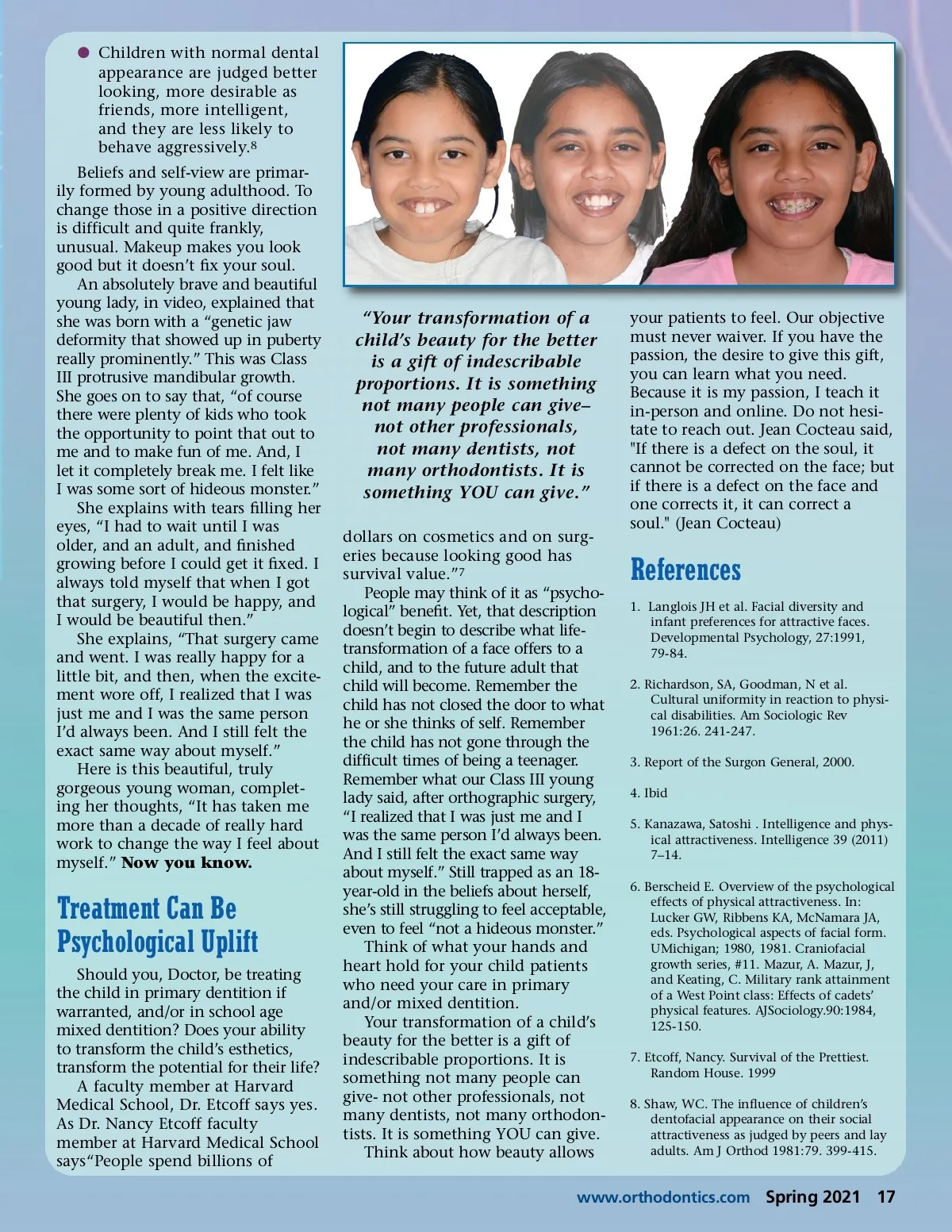
b Children with normal dental appearance are judged better looking, more desirable as friends, more intelligent, and they are less likely to behave aggressively. 8 Beliefs and self-view are primar-ily formed by young adulthood. To change those in a positive direction is difficult and quite frankly, unusual. Makeup makes you look good but it doesn’t fix your soul. An absolutely brave and beautiful young lady, in video, explained that she was born with a “genetic jaw deformity that showed up in puberty really prominently.” This was Class III protrusive mandibular growth. She goes on to say that, “of course there were plenty of kids who took the opportunity to point that out to me and to make fun of me. And, I let it completely break me. I felt like I was some sort of hideous monster.” She explains with tears filling her eyes, “I had to wait until I was older, and an adult, and finished growing before I could get it fixed. I always told myself that when I got that surgery, I would be happy, and I would be beautiful then.” She explains, “That surgery came and went. I was really happy for a little bit, and then, when the excite-ment wore off, I realized that I was just me and I was the same person I’d always been. And I still felt the exact same way about myself.” Here is this beautiful, truly gorgeous young woman, complet-ing her thoughts, “It has taken me more than a decade of really hard work to change the way I feel about myself.” Now you know. “Your transformation of a child’s beauty for the better is a gift of indescribable proportions. It is something not many people can give– not other professionals, not many dentists, not many orthodontists. It is something YOU can give.” dollars on cosmetics and on surg-eries because looking good has survival value.” 7 People may think of it as “psycho-logical” benefit. Yet, that description doesn’t begin to describe what life-transformation of a face offers to a child, and to the future adult that child will become. Remember the child has not closed the door to what he or she thinks of self. Remember the child has not gone through the difficult times of being a teenager. Remember what our Class III young lady said, after orthographic surgery, “I realized that I was just me and I was the same person I’d always been. And I still felt the exact same way about myself.” Still trapped as an 18-year-old in the beliefs about herself, she’s still struggling to feel acceptable, even to feel “not a hideous monster.” Think of what your hands and heart hold for your child patients who need your care in primary and/or mixed dentition. Your transformation of a child’s beauty for the better is a gift of indescribable proportions. It is something not many people can give-not other professionals, not many dentists, not many orthodon-tists. It is something YOU can give. Think about how beauty allows your patients to feel. Our objective must never waiver. If you have the passion, the desire to give this gift, you can learn what you need. Because it is my passion, I teach it in-person and online. Do not hesi-tate to reach out. Jean Cocteau said, "If there is a defect on the soul, it cannot be corrected on the face; but if there is a defect on the face and one corrects it, it can correct a soul." (Jean Cocteau) References 1. Langlois JH et al. Facial diversity and infant preferences for attractive faces. Developmental Psychology, 27:1991, 79-84. 2. Richardson, SA, Goodman, N et al. Cultural uniformity in reaction to physi-cal disabilities. Am Sociologic Rev 1961:26. 241-247. 3. Report of the Surgon General, 2000. 4. Ibid 5. Kanazawa, Satoshi . Intelligence and phys-ical attractiveness. Intelligence 39 (2011) 7–14. 6. Berscheid E. Overview of the psychological effects of physical attractiveness. In: Lucker GW, Ribbens KA, McNamara JA, eds. Psychological aspects of facial form. UMichigan; 1980, 1981. Craniofacial growth series, #11. Mazur, A. Mazur, J, and Keating, C. Military rank attainment of a West Point class: Effects of cadets’ physical features. AJSociology.90:1984, 125-150. 7. Etcoff, Nancy. Survival of the Prettiest. Random House. 1999 8. Shaw, WC. The influence of children’s dentofacial appearance on their social attractiveness as judged by peers and lay adults. Am J Orthod 1981:79. 399-415. Treatment Can Be Psychological Uplift Should you, Doctor, be treating the child in primary dentition if warranted, and/or in school age mixed dentition? Does your ability to transform the child’s esthetics, transform the potential for their life? A faculty member at Harvard Medical School, Dr. Etcoff says yes. As Dr. Nancy Etcoff faculty member at Harvard Medical School says“People spend billions of www.orthodontics.com Spring 2021 17
Journal of the American Orthodontic Society Spring 2021: Page 17