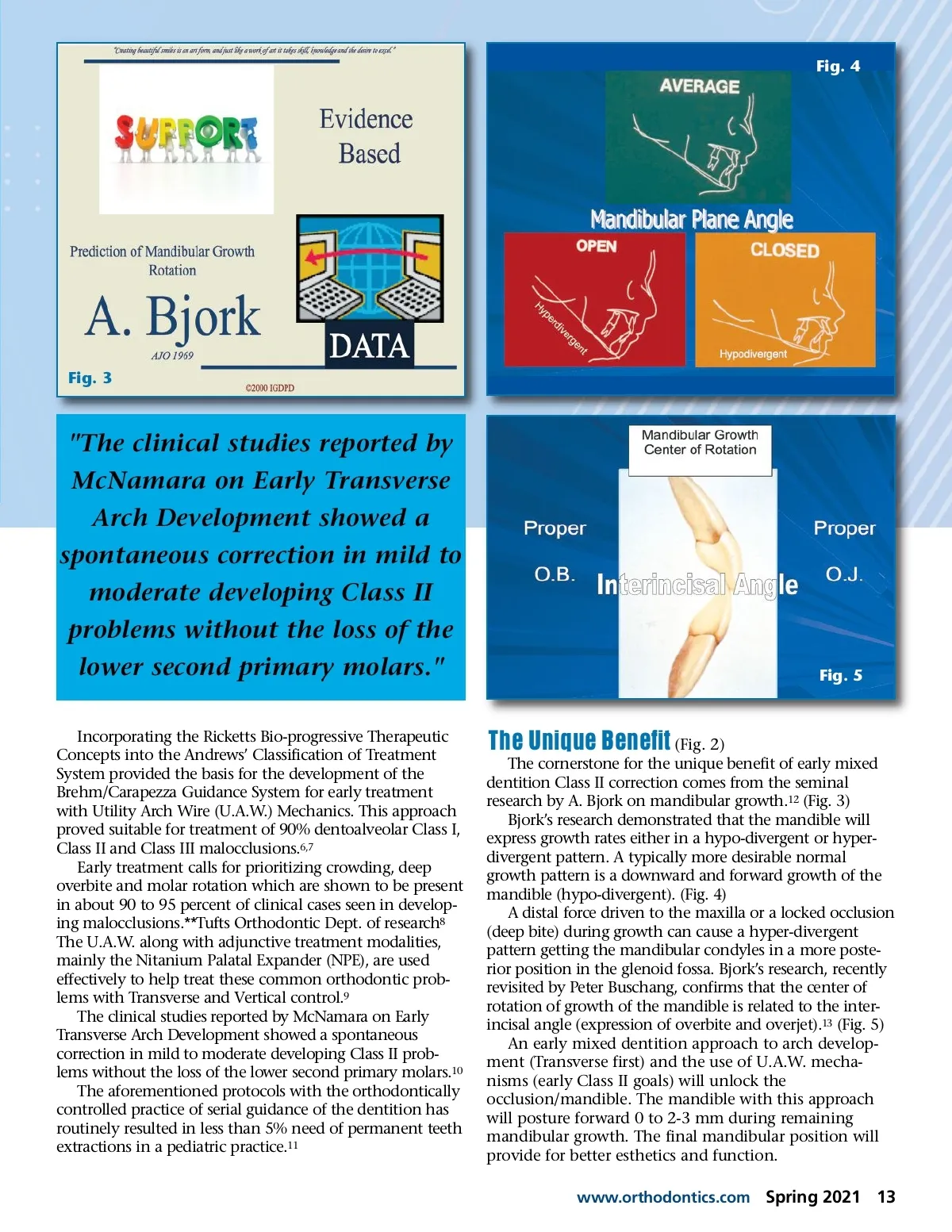
Fig. 4 Fig. 3 "The clinical studies reported by McNamara on Early Transverse Arch Development showed a spontaneous correction in mild to moderate developing Class II problems without the loss of the lower second primary molars." Incorporating the Ricketts Bio-progressive Therapeutic Concepts into the Andrews’ Classification of Treatment System provided the basis for the development of the Brehm/Carapezza Guidance System for early treatment with Utility Arch Wire (U.A.W.) Mechanics. This approach proved suitable for treatment of 90% dentoalveolar Class I, Class II and Class III malocclusions. 6,7 Early treatment calls for prioritizing crowding, deep overbite and molar rotation which are shown to be present in about 90 to 95 percent of clinical cases seen in develop-ing malocclusions.**Tufts Orthodontic Dept. of research 8 The U.A.W. along with adjunctive treatment modalities, mainly the Nitanium Palatal Expander (NPE), are used effectively to help treat these common orthodontic prob-lems with Transverse and Vertical control. 9 The clinical studies reported by McNamara on Early Transverse Arch Development showed a spontaneous correction in mild to moderate developing Class II prob-lems without the loss of the lower second primary molars. 10 The aforementioned protocols with the orthodontically controlled practice of serial guidance of the dentition has routinely resulted in less than 5% need of permanent teeth extractions in a pediatric practice. 11 Fig. 5 The Unique Benefit (Fig. 2) The cornerstone for the unique benefit of early mixed dentition Class II correction comes from the seminal research by A. Bjork on mandibular growth. 12 (Fig. 3) Bjork’s research demonstrated that the mandible will express growth rates either in a hypo-divergent or hyper-divergent pattern. A typically more desirable normal growth pattern is a downward and forward growth of the mandible (hypo-divergent). (Fig. 4) A distal force driven to the maxilla or a locked occlusion (deep bite) during growth can cause a hyper-divergent pattern getting the mandibular condyles in a more poste-rior position in the glenoid fossa. Bjork’s research, recently revisited by Peter Buschang, confirms that the center of rotation of growth of the mandible is related to the inter-incisal angle (expression of overbite and overjet). 13 (Fig. 5) An early mixed dentition approach to arch develop-ment (Transverse first) and the use of U.A.W. mecha-nisms (early Class II goals) will unlock the occlusion/mandible. The mandible with this approach will posture forward 0 to 2-3 mm during remaining mandibular growth. The final mandibular position will provide for better esthetics and function. www.orthodontics.com Spring 2021 13
Journal of the American Orthodontic Society Spring 2021: Page 13