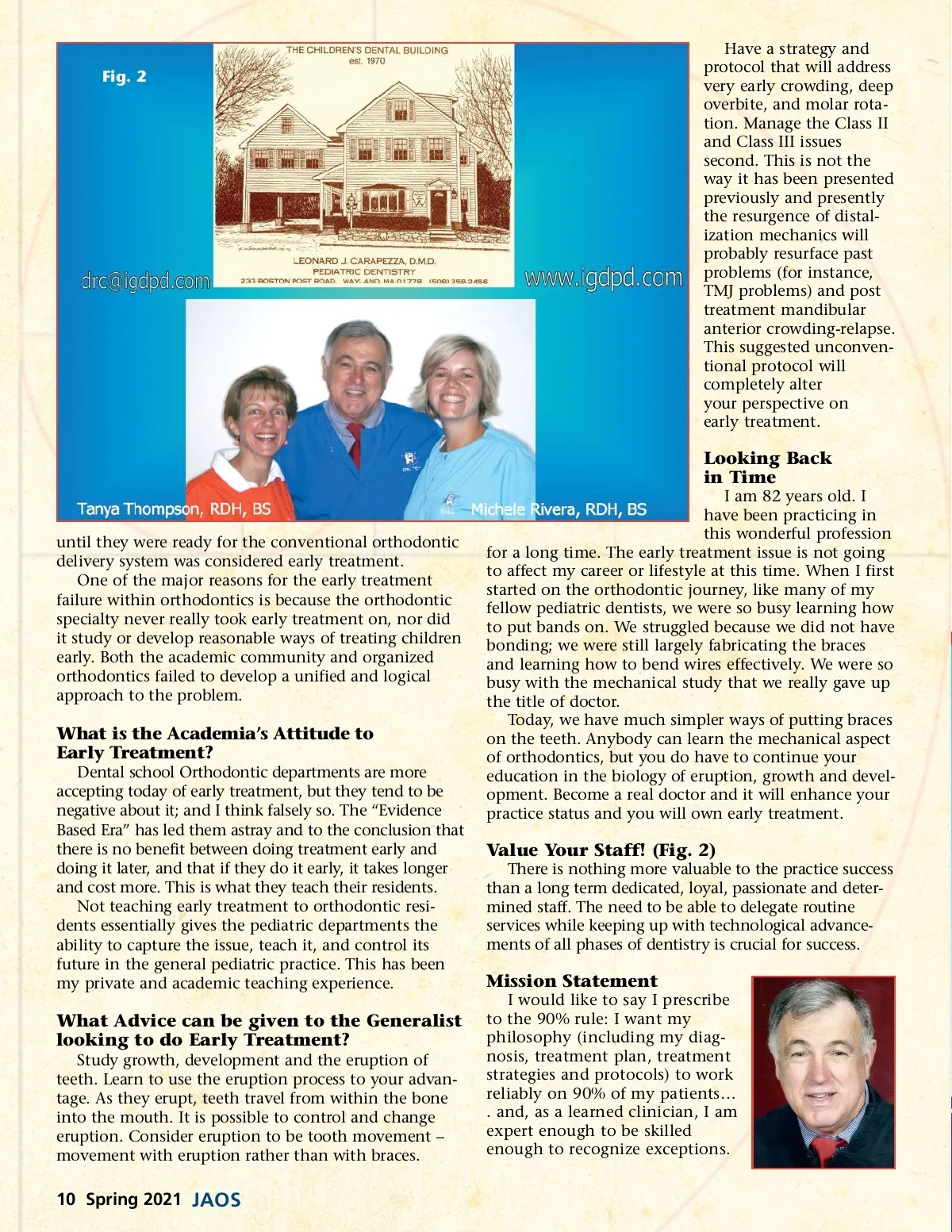
Fig. 2 Have a strategy and protocol that will address very early crowding, deep overbite, and molar rota-tion. Manage the Class II and Class III issues second. This is not the way it has been presented previously and presently the resurgence of distal-ization mechanics will probably resurface past problems (for instance, TMJ problems) and post treatment mandibular anterior crowding-relapse. This suggested unconven-tional protocol will completely alter your perspective on early treatment. Looking Back in Time I am 82 years old. I have been practicing in this wonderful profession for a long time. The early treatment issue is not going to affect my career or lifestyle at this time. When I first started on the orthodontic journey, like many of my fellow pediatric dentists, we were so busy learning how to put bands on. We struggled because we did not have bonding; we were still largely fabricating the braces and learning how to bend wires effectively. We were so busy with the mechanical study that we really gave up the title of doctor. Today, we have much simpler ways of putting braces on the teeth. Anybody can learn the mechanical aspect of orthodontics, but you do have to continue your education in the biology of eruption, growth and devel-opment. Become a real doctor and it will enhance your practice status and you will own early treatment. until they were ready for the conventional orthodontic delivery system was considered early treatment. One of the major reasons for the early treatment failure within orthodontics is because the orthodontic specialty never really took early treatment on, nor did it study or develop reasonable ways of treating children early. Both the academic community and organized orthodontics failed to develop a unified and logical approach to the problem. What is the Academia’s Attitude to Early Treatment? Dental school Orthodontic departments are more accepting today of early treatment, but they tend to be negative about it; and I think falsely so. The “Evidence Based Era” has led them astray and to the conclusion that there is no benefit between doing treatment early and doing it later, and that if they do it early, it takes longer and cost more. This is what they teach their residents. Not teaching early treatment to orthodontic resi-dents essentially gives the pediatric departments the ability to capture the issue, teach it, and control its future in the general pediatric practice. This has been my private and academic teaching experience. Value Your Staff! (Fig. 2) There is nothing more valuable to the practice success than a long term dedicated, loyal, passionate and deter-mined staff. The need to be able to delegate routine services while keeping up with technological advance-ments of all phases of dentistry is crucial for success. Mission Statement I would like to say I prescribe to the 90% rule: I want my philosophy (including my diag-nosis, treatment plan, treatment strategies and protocols) to work reliably on 90% of my patients… . and, as a learned clinician, I am expert enough to be skilled enough to recognize exceptions. What Advice can be given to the Generalist looking to do Early Treatment? Study growth, development and the eruption of teeth. Learn to use the eruption process to your advan-tage. As they erupt, teeth travel from within the bone into the mouth. It is possible to control and change eruption. Consider eruption to be tooth movement – movement with eruption rather than with braces. 10 Spring 2021 JAOS
Journal of the American Orthodontic Society Spring 2021: Page 10