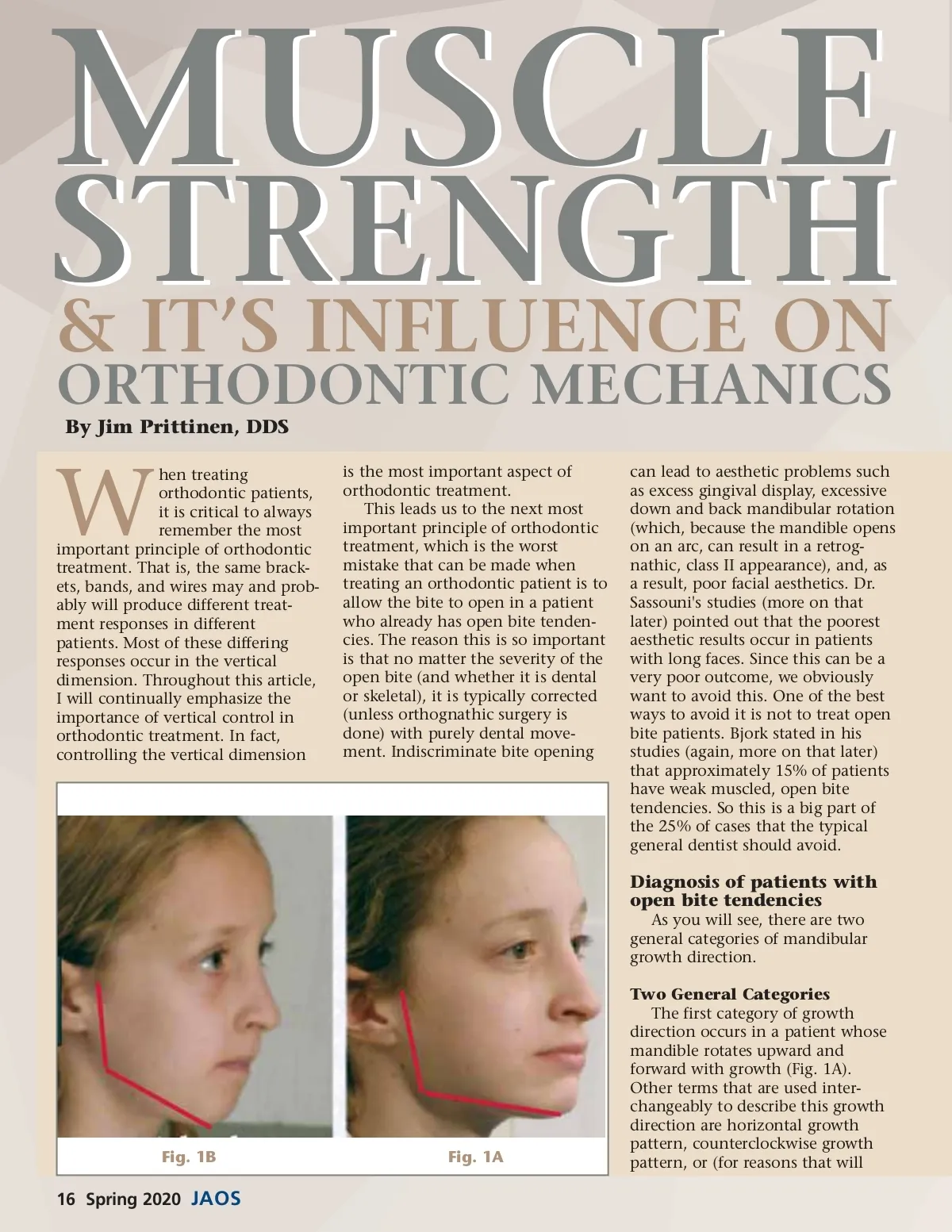
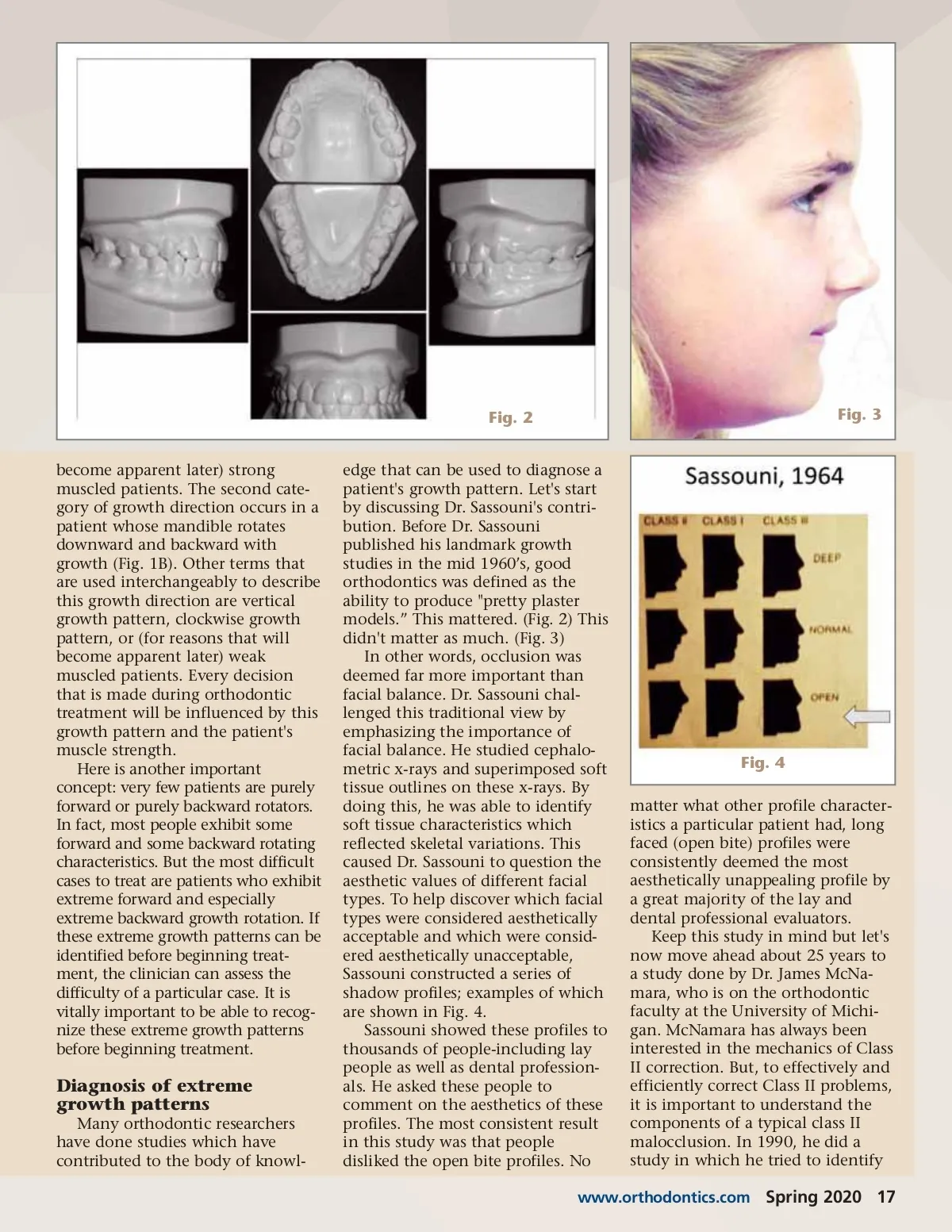
Fig. 2 become apparent later) strong muscled patients. The second cate-gory of growth direction occurs in a patient whose mandible rotates downward and backward with growth (Fig. 1B). Other terms that are used interchangeably to describe this growth direction are vertical growth pattern, clockwise growth pattern, or (for reasons that will become apparent later) weak muscled patients. Every decision that is made during orthodontic treatment will be influenced by this growth pattern and the patient's muscle strength. Here is another important concept: very few patients are purely forward or purely backward rotators. In fact, most people exhibit some forward and some backward rotating characteristics. But the most difficult cases to treat are patients who exhibit extreme forward and especially extreme backward growth rotation. If these extreme growth patterns can be identified before beginning treat-ment, the clinician can assess the difficulty of a particular case. It is vitally important to be able to recog-nize these extreme growth patterns before beginning treatment. edge that can be used to diagnose a patient's growth pattern. Let's start by discussing Dr. Sassouni's contri-bution. Before Dr. Sassouni published his landmark growth studies in the mid 1960’s, good orthodontics was defined as the ability to produce "pretty plaster models.” This mattered. (Fig. 2) This didn't matter as much. (Fig. 3) In other words, occlusion was deemed far more important than facial balance. Dr. Sassouni chal-lenged this traditional view by emphasizing the importance of facial balance. He studied cephalo-metric x-rays and superimposed soft tissue outlines on these x-rays. By doing this, he was able to identify soft tissue characteristics which reflected skeletal variations. This caused Dr. Sassouni to question the aesthetic values of different facial types. To help discover which facial types were considered aesthetically acceptable and which were consid-ered aesthetically unacceptable, Sassouni constructed a series of shadow profiles; examples of which are shown in Fig. 4. Sassouni showed these profiles to thousands of people-including lay people as well as dental profession-als. He asked these people to comment on the aesthetics of these profiles. The most consistent result in this study was that people disliked the open bite profiles. No Fig. 3 Fig. 4 matter what other profile character-istics a particular patient had, long faced (open bite) profiles were consistently deemed the most aesthetically unappealing profile by a great majority of the lay and dental professional evaluators. Keep this study in mind but let's now move ahead about 25 years to a study done by Dr. James McNa-mara, who is on the orthodontic faculty at the University of Michi-gan. McNamara has always been interested in the mechanics of Class II correction. But, to effectively and efficiently correct Class II problems, it is important to understand the components of a typical class II malocclusion. In 1990, he did a study in which he tried to identify Diagnosis of extreme growth patterns Many orthodontic researchers have done studies which have contributed to the body of knowl-www.orthodontics.com Spring 2020 17
Journal of the American Orthodontic Society Spring 2020: Page 17