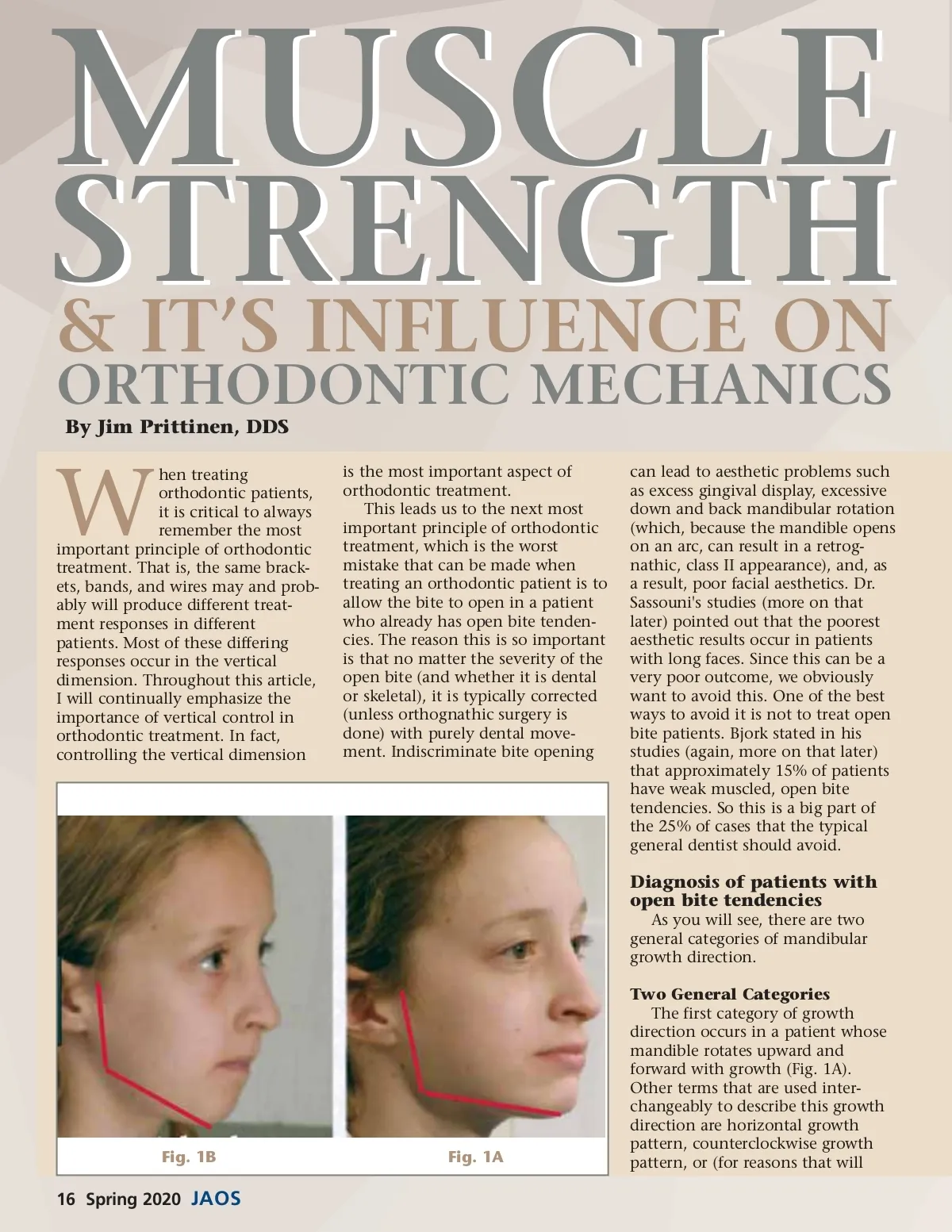
STRENGTH & IT’S INFLUENCE ON ORTHODONTIC MECHANICS By Jim Prittinen, DDS hen treating orthodontic patients, it is critical to always remember the most important principle of orthodontic treatment. That is, the same brack-ets, bands, and wires may and prob-ably will produce different treat-ment responses in different patients. Most of these differing responses occur in the vertical dimension. Throughout this article, I will continually emphasize the importance of vertical control in orthodontic treatment. In fact, controlling the vertical dimension is the most important aspect of orthodontic treatment. This leads us to the next most important principle of orthodontic treatment, which is the worst mistake that can be made when treating an orthodontic patient is to allow the bite to open in a patient who already has open bite tenden-cies. The reason this is so important is that no matter the severity of the open bite (and whether it is dental or skeletal), it is typically corrected (unless orthognathic surgery is done) with purely dental move-ment. Indiscriminate bite opening MUSCLE W can lead to aesthetic problems such as excess gingival display, excessive down and back mandibular rotation (which, because the mandible opens on an arc, can result in a retrog-nathic, class II appearance), and, as a result, poor facial aesthetics. Dr. Sassouni's studies (more on that later) pointed out that the poorest aesthetic results occur in patients with long faces. Since this can be a very poor outcome, we obviously want to avoid this. One of the best ways to avoid it is not to treat open bite patients. Bjork stated in his studies (again, more on that later) that approximately 15% of patients have weak muscled, open bite tendencies. So this is a big part of the 25% of cases that the typical general dentist should avoid. Diagnosis of patients with open bite tendencies As you will see, there are two general categories of mandibular growth direction. Two General Categories The first category of growth direction occurs in a patient whose mandible rotates upward and forward with growth (Fig. 1A). Other terms that are used inter-changeably to describe this growth direction are horizontal growth pattern, counterclockwise growth pattern, or (for reasons that will Fig. 1B Fig. 1A 16 Spring 2020 JAOS
Journal of the American Orthodontic Society Spring 2020: Page 16