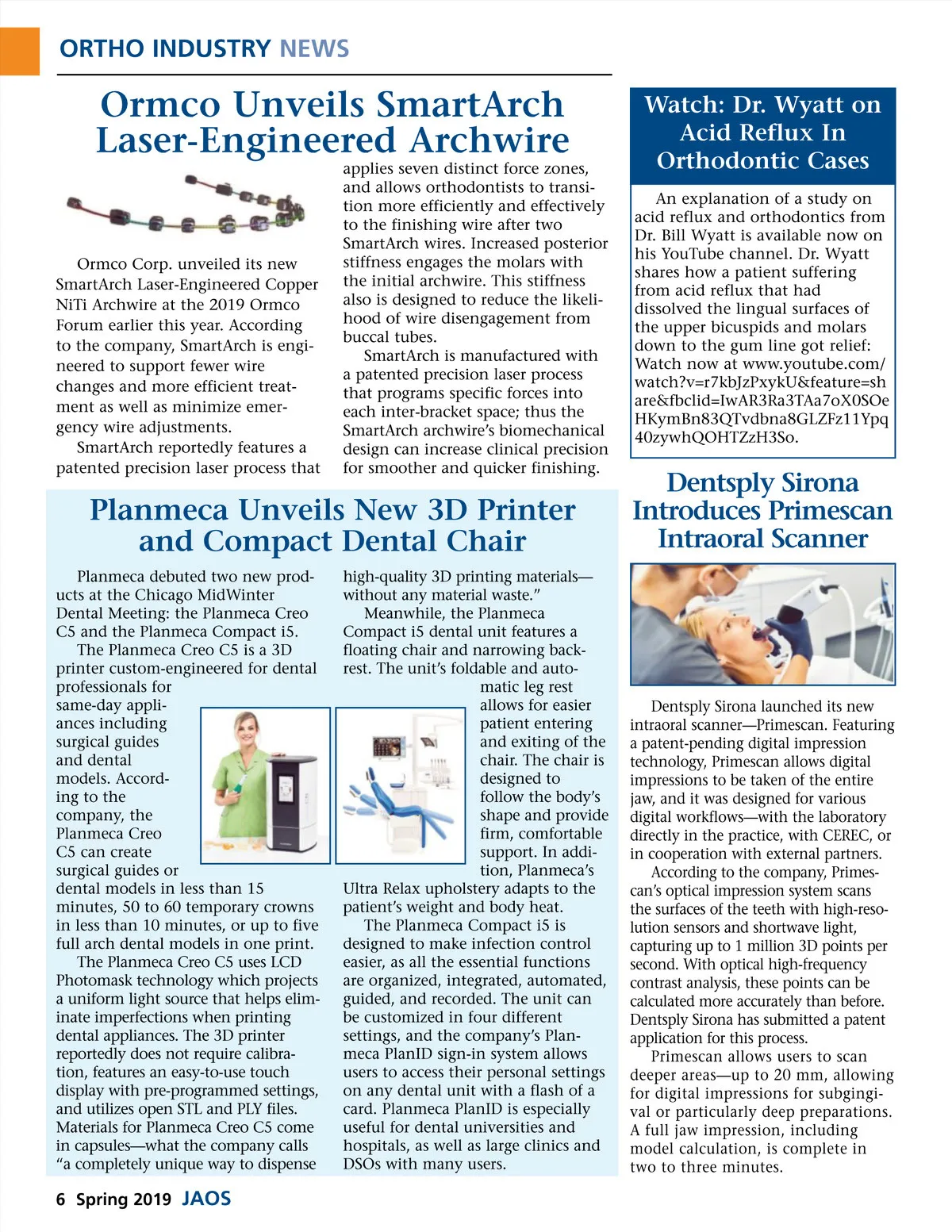
ORTHO INDUSTRY NEWS Ormco Unveils SmartArch Laser-Engineered Archwire applies seven distinct force zones, and allows orthodontists to transi-tion more efficiently and effectively to the finishing wire after two SmartArch wires. Increased posterior stiffness engages the molars with the initial archwire. This stiffness also is designed to reduce the likeli-hood of wire disengagement from buccal tubes. SmartArch is manufactured with a patented precision laser process that programs specific forces into each inter-bracket space; thus the SmartArch archwire’s biomechanical design can increase clinical precision for smoother and quicker finishing. Watch: Dr. Wyatt on Acid Reflux In Orthodontic Cases An explanation of a study on acid reflux and orthodontics from Dr. Bill Wyatt is available now on his YouTube channel. Dr. Wyatt shares how a patient suffering from acid reflux that had dissolved the lingual surfaces of the upper bicuspids and molars down to the gum line got relief: Watch now at www.youtube.com/ watch?v=r7kbJzPxykU&feature=sh are&fbclid=IwAR3Ra3TAa7oX0SOe HKymBn83QTvdbna8GLZFz11Ypq 40zywhQOHTZzH3So. Ormco Corp. unveiled its new SmartArch Laser-Engineered Copper NiTi Archwire at the 2019 Ormco Forum earlier this year. According to the company, SmartArch is engi-neered to support fewer wire changes and more efficient treat-ment as well as minimize emer-gency wire adjustments. SmartArch reportedly features a patented precision laser process that Planmeca Unveils New 3D Printer and Compact Dental Chair Planmeca debuted two new prod-ucts at the Chicago MidWinter Dental Meeting: the Planmeca Creo C5 and the Planmeca Compact i5. The Planmeca Creo C5 is a 3D printer custom-engineered for dental professionals for same-day appli-ances including surgical guides and dental models. Accord-ing to the company, the Planmeca Creo C5 can create surgical guides or dental models in less than 15 minutes, 50 to 60 temporary crowns in less than 10 minutes, or up to five full arch dental models in one print. The Planmeca Creo C5 uses LCD Photomask technology which projects a uniform light source that helps elim-inate imperfections when printing dental appliances. The 3D printer reportedly does not require calibra-tion, features an easy-to-use touch display with pre-programmed settings, and utilizes open STL and PLY files. Materials for Planmeca Creo C5 come in capsules—what the company calls “a completely unique way to dispense high-quality 3D printing materials— without any material waste.” Meanwhile, the Planmeca Compact i5 dental unit features a floating chair and narrowing back-rest. The unit’s foldable and auto-matic leg rest allows for easier patient entering and exiting of the chair. The chair is designed to follow the body’s shape and provide firm, comfortable support. In addi-tion, Planmeca’s Ultra Relax upholstery adapts to the patient’s weight and body heat. The Planmeca Compact i5 is designed to make infection control easier, as all the essential functions are organized, integrated, automated, guided, and recorded. The unit can be customized in four different settings, and the company’s Plan-meca PlanID sign-in system allows users to access their personal settings on any dental unit with a flash of a card. Planmeca PlanID is especially useful for dental universities and hospitals, as well as large clinics and DSOs with many users. Dentsply Sirona Introduces Primescan Intraoral Scanner Dentsply Sirona launched its new intraoral scanner—Primescan. Featuring a patent-pending digital impression technology, Primescan allows digital impressions to be taken of the entire jaw, and it was designed for various digital workflows—with the laboratory directly in the practice, with CEREC, or in cooperation with external partners. According to the company, Primes-can’s optical impression system scans the surfaces of the teeth with high-reso-lution sensors and shortwave light, capturing up to 1 million 3D points per second. With optical high-frequency contrast analysis, these points can be calculated more accurately than before. Dentsply Sirona has submitted a patent application for this process. Primescan allows users to scan deeper areas—up to 20 mm, allowing for digital impressions for subgingi-val or particularly deep preparations. A full jaw impression, including model calculation, is complete in two to three minutes. 6 Spring 2019 JAOS
Journal of the American Orthodontic Society Spring 2019: Page 6