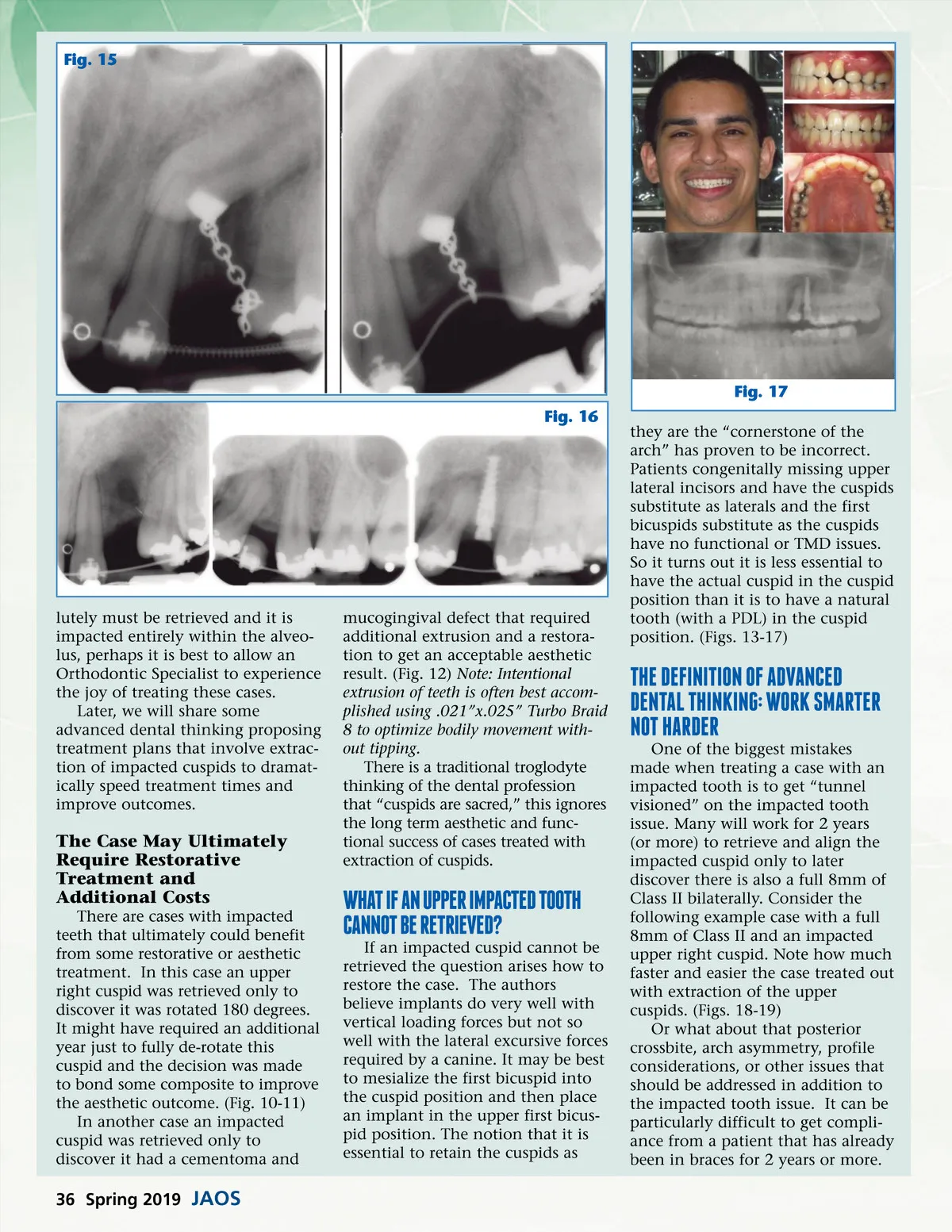
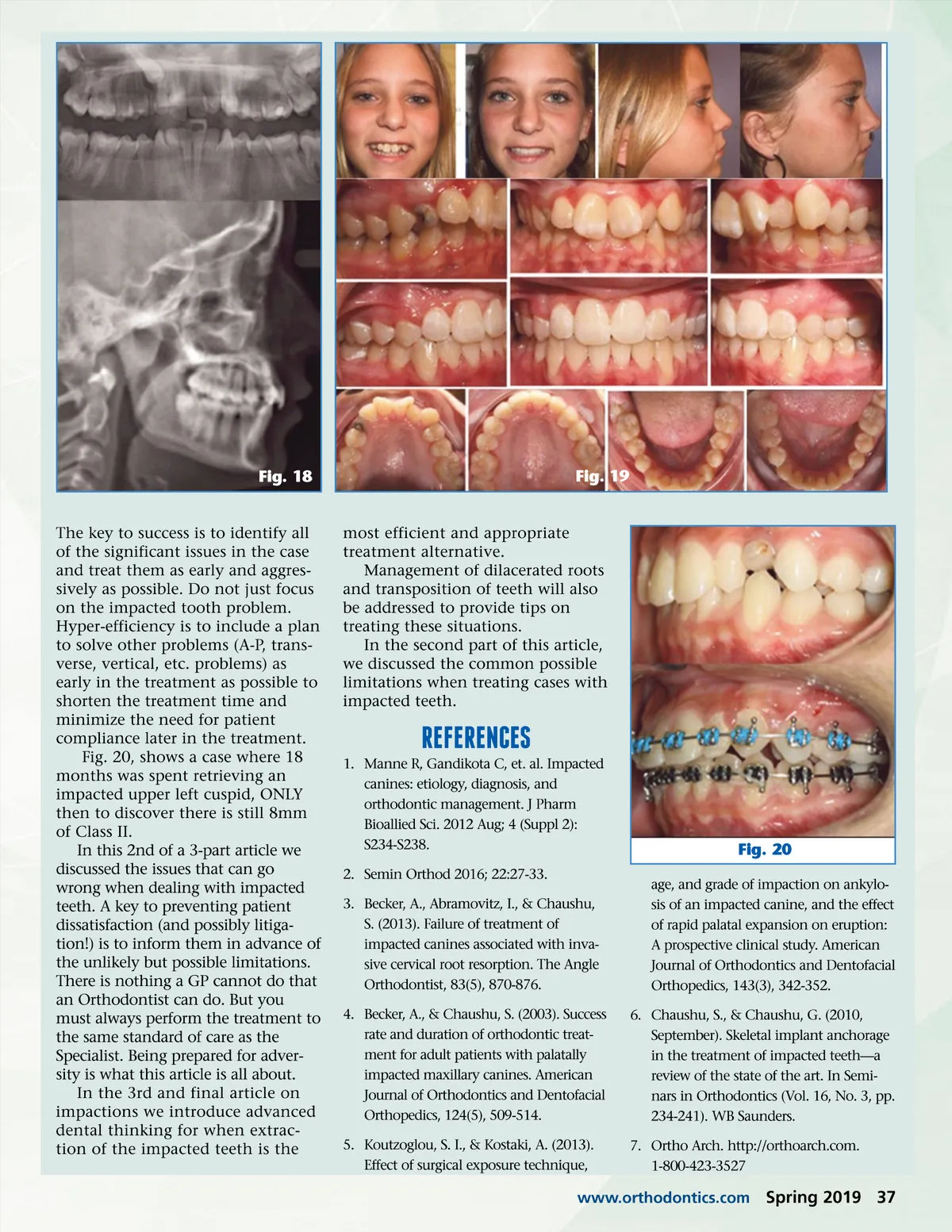
Fig. 18 Fig. 19 The key to success is to identify all of the significant issues in the case and treat them as early and aggres-sively as possible. Do not just focus on the impacted tooth problem. Hyper-efficiency is to include a plan to solve other problems (A-P, trans-verse, vertical, etc. problems) as early in the treatment as possible to shorten the treatment time and minimize the need for patient compliance later in the treatment. Fig. 20, shows a case where 18 months was spent retrieving an impacted upper left cuspid, ONLY then to discover there is still 8mm of Class II. In this 2nd of a 3-part article we discussed the issues that can go wrong when dealing with impacted teeth. A key to preventing patient dissatisfaction (and possibly litiga-tion!) is to inform them in advance of the unlikely but possible limitations. There is nothing a GP cannot do that an Orthodontist can do. But you must always perform the treatment to the same standard of care as the Specialist. Being prepared for adver-sity is what this article is all about. In the 3rd and final article on impactions we introduce advanced dental thinking for when extrac-tion of the impacted teeth is the most efficient and appropriate treatment alternative. Management of dilacerated roots and transposition of teeth will also be addressed to provide tips on treating these situations. In the second part of this article, we discussed the common possible limitations when treating cases with impacted teeth. references 1. Manne R, Gandikota C, et. al. Impacted canines: etiology, diagnosis, and orthodontic management. J Pharm Bioallied Sci. 2012 Aug; 4 (Suppl 2): S234-S238. 2. Semin Orthod 2016; 22:27-33. 3. Becker, A., Abramovitz, I., & Chaushu, S. (2013). Failure of treatment of impacted canines associated with inva-sive cervical root resorption. The Angle Orthodontist, 83(5), 870-876. 4. Becker, A., & Chaushu, S. (2003). Success rate and duration of orthodontic treat-ment for adult patients with palatally impacted maxillary canines. American Journal of Orthodontics and Dentofacial Orthopedics, 124(5), 509-514. 5. Koutzoglou, S. I., & Kostaki, A. (2013). Effect of surgical exposure technique, Fig. 20 age, and grade of impaction on ankylo-sis of an impacted canine, and the effect of rapid palatal expansion on eruption: A prospective clinical study. American Journal of Orthodontics and Dentofacial Orthopedics, 143(3), 342-352. 6. Chaushu, S., & Chaushu, G. (2010, September). Skeletal implant anchorage in the treatment of impacted teeth—a review of the state of the art. In Semi-nars in Orthodontics (Vol. 16, No. 3, pp. 234-241). WB Saunders. 7. Ortho Arch. http://orthoarch.com. 1-800-423-3527 www.orthodontics.com Spring 2019 37
Journal of the American Orthodontic Society Spring 2019: Page 37