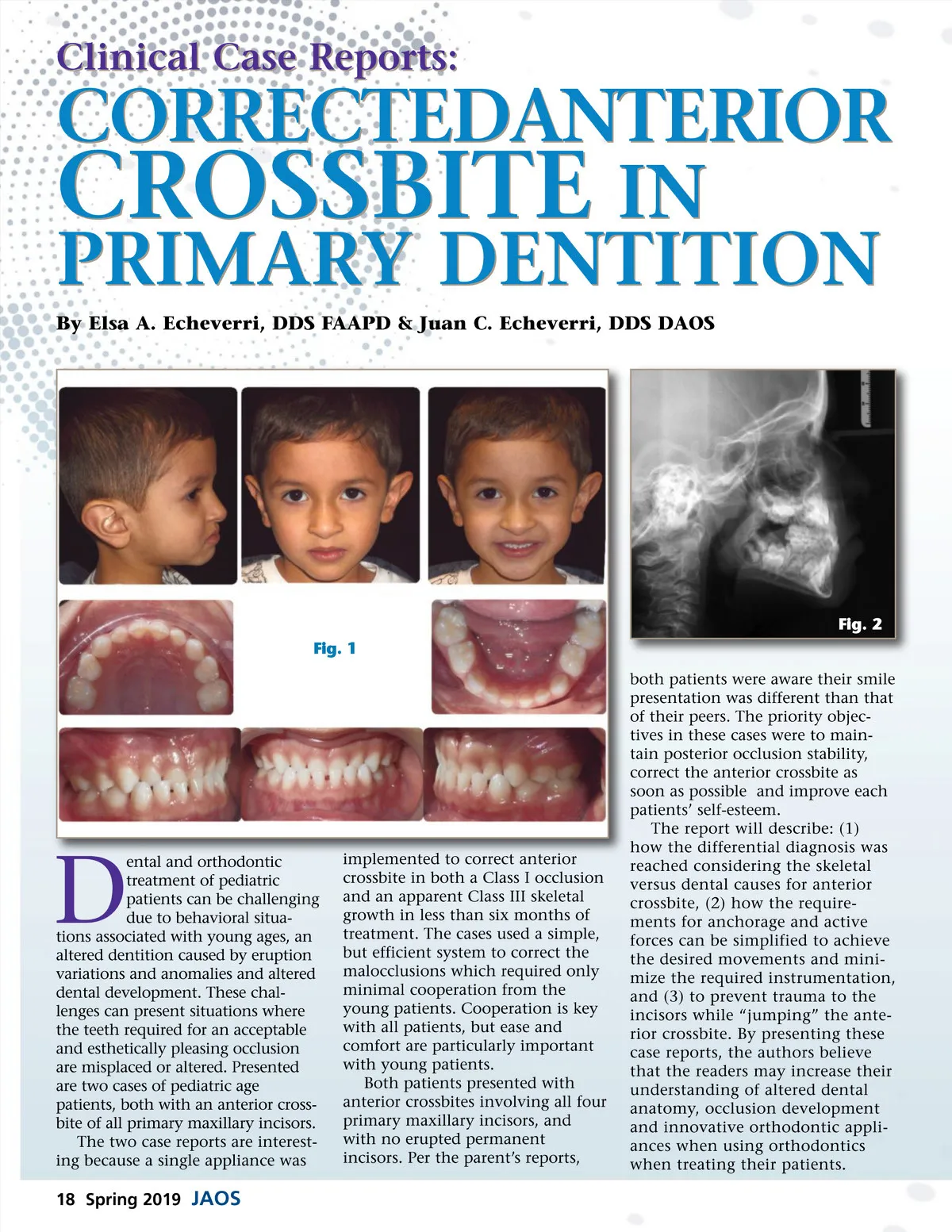
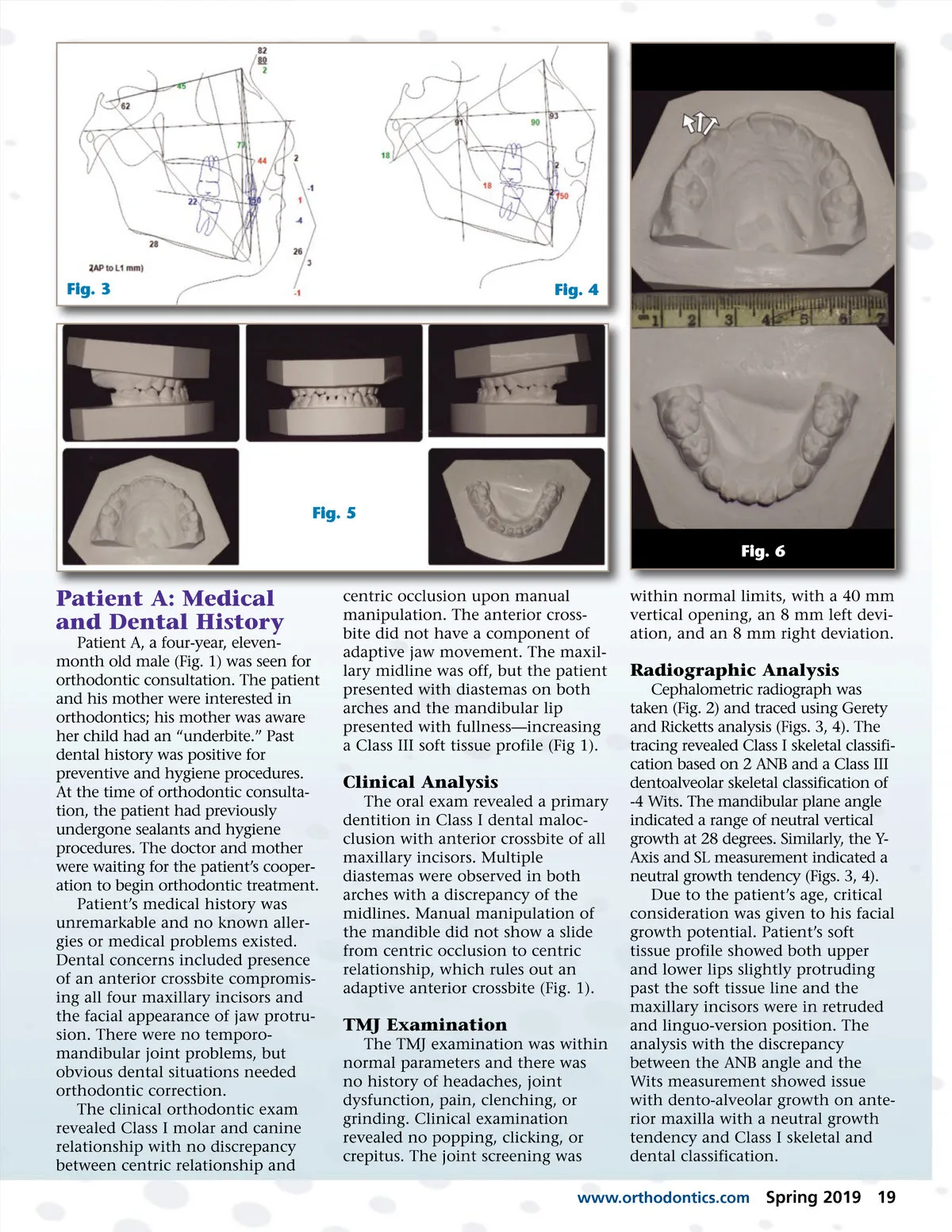
Clinical Case Reports: CORRECTEDANTERIOR CROSSBITE IN PRIMARY DENTITION By Elsa A. Echeverri, DDS FAAPD & Juan C. Echeverri, DDS DAOS Fig. 2 Fig. 1 both patients were aware their smile presentation was different than that of their peers. The priority objec-tives in these cases were to main-tain posterior occlusion stability, correct the anterior crossbite as soon as possible and improve each patients’ self-esteem. The report will describe: (1) how the differential diagnosis was reached considering the skeletal versus dental causes for anterior crossbite, (2) how the require-ments for anchorage and active forces can be simplified to achieve the desired movements and mini-mize the required instrumentation, and (3) to prevent trauma to the incisors while “jumping” the ante-rior crossbite. By presenting these case reports, the authors believe that the readers may increase their understanding of altered dental anatomy, occlusion development and innovative orthodontic appli-ances when using orthodontics when treating their patients. D ental and orthodontic treatment of pediatric patients can be challenging due to behavioral situa-tions associated with young ages, an altered dentition caused by eruption variations and anomalies and altered dental development. These chal-lenges can present situations where the teeth required for an acceptable and esthetically pleasing occlusion are misplaced or altered. Presented are two cases of pediatric age patients, both with an anterior cross-bite of all primary maxillary incisors. The two case reports are interest-ing because a single appliance was implemented to correct anterior crossbite in both a Class I occlusion and an apparent Class III skeletal growth in less than six months of treatment. The cases used a simple, but efficient system to correct the malocclusions which required only minimal cooperation from the young patients. Cooperation is key with all patients, but ease and comfort are particularly important with young patients. Both patients presented with anterior crossbites involving all four primary maxillary incisors, and with no erupted permanent incisors. Per the parent’s reports, 18 Spring 2019 JAOS
Journal of the American Orthodontic Society Spring 2019: Page 18