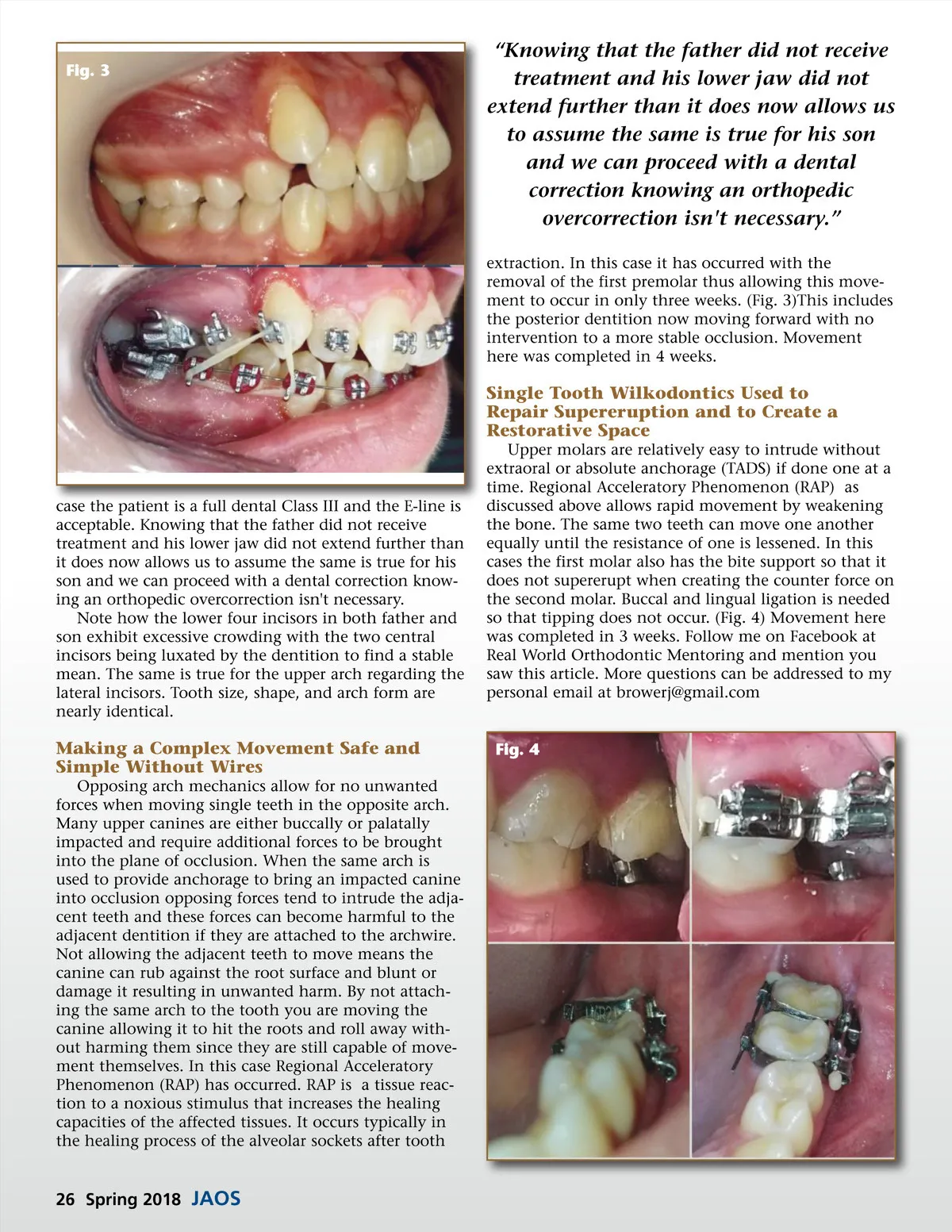
Fig. 3 “Knowing that the father did not receive treatment and his lower jaw did not extend further than it does now allows us to assume the same is true for his son and we can proceed with a dental correction knowing an orthopedic overcorrection isn't necessary.” extraction. In this case it has occurred with the removal of the first premolar thus allowing this move-ment to occur in only three weeks. (Fig. 3)This includes the posterior dentition now moving forward with no intervention to a more stable occlusion. Movement here was completed in 4 weeks. Single Tooth Wilkodontics Used to Repair Supereruption and to Create a Restorative Space Upper molars are relatively easy to intrude without extraoral or absolute anchorage (TADS) if done one at a time. Regional Acceleratory Phenomenon (RAP) as discussed above allows rapid movement by weakening the bone. The same two teeth can move one another equally until the resistance of one is lessened. In this cases the first molar also has the bite support so that it does not supererupt when creating the counter force on the second molar. Buccal and lingual ligation is needed so that tipping does not occur. (Fig. 4) Movement here was completed in 3 weeks. Follow me on Facebook at Real World Orthodontic Mentoring and mention you saw this article. More questions can be addressed to my personal email at browerj@gmail.com case the patient is a full dental Class III and the E-line is acceptable. Knowing that the father did not receive treatment and his lower jaw did not extend further than it does now allows us to assume the same is true for his son and we can proceed with a dental correction know-ing an orthopedic overcorrection isn't necessary. Note how the lower four incisors in both father and son exhibit excessive crowding with the two central incisors being luxated by the dentition to find a stable mean. The same is true for the upper arch regarding the lateral incisors. Tooth size, shape, and arch form are nearly identical. Making a Complex Movement Safe and Simple Without Wires Opposing arch mechanics allow for no unwanted forces when moving single teeth in the opposite arch. Many upper canines are either buccally or palatally impacted and require additional forces to be brought into the plane of occlusion. When the same arch is used to provide anchorage to bring an impacted canine into occlusion opposing forces tend to intrude the adja-cent teeth and these forces can become harmful to the adjacent dentition if they are attached to the archwire. Not allowing the adjacent teeth to move means the canine can rub against the root surface and blunt or damage it resulting in unwanted harm. By not attach-ing the same arch to the tooth you are moving the canine allowing it to hit the roots and roll away with-out harming them since they are still capable of move-ment themselves. In this case Regional Acceleratory Phenomenon (RAP) has occurred. RAP is a tissue reac-tion to a noxious stimulus that increases the healing capacities of the affected tissues. It occurs typically in the healing process of the alveolar sockets after tooth Fig. 4 26 Spring 2018 JAOS
Journal of the American Orthodontic Society Spring 2018: Page 26