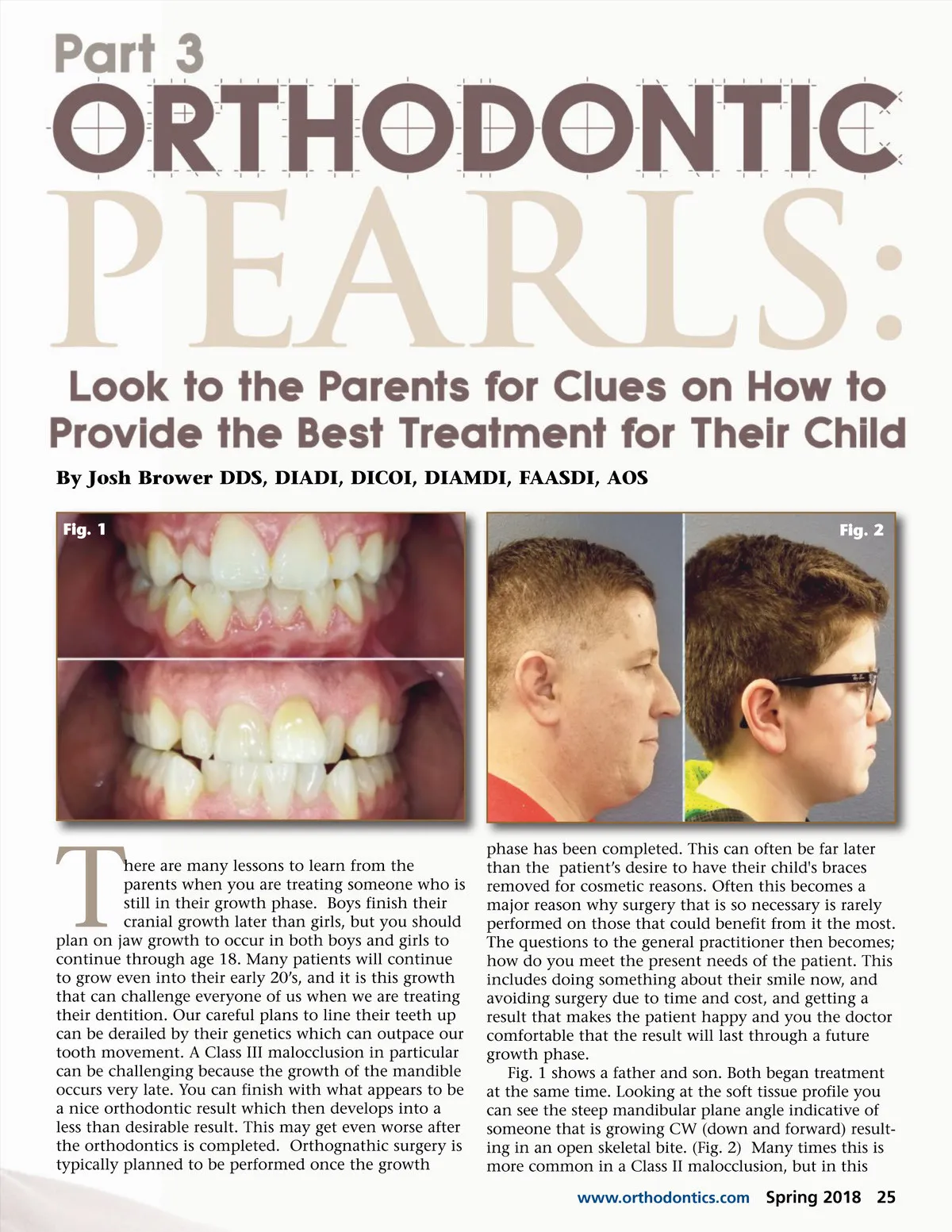
By Josh Brower DDS, DIADI, DICOI, DIAMDI, FAASDI, AOS Fig. 1 Fig. 2 T here are many lessons to learn from the parents when you are treating someone who is still in their growth phase. Boys finish their cranial growth later than girls, but you should plan on jaw growth to occur in both boys and girls to continue through age 18. Many patients will continue to grow even into their early 20’s, and it is this growth that can challenge everyone of us when we are treating their dentition. Our careful plans to line their teeth up can be derailed by their genetics which can outpace our tooth movement. A Class III malocclusion in particular can be challenging because the growth of the mandible occurs very late. You can finish with what appears to be a nice orthodontic result which then develops into a less than desirable result. This may get even worse after the orthodontics is completed. Orthognathic surgery is typically planned to be performed once the growth phase has been completed. This can often be far later than the patient’s desire to have their child's braces removed for cosmetic reasons. Often this becomes a major reason why surgery that is so necessary is rarely performed on those that could benefit from it the most. The questions to the general practitioner then becomes; how do you meet the present needs of the patient. This includes doing something about their smile now, and avoiding surgery due to time and cost, and getting a result that makes the patient happy and you the doctor comfortable that the result will last through a future growth phase. Fig. 1 shows a father and son. Both began treatment at the same time. Looking at the soft tissue profile you can see the steep mandibular plane angle indicative of someone that is growing CW (down and forward) result-ing in an open skeletal bite. (Fig. 2) Many times this is more common in a Class II malocclusion, but in this www.orthodontics.com Spring 2018 25
Journal of the American Orthodontic Society Spring 2018: Page 25