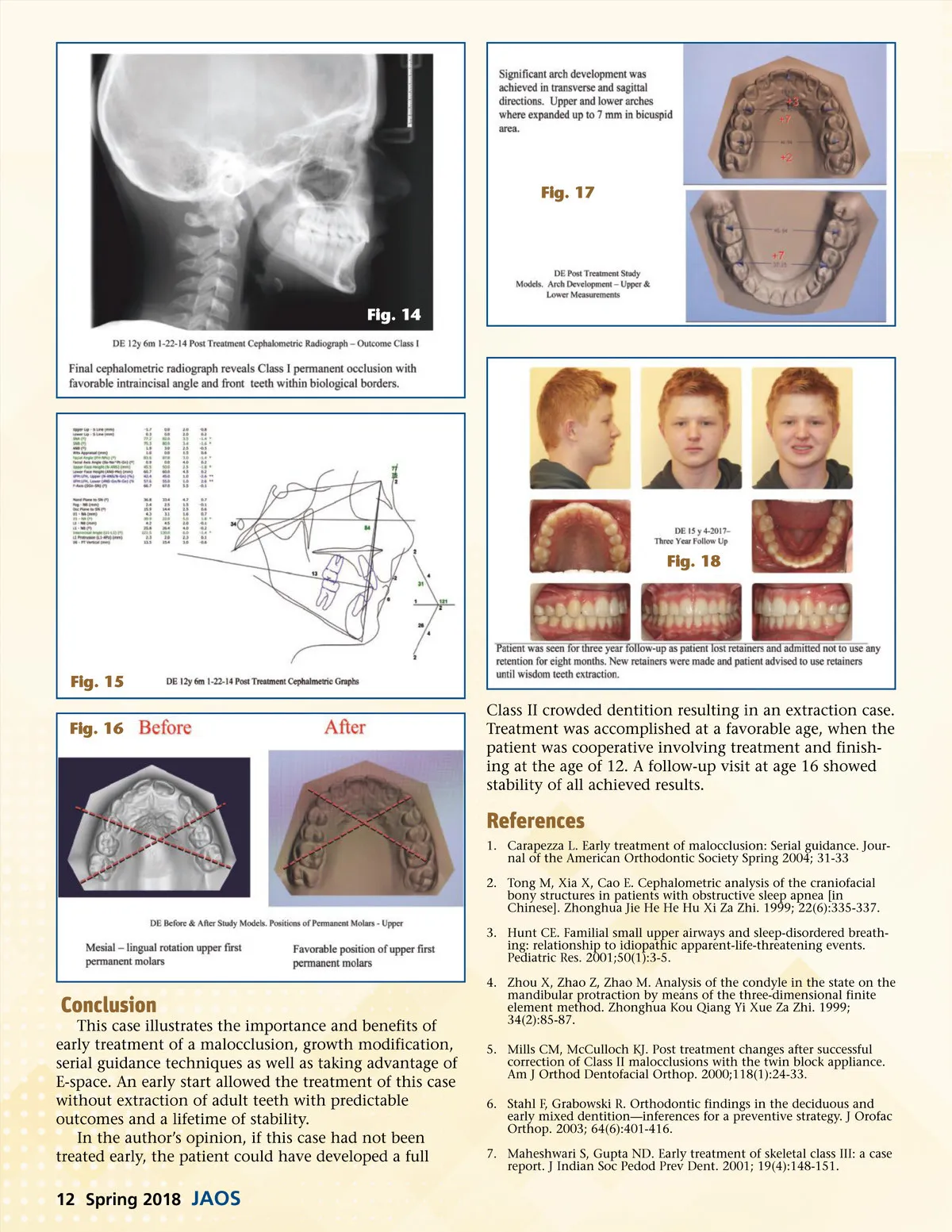
Fig. 17 Fig. 14 Fig. 18 Fig. 15 Fig. 16 Class II crowded dentition resulting in an extraction case. Treatment was accomplished at a favorable age, when the patient was cooperative involving treatment and finish-ing at the age of 12. A follow-up visit at age 16 showed stability of all achieved results. References 1. Carapezza L. Early treatment of malocclusion: Serial guidance. Jour-nal of the American Orthodontic Society Spring 2004; 31-33 2. Tong M, Xia X, Cao E. Cephalometric analysis of the craniofacial bony structures in patients with obstructive sleep apnea [in Chinese]. Zhonghua Jie He He Hu Xi Za Zhi. 1999; 22(6):335-337. 3. Hunt CE. Familial small upper airways and sleep-disordered breath-ing: relationship to idiopathic apparent-life-threatening events. Pediatric Res. 2001;50(1):3-5. 4. Zhou X, Zhao Z, Zhao M. Analysis of the condyle in the state on the mandibular protraction by means of the three-dimensional finite element method. Zhonghua Kou Qiang Yi Xue Za Zhi. 1999; 34(2):85-87. 5. Mills CM, McCulloch KJ. Post treatment changes after successful correction of Class II malocclusions with the twin block appliance. Am J Orthod Dentofacial Orthop. 2000;118(1):24-33. 6. Stahl F, Grabowski R. Orthodontic findings in the deciduous and early mixed dentition—inferences for a preventive strategy. J Orofac Orthop. 2003; 64(6):401-416. 7. Maheshwari S, Gupta ND. Early treatment of skeletal class III: a case report. J Indian Soc Pedod Prev Dent. 2001; 19(4):148-151. Conclusion This case illustrates the importance and benefits of early treatment of a malocclusion, growth modification, serial guidance techniques as well as taking advantage of E-space. An early start allowed the treatment of this case without extraction of adult teeth with predictable outcomes and a lifetime of stability. In the author’s opinion, if this case had not been treated early, the patient could have developed a full 12 Spring 2018 JAOS
Journal of the American Orthodontic Society Spring 2018: Page 12