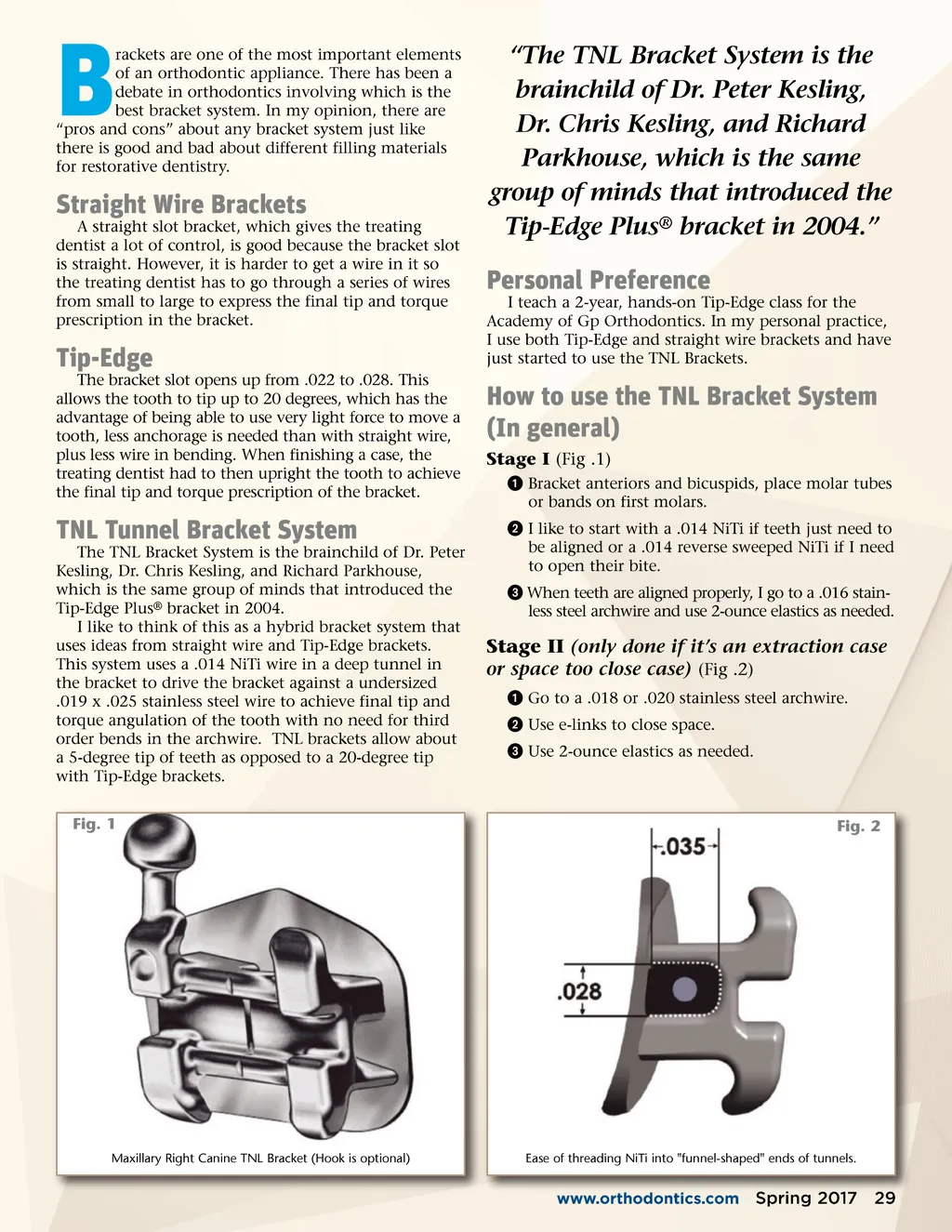
B rackets are one of the most important elements of an orthodontic appliance. There has been a debate in orthodontics involving which is the best bracket system. In my opinion, there are “pros and cons” about any bracket system just like there is good and bad about different filling materials for restorative dentistry. Straight Wire Brackets A straight slot bracket, which gives the treating dentist a lot of control, is good because the bracket slot is straight. However, it is harder to get a wire in it so the treating dentist has to go through a series of wires from small to large to express the final tip and torque prescription in the bracket. “The TNL Bracket System is the brainchild of Dr. Peter Kesling, Dr. Chris Kesling, and Richard Parkhouse, which is the same group of minds that introduced the Tip-Edge Plus ® bracket in 2004.” Personal Preference I teach a 2-year, hands-on Tip-Edge class for the Academy of Gp Orthodontics. In my personal practice, I use both Tip-Edge and straight wire brackets and have just started to use the TNL Brackets. Tip-Edge The bracket slot opens up from .022 to .028. This allows the tooth to tip up to 20 degrees, which has the advantage of being able to use very light force to move a tooth, less anchorage is needed than with straight wire, plus less wire in bending. When finishing a case, the treating dentist had to then upright the tooth to achieve the final tip and torque prescription of the bracket. How to use the TNL Bracket System (In general) Stage I (Fig .1) ᕡ Bracket anteriors and bicuspids, place molar tubes or bands on first molars. ᕢ I like to start with a .014 NiTi if teeth just need to be aligned or a .014 reverse sweeped NiTi if I need to open their bite. ᕣ When teeth are aligned properly, I go to a .016 stain-less steel archwire and use 2-ounce elastics as needed. TNL Tunnel Bracket System The TNL Bracket System is the brainchild of Dr. Peter Kesling, Dr. Chris Kesling, and Richard Parkhouse, which is the same group of minds that introduced the Tip-Edge Plus ® bracket in 2004. I like to think of this as a hybrid bracket system that uses ideas from straight wire and Tip-Edge brackets. This system uses a .014 NiTi wire in a deep tunnel in the bracket to drive the bracket against a undersized .019 x .025 stainless steel wire to achieve final tip and torque angulation of the tooth with no need for third order bends in the archwire. TNL brackets allow about a 5-degree tip of teeth as opposed to a 20-degree tip with Tip-Edge brackets. Fig. 1 Stage II (only done if it’s an extraction case or space too close case) (Fig .2) ᕡ Go to a .018 or .020 stainless steel archwire. ᕢ Use e-links to close space. ᕣ Use 2-ounce elastics as needed. Fig. 2 Maxillary Right Canine TNL Bracket (Hook is optional) Ease of threading NiTi into "funnel-shaped" ends of tunnels. www.orthodontics.com Spring 2017 29
Journal of the American Orthodontic Society Spring 2017: Page 29