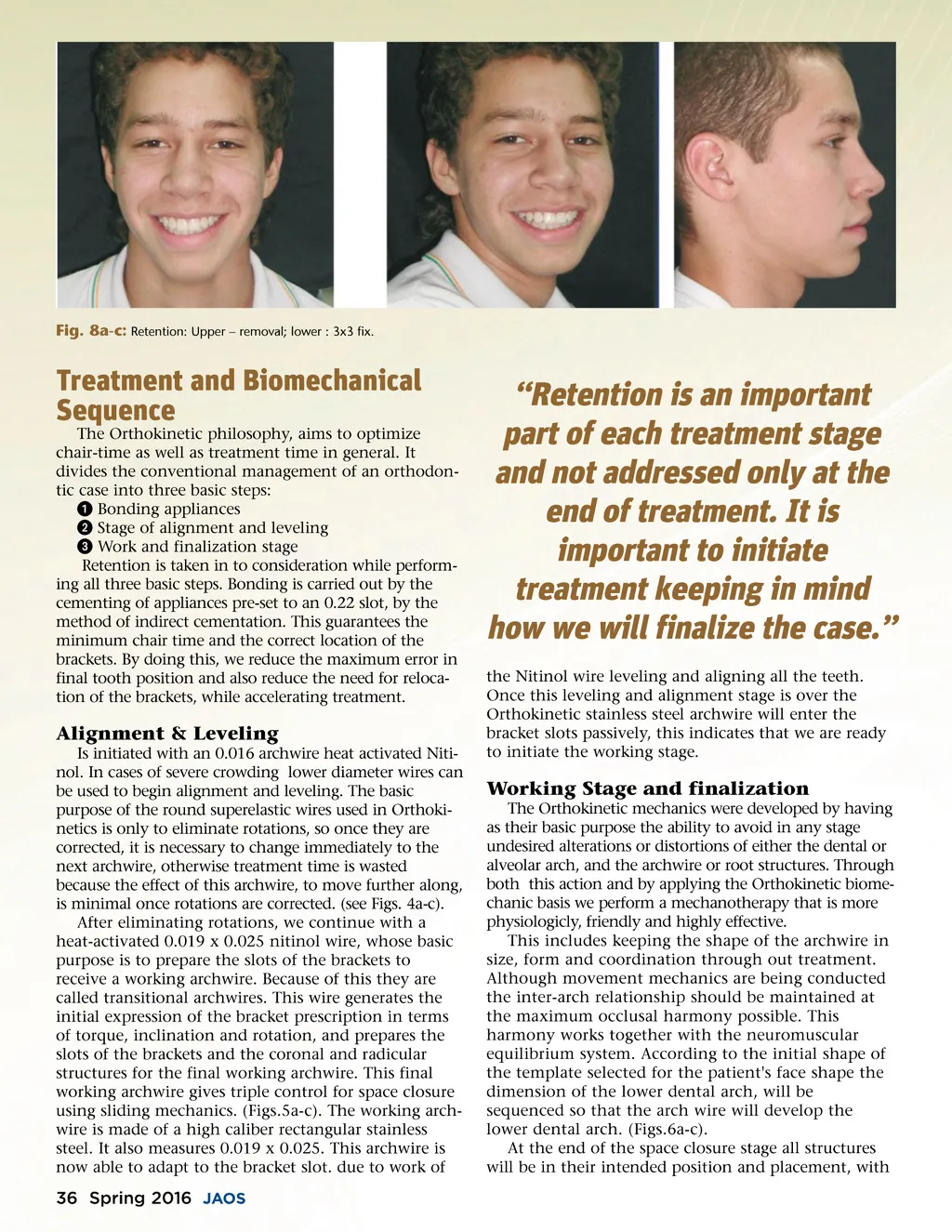
adequate functional engagement having occurred. It is possible to avoid the extensive hard work involved with the maneuvers of finalization used in classic orthodontics, because with Orthokinetics it is usually not necessary to devote time to correcting errors from the initial stages and from the general sequence of treatment. By avoiding committing errors we can now reach the final stage quicker. It is possible to save up to 50 % of treatment time by performing our treatment almost error free. We are now ready to perform extraction space closure or closure of any other space that has been generated as a result of treatment. This is done through sliding mechan-ics, with the Orthokinetic (O.K.) archwire. Made of 0.019x0.025 inch stainless steel and with hooks distally placed in canine teeth anchored to the retraction systems, as mentioned above.(Figs.6a-c) The activation of the Orthokinetic retraction system arch-wires is made by stretching the elastic module to 1/3 or 1/2 of its diameter until completing the space closure. (Fig. 2) The purpose of this stage is not just space closure but to also find out and achieve the final position and placement of all structures. At the end of the space closure stage, we reestablish both the intra and inter arch crown/root relationships in space obtaining the static and dynamic therapeutic goals. Now the case is finished (Figs.7a-c). Retention Retention is an important part of each treatment stage and not addressed only at the end of treatment. It is important to initiate treatment keeping in mind how we will finalize the case. The design of retention appliances must take into account all the changes and corrections that have been achieved during the treatment, including the elimina-tion of the etiological factors that caused the original malocclusion. The appliances used for retention are adapted to the finished occlusion and both allow for and facilitate any rebound from overcorrection that has occurred. There is a certain amount of overcorrection or overtreatment that can occur with the uprighting, involved with restoring distal inclination and with the unrotating of premolar and molar teeth to improve their anchorage; hence during treatment the marginal ridge height for posterior teeth becomes unequal. After debanding a case, the rebound that occurs from overcorrection helps to level the marginal ridges and fix the desired occlusion. In addition there is also a mild return of the curve of Spee and of the normal meso-axial position of the posterior teeth (Figs.7a-c) For upper arch retention, we placed splints with a continu-ous contoured arch without occlusal additives. For the lower arch we placed a 3x3 coax wire.(Figs.8a-c). www.orthodontics.com Spring 2016 37
Journal of the American Orthodontic Society Spring 2016: Page 37