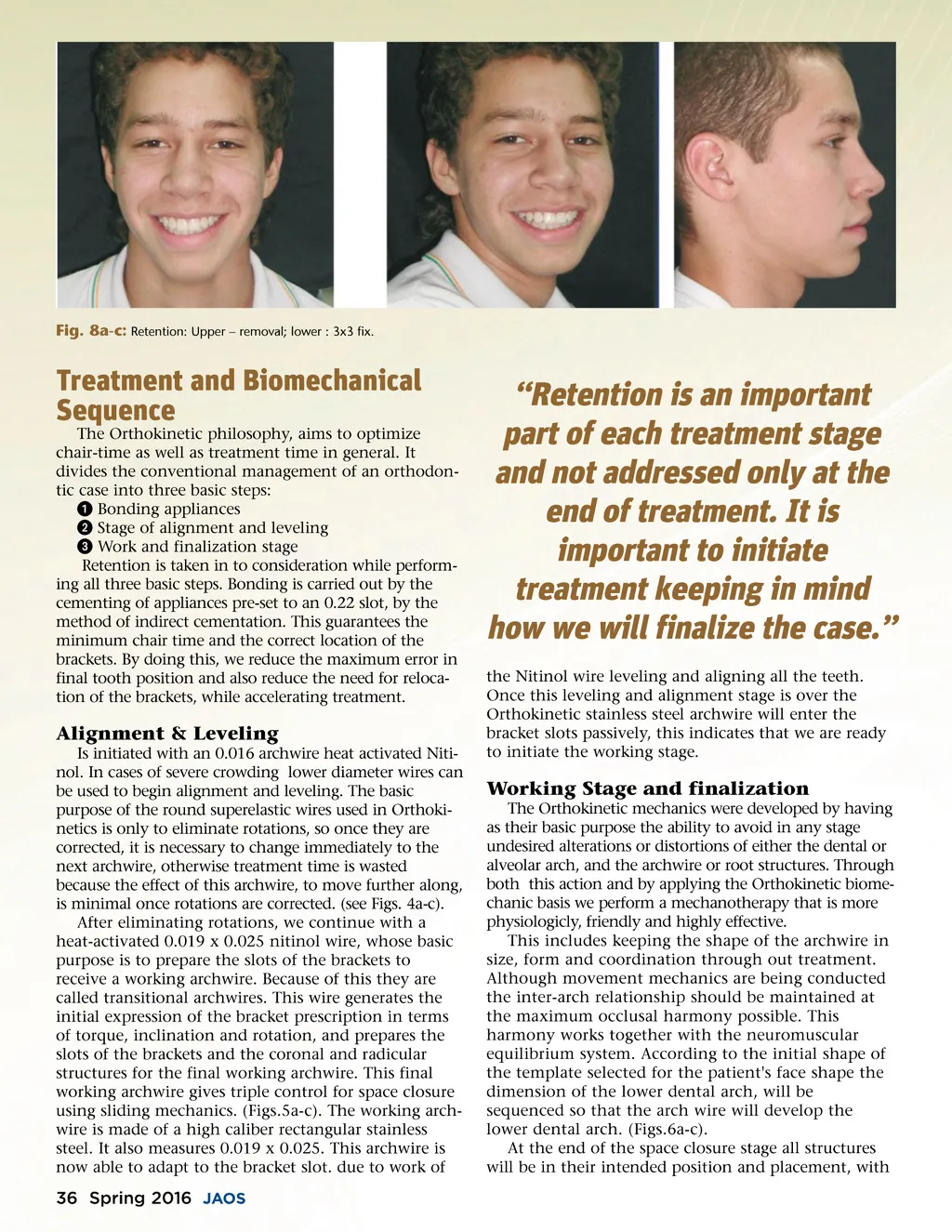
Fig. 8a-c: Retention: Upper – removal; lower : 3x3 fix. Treatment and Biomechanical Sequence The Orthokinetic philosophy, aims to optimize chair-time as well as treatment time in general. It divides the conventional management of an orthodon-tic case into three basic steps: ᕡ Bonding appliances ᕢ Stage of alignment and leveling ᕣ Work and finalization stage Retention is taken in to consideration while perform-ing all three basic steps. Bonding is carried out by the cementing of appliances pre-set to an 0.22 slot, by the method of indirect cementation. This guarantees the minimum chair time and the correct location of the brackets. By doing this, we reduce the maximum error in final tooth position and also reduce the need for reloca-tion of the brackets, while accelerating treatment. “Retention is an important part of each treatment stage and not addressed only at the end of treatment. It is important to initiate treatment keeping in mind how we will finalize the case.” the Nitinol wire leveling and aligning all the teeth. Once this leveling and alignment stage is over the Orthokinetic stainless steel archwire will enter the bracket slots passively, this indicates that we are ready to initiate the working stage. Alignment & Leveling Is initiated with an 0.016 archwire heat activated Niti-nol. In cases of severe crowding lower diameter wires can be used to begin alignment and leveling. The basic purpose of the round superelastic wires used in Orthoki-netics is only to eliminate rotations, so once they are corrected, it is necessary to change immediately to the next archwire, otherwise treatment time is wasted because the effect of this archwire, to move further along, is minimal once rotations are corrected. (see Figs. 4a-c). After eliminating rotations, we continue with a heat-activated 0.019 x 0.025 nitinol wire, whose basic purpose is to prepare the slots of the brackets to receive a working archwire. Because of this they are called transitional archwires. This wire generates the initial expression of the bracket prescription in terms of torque, inclination and rotation, and prepares the slots of the brackets and the coronal and radicular structures for the final working archwire. This final working archwire gives triple control for space closure using sliding mechanics. (Figs.5a-c). The working arch-wire is made of a high caliber rectangular stainless steel. It also measures 0.019 x 0.025. This archwire is now able to adapt to the bracket slot. due to work of Working Stage and finalization The Orthokinetic mechanics were developed by having as their basic purpose the ability to avoid in any stage undesired alterations or distortions of either the dental or alveolar arch, and the archwire or root structures. Through both this action and by applying the Orthokinetic biome-chanic basis we perform a mechanotherapy that is more physiologicly, friendly and highly effective. This includes keeping the shape of the archwire in size, form and coordination through out treatment. Although movement mechanics are being conducted the inter-arch relationship should be maintained at the maximum occlusal harmony possible. This harmony works together with the neuromuscular equilibrium system. According to the initial shape of the template selected for the patient's face shape the dimension of the lower dental arch, will be sequenced so that the arch wire will develop the lower dental arch. (Figs.6a-c). At the end of the space closure stage all structures will be in their intended position and placement, with 36 Spring 2016 JAOS
Journal of the American Orthodontic Society Spring 2016: Page 36