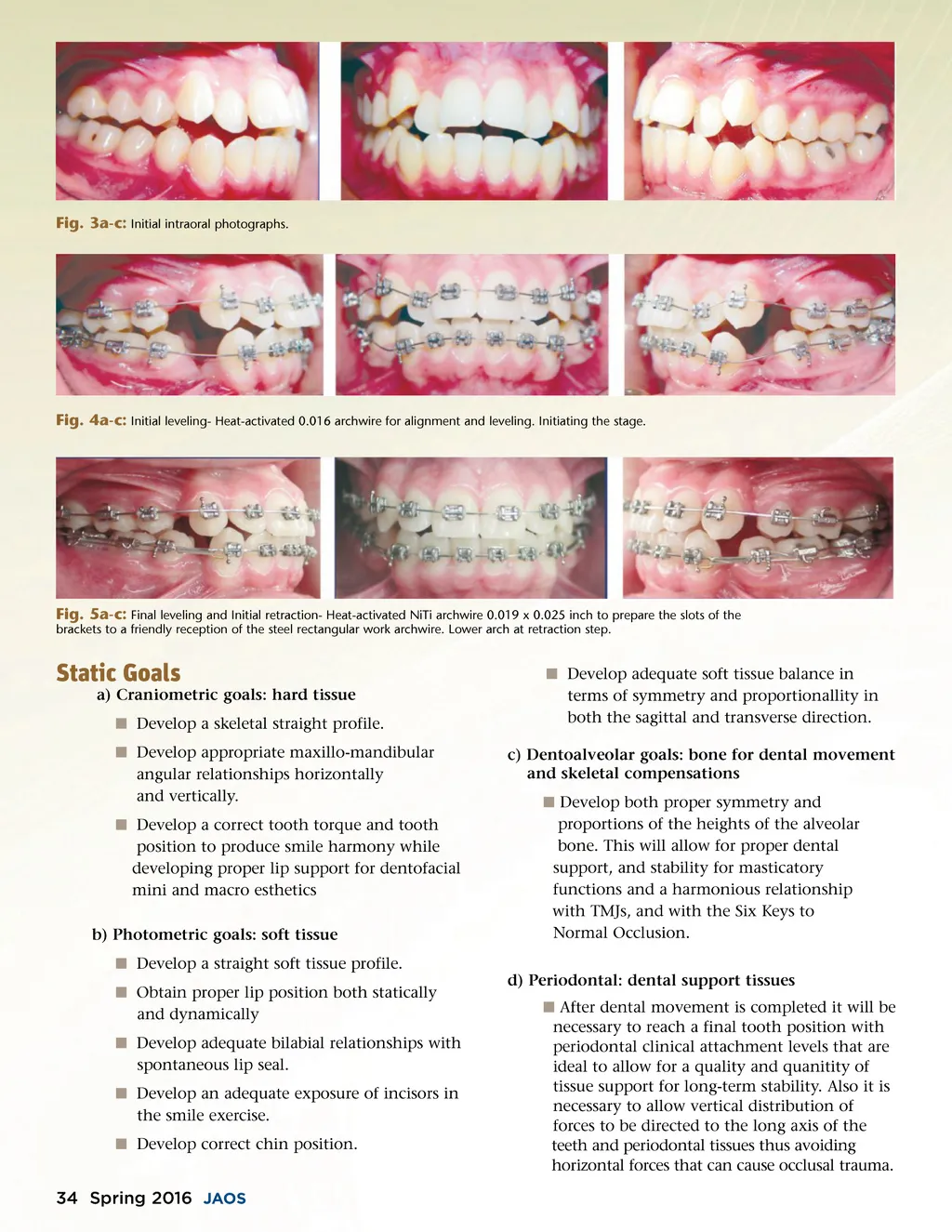
Fig. 3a-c: Initial intraoral photographs. Fig. 4a-c: Initial leveling-Heat-activated 0.016 archwire for alignment and leveling. Initiating the stage. Fig. 5a-c: Final leveling and Initial retraction-Heat-activated NiTi archwire 0.019 x 0.025 inch to prepare the slots of the brackets to a friendly reception of the steel rectangular work archwire. Lower arch at retraction step. Static Goals a) Craniometric goals: hard tissue í Develop a skeletal straight profile. í Develop appropriate maxillo-mandibular angular relationships horizontally and vertically. í Develop a correct tooth torque and tooth position to produce smile harmony while developing proper lip support for dentofacial mini and macro esthetics b) Photometric goals: soft tissue í Develop a straight soft tissue profile. í Obtain proper lip position both statically and dynamically í Develop adequate bilabial relationships with spontaneous lip seal. í Develop an adequate exposure of incisors in the smile exercise. í Develop correct chin position. í Develop adequate soft tissue balance in terms of symmetry and proportionallity in both the sagittal and transverse direction. c) Dentoalveolar goals: bone for dental movement and skeletal compensations í Develop both proper symmetry and proportions of the heights of the alveolar bone. This will allow for proper dental support, and stability for masticatory functions and a harmonious relationship with TMJs, and with the Six Keys to Normal Occlusion. d) Periodontal: dental support tissues í After dental movement is completed it will be necessary to reach a final tooth position with periodontal clinical attachment levels that are ideal to allow for a quality and quanitity of tissue support for long-term stability. Also it is necessary to allow vertical distribution of forces to be directed to the long axis of the teeth and periodontal tissues thus avoiding horizontal forces that can cause occlusal trauma. 34 Spring 2016 JAOS
Journal of the American Orthodontic Society Spring 2016: Page 34