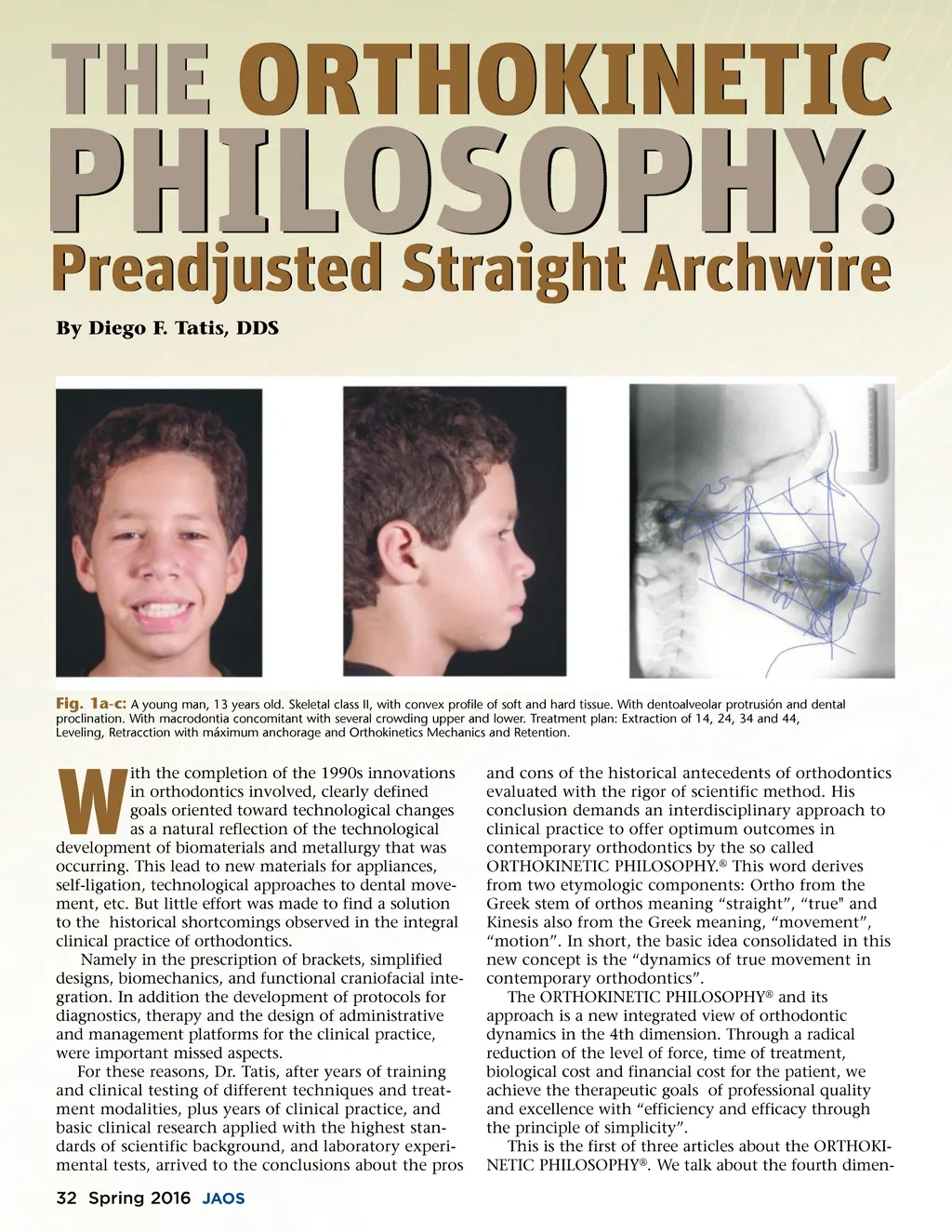
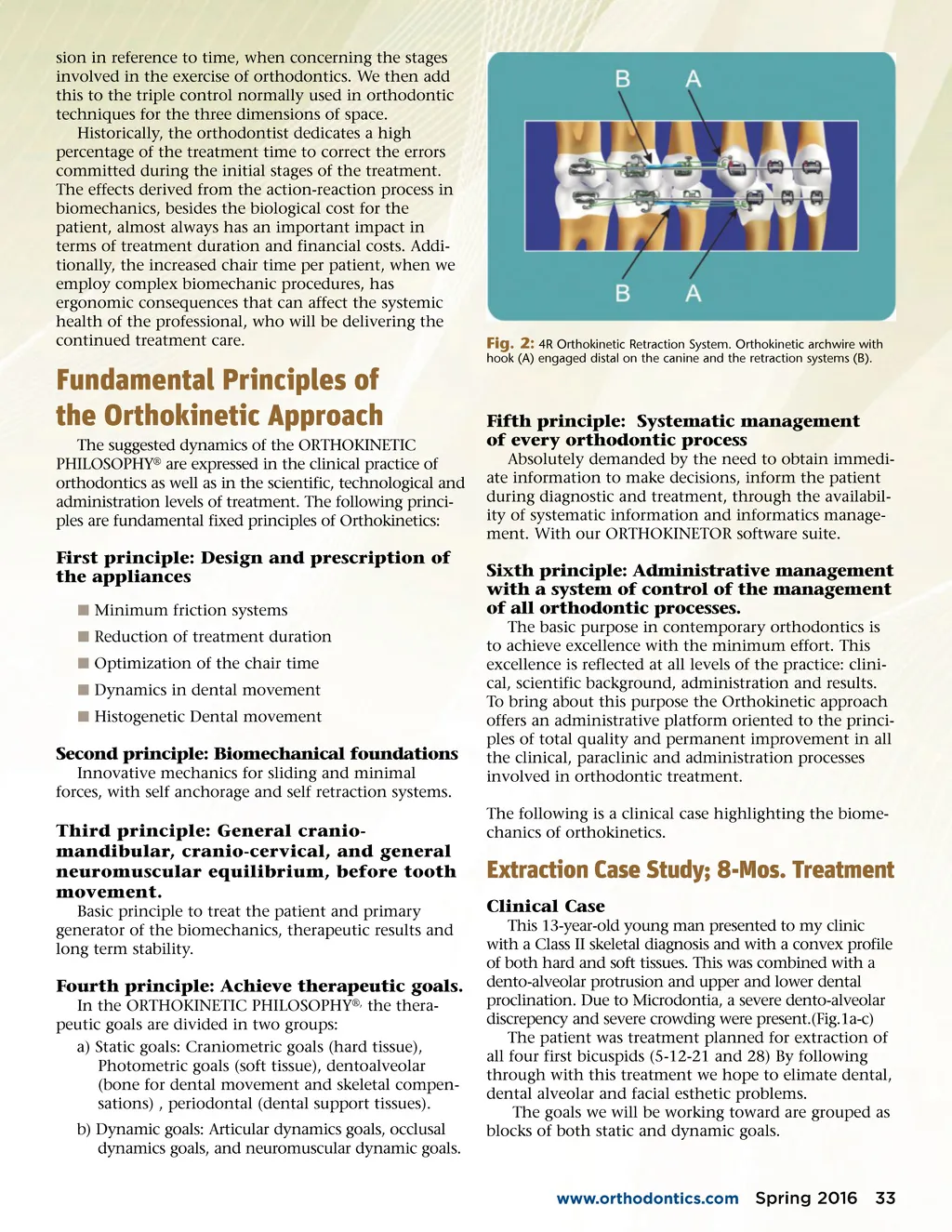
sion in reference to time, when concerning the stages involved in the exercise of orthodontics. We then add this to the triple control normally used in orthodontic techniques for the three dimensions of space. Historically, the orthodontist dedicates a high percentage of the treatment time to correct the errors committed during the initial stages of the treatment. The effects derived from the action-reaction process in biomechanics, besides the biological cost for the patient, almost always has an important impact in terms of treatment duration and financial costs. Addi-tionally, the increased chair time per patient, when we employ complex biomechanic procedures, has ergonomic consequences that can affect the systemic health of the professional, who will be delivering the continued treatment care. Fig. 2: 4R Orthokinetic Retraction System. Orthokinetic archwire with hook (A) engaged distal on the canine and the retraction systems (B). Fundamental Principles of the Orthokinetic Approach The suggested dynamics of the ORTHOKINETIC PHILOSOPHY ® are expressed in the clinical practice of orthodontics as well as in the scientific, technological and administration levels of treatment. The following princi-ples are fundamental fixed principles of Orthokinetics: Fifth principle: Systematic management of every orthodontic process Absolutely demanded by the need to obtain immedi-ate information to make decisions, inform the patient during diagnostic and treatment, through the availabil-ity of systematic information and informatics manage-ment. With our ORTHOKINETOR software suite. First principle: Design and prescription of the appliances í Minimum friction systems í Reduction of treatment duration í Optimization of the chair time í Dynamics in dental movement í Histogenetic Dental movement Sixth principle: Administrative management with a system of control of the management of all orthodontic processes. The basic purpose in contemporary orthodontics is to achieve excellence with the minimum effort. This excellence is reflected at all levels of the practice: clini-cal, scientific background, administration and results. To bring about this purpose the Orthokinetic approach offers an administrative platform oriented to the princi-ples of total quality and permanent improvement in all the clinical, paraclinic and administration processes involved in orthodontic treatment. The following is a clinical case highlighting the biome-chanics of orthokinetics. Second principle: Biomechanical foundations Innovative mechanics for sliding and minimal forces, with self anchorage and self retraction systems. Third principle: General cranio-mandibular, cranio-cervical, and general neuromuscular equilibrium, before tooth movement. Basic principle to treat the patient and primary generator of the biomechanics, therapeutic results and long term stability. Extraction Case Study; 8-Mos. Treatment Clinical Case This 13-year-old young man presented to my clinic with a Class II skeletal diagnosis and with a convex profile of both hard and soft tissues. This was combined with a dento-alveolar protrusion and upper and lower dental proclination. Due to Microdontia, a severe dento-alveolar discrepency and severe crowding were present.(Fig.1a-c) The patient was treatment planned for extraction of all four first bicuspids (5-12-21 and 28) By following through with this treatment we hope to elimate dental, dental alveolar and facial esthetic problems. The goals we will be working toward are grouped as blocks of both static and dynamic goals. Fourth principle: Achieve therapeutic goals. In the ORTHOKINETIC PHILOSOPHY ®, the thera-peutic goals are divided in two groups: a) Static goals: Craniometric goals (hard tissue), Photometric goals (soft tissue), dentoalveolar (bone for dental movement and skeletal compen-sations) , periodontal (dental support tissues). b) Dynamic goals: Articular dynamics goals, occlusal dynamics goals, and neuromuscular dynamic goals. www.orthodontics.com Spring 2016 33
Journal of the American Orthodontic Society Spring 2016: Page 33