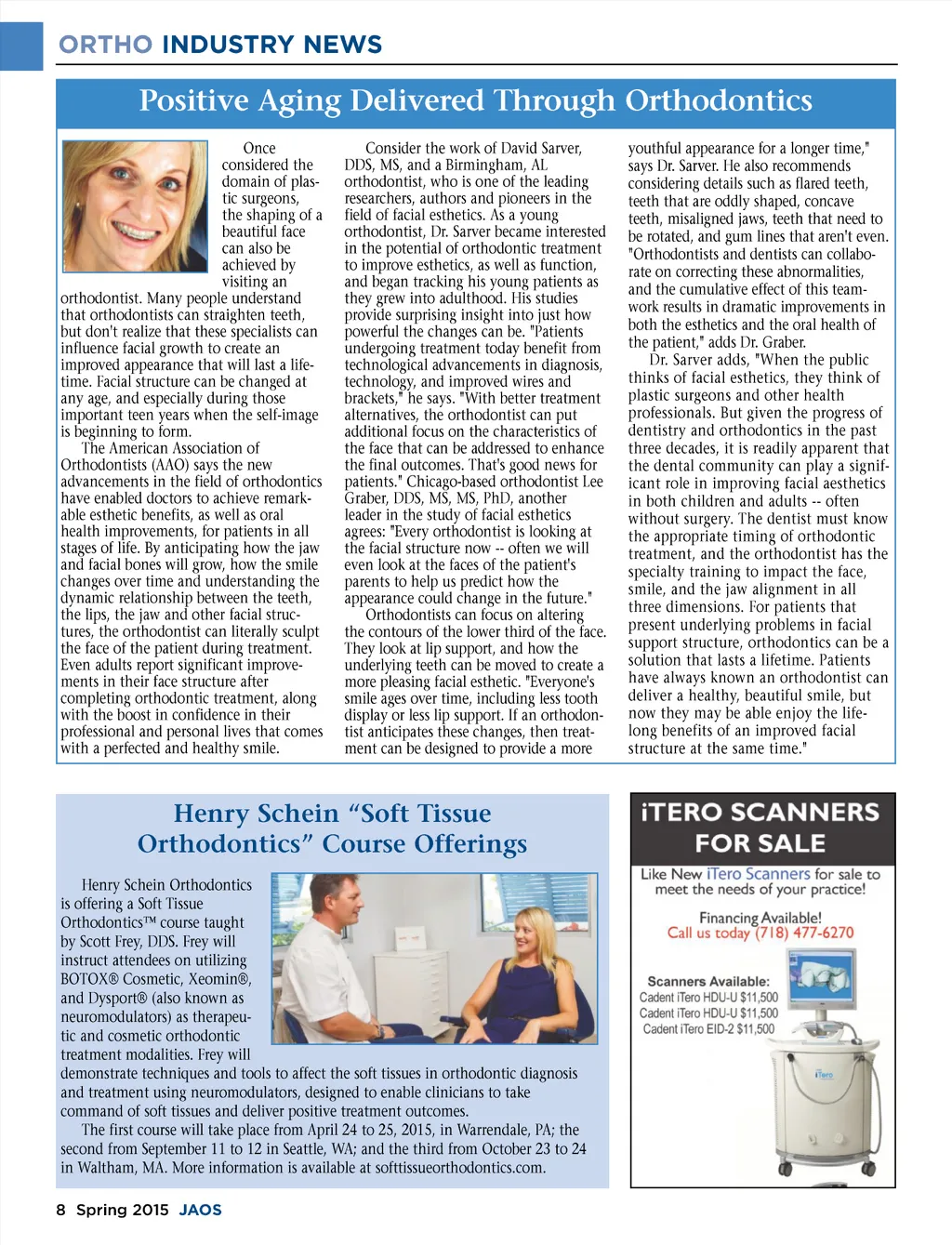
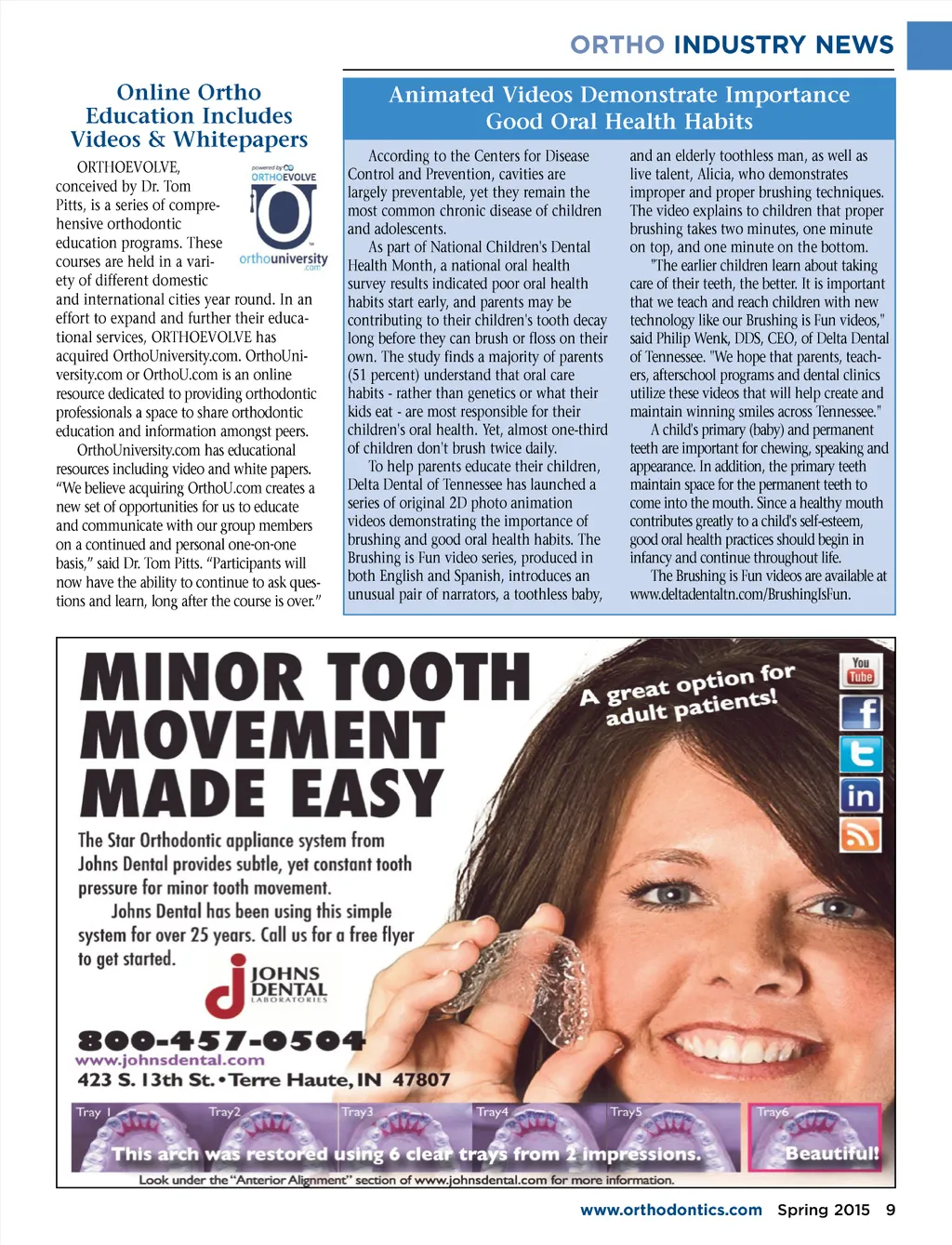
ORTHO INDUSTRY NEWS Positive Aging Delivered Through Orthodontics Once considered the domain of plas-tic surgeons, the shaping of a beautiful face can also be achieved by visiting an orthodontist. Many people understand that orthodontists can straighten teeth, but don't realize that these specialists can influence facial growth to create an improved appearance that will last a life-time. Facial structure can be changed at any age, and especially during those important teen years when the self-image is beginning to form. The American Association of Orthodontists (AAO) says the new advancements in the field of orthodontics have enabled doctors to achieve remark-able esthetic benefits, as well as oral health improvements, for patients in all stages of life. By anticipating how the jaw and facial bones will grow, how the smile changes over time and understanding the dynamic relationship between the teeth, the lips, the jaw and other facial struc-tures, the orthodontist can literally sculpt the face of the patient during treatment. Even adults report significant improve-ments in their face structure after completing orthodontic treatment, along with the boost in confidence in their professional and personal lives that comes with a perfected and healthy smile. Consider the work of David Sarver, DDS, MS, and a Birmingham, AL orthodontist, who is one of the leading researchers, authors and pioneers in the field of facial esthetics. As a young orthodontist, Dr. Sarver became interested in the potential of orthodontic treatment to improve esthetics, as well as function, and began tracking his young patients as they grew into adulthood. His studies provide surprising insight into just how powerful the changes can be. "Patients undergoing treatment today benefit from technological advancements in diagnosis, technology, and improved wires and brackets," he says. "With better treatment alternatives, the orthodontist can put additional focus on the characteristics of the face that can be addressed to enhance the final outcomes. That's good news for patients." Chicago-based orthodontist Lee Graber, DDS, MS, MS, PhD, another leader in the study of facial esthetics agrees: "Every orthodontist is looking at the facial structure now --often we will even look at the faces of the patient's parents to help us predict how the appearance could change in the future." Orthodontists can focus on altering the contours of the lower third of the face. They look at lip support, and how the underlying teeth can be moved to create a more pleasing facial esthetic. "Everyone's smile ages over time, including less tooth display or less lip support. If an orthodon-tist anticipates these changes, then treat-ment can be designed to provide a more youthful appearance for a longer time," says Dr. Sarver. He also recommends considering details such as flared teeth, teeth that are oddly shaped, concave teeth, misaligned jaws, teeth that need to be rotated, and gum lines that aren't even. "Orthodontists and dentists can collabo-rate on correcting these abnormalities, and the cumulative effect of this team-work results in dramatic improvements in both the esthetics and the oral health of the patient," adds Dr. Graber. Dr. Sarver adds, "When the public thinks of facial esthetics, they think of plastic surgeons and other health professionals. But given the progress of dentistry and orthodontics in the past three decades, it is readily apparent that the dental community can play a signif-icant role in improving facial aesthetics in both children and adults --often without surgery. The dentist must know the appropriate timing of orthodontic treatment, and the orthodontist has the specialty training to impact the face, smile, and the jaw alignment in all three dimensions. For patients that present underlying problems in facial support structure, orthodontics can be a solution that lasts a lifetime. Patients have always known an orthodontist can deliver a healthy, beautiful smile, but now they may be able enjoy the life-long benefits of an improved facial structure at the same time." Henry Schein “Soft Tissue Orthodontics” Course Offerings Henry Schein Orthodontics is offering a Soft Tissue Orthodontics™ course taught by Scott Frey, DDS. Frey will instruct attendees on utilizing BOTOX® Cosmetic, Xeomin®, and Dysport® (also known as neuromodulators) as therapeu-tic and cosmetic orthodontic treatment modalities. Frey will demonstrate techniques and tools to affect the soft tissues in orthodontic diagnosis and treatment using neuromodulators, designed to enable clinicians to take command of soft tissues and deliver positive treatment outcomes. The first course will take place from April 24 to 25, 2015, in Warrendale, PA; the second from September 11 to 12 in Seattle, WA; and the third from October 23 to 24 in Waltham, MA. More information is available at softtissueorthodontics.com. 8 Spring 2015 JAOS
Journal of the American Orthodontic Society Spring 2015: Page 8