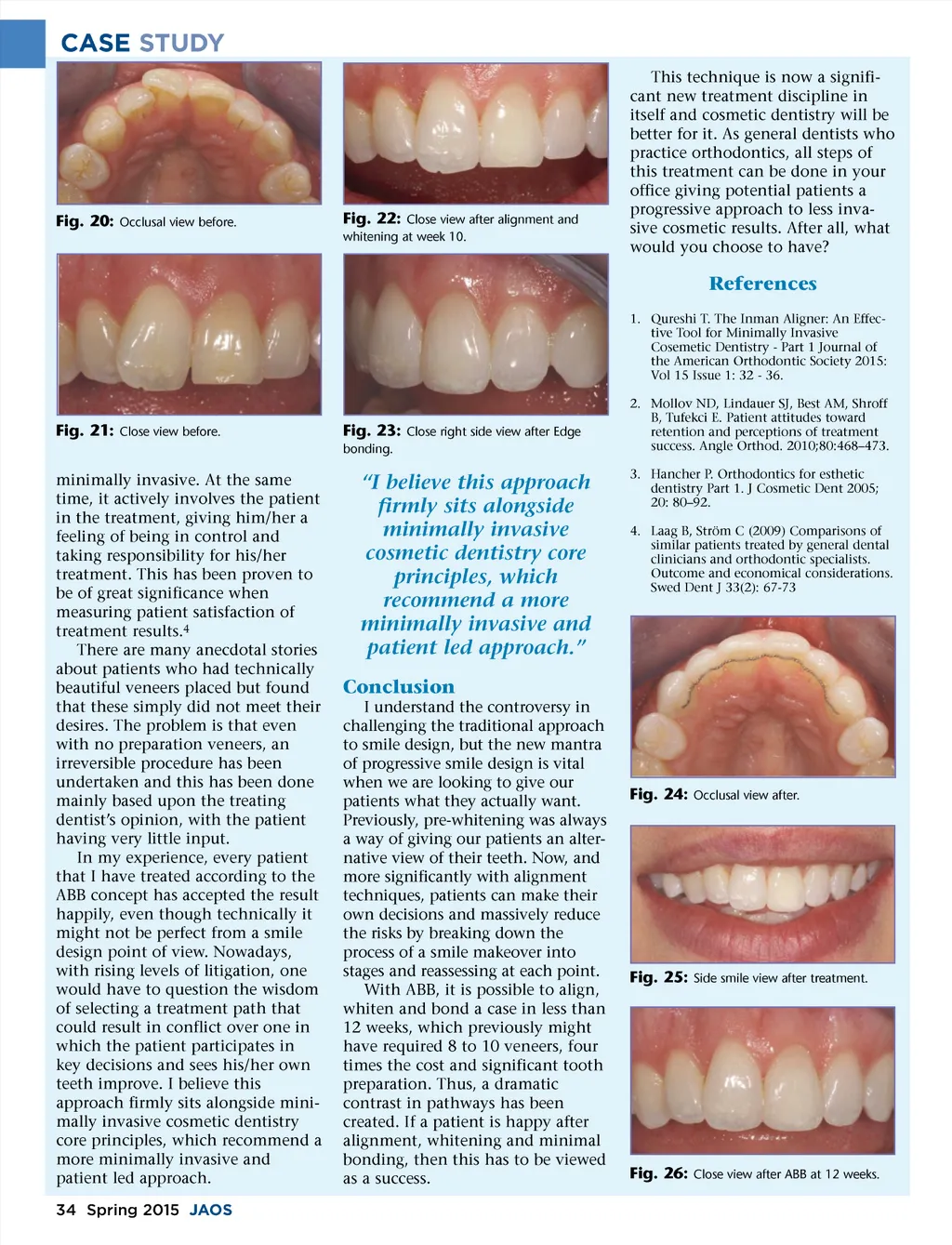
CASE STUDY This technique is now a signifi-cant new treatment discipline in itself and cosmetic dentistry will be better for it. As general dentists who practice orthodontics, all steps of this treatment can be done in your office giving potential patients a progressive approach to less inva-sive cosmetic results. After all, what would you choose to have? Fig. 20: Occlusal view before. Fig. 22: Close view after alignment and whitening at week 10. References 1. Qureshi T. The Inman Aligner: An Effec-tive Tool for Minimally Invasive Cosemetic Dentistry -Part 1 Journal of the American Orthodontic Society 2015: Vol 15 Issue 1: 32 -36. 2. Mollov ND, Lindauer SJ, Best AM, Shroff B, Tufekci E. Patient attitudes toward retention and perceptions of treatment success. Angle Orthod. 2010;80:468–473. 3. Hancher P. Orthodontics for esthetic dentistry Part 1. J Cosmetic Dent 2005; 20: 80–92. 4. Laag B, Ström C (2009) Comparisons of similar patients treated by general dental clinicians and orthodontic specialists. Outcome and economical considerations. Swed Dent J 33(2): 67-73 Fig. 21: Close view before. minimally invasive. At the same time, it actively involves the patient in the treatment, giving him/her a feeling of being in control and taking responsibility for his/her treatment. This has been proven to be of great significance when measuring patient satisfaction of treatment results. 4 There are many anecdotal stories about patients who had technically beautiful veneers placed but found that these simply did not meet their desires. The problem is that even with no preparation veneers, an irreversible procedure has been undertaken and this has been done mainly based upon the treating dentist’s opinion, with the patient having very little input. In my experience, every patient that I have treated according to the ABB concept has accepted the result happily, even though technically it might not be perfect from a smile design point of view. Nowadays, with rising levels of litigation, one would have to question the wisdom of selecting a treatment path that could result in conflict over one in which the patient participates in key decisions and sees his/her own teeth improve. I believe this approach firmly sits alongside mini-mally invasive cosmetic dentistry core principles, which recommend a more minimally invasive and patient led approach. 34 Spring 2015 JAOS Fig. 23: Close right side view after Edge bonding. “I believe this approach firmly sits alongside minimally invasive cosmetic dentistry core principles, which recommend a more minimally invasive and patient led approach.” Conclusion I understand the controversy in challenging the traditional approach to smile design, but the new mantra of progressive smile design is vital when we are looking to give our patients what they actually want. Previously, pre-whitening was always a way of giving our patients an alter-native view of their teeth. Now, and more significantly with alignment techniques, patients can make their own decisions and massively reduce the risks by breaking down the process of a smile makeover into stages and reassessing at each point. With ABB, it is possible to align, whiten and bond a case in less than 12 weeks, which previously might have required 8 to 10 veneers, four times the cost and significant tooth preparation. Thus, a dramatic contrast in pathways has been created. If a patient is happy after alignment, whitening and minimal bonding, then this has to be viewed as a success. Fig. 24: Occlusal view after. Fig. 25: Side smile view after treatment. Fig. 26: Close view after ABB at 12 weeks.
Journal of the American Orthodontic Society Spring 2015: Page 34