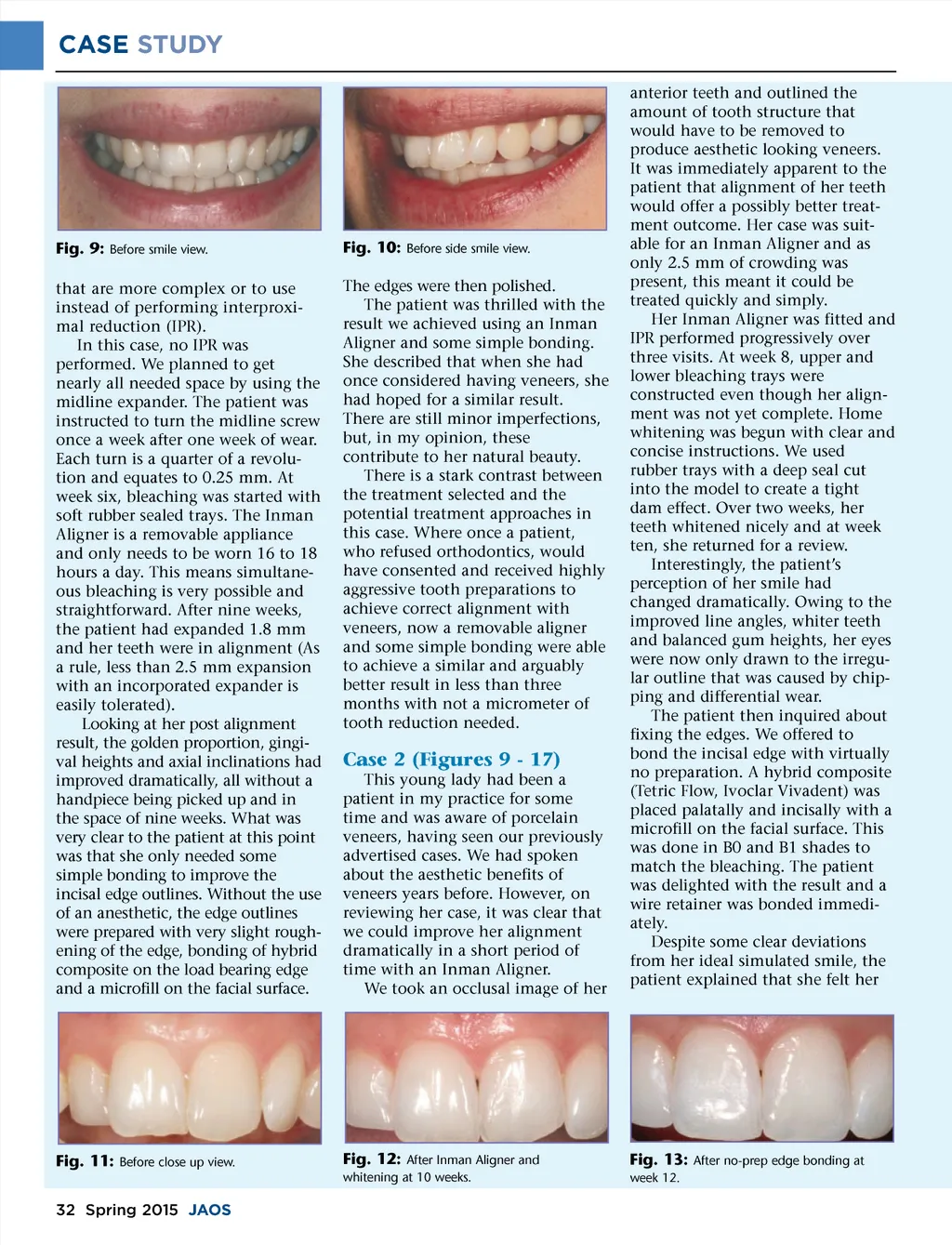
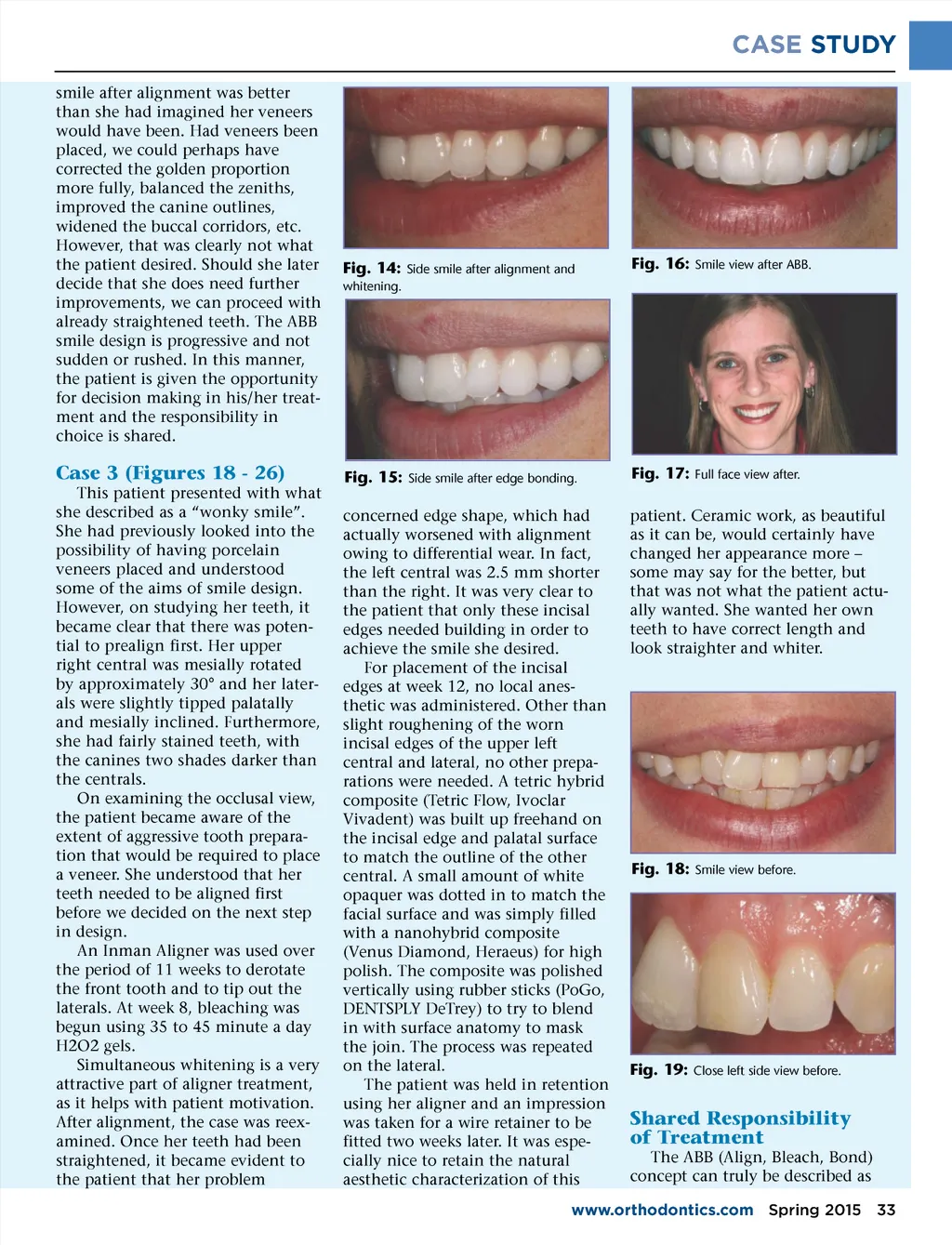
CASE STUDY smile after alignment was better than she had imagined her veneers would have been. Had veneers been placed, we could perhaps have corrected the golden proportion more fully, balanced the zeniths, improved the canine outlines, widened the buccal corridors, etc. However, that was clearly not what the patient desired. Should she later decide that she does need further improvements, we can proceed with already straightened teeth. The ABB smile design is progressive and not sudden or rushed. In this manner, the patient is given the opportunity for decision making in his/her treat-ment and the responsibility in choice is shared. Fig. 14: Side smile after alignment and whitening. Fig. 16: Smile view after ABB. Case 3 (Figures 18 -26) This patient presented with what she described as a “wonky smile”. She had previously looked into the possibility of having porcelain veneers placed and understood some of the aims of smile design. However, on studying her teeth, it became clear that there was poten-tial to prealign first. Her upper right central was mesially rotated by approximately 30° and her later-als were slightly tipped palatally and mesially inclined. Furthermore, she had fairly stained teeth, with the canines two shades darker than the centrals. On examining the occlusal view, the patient became aware of the extent of aggressive tooth prepara-tion that would be required to place a veneer. She understood that her teeth needed to be aligned first before we decided on the next step in design. An Inman Aligner was used over the period of 11 weeks to derotate the front tooth and to tip out the laterals. At week 8, bleaching was begun using 35 to 45 minute a day H2O2 gels. Simultaneous whitening is a very attractive part of aligner treatment, as it helps with patient motivation. After alignment, the case was reex-amined. Once her teeth had been straightened, it became evident to the patient that her problem Fig. 15: Side smile after edge bonding. concerned edge shape, which had actually worsened with alignment owing to differential wear. In fact, the left central was 2.5 mm shorter than the right. It was very clear to the patient that only these incisal edges needed building in order to achieve the smile she desired. For placement of the incisal edges at week 12, no local anes-thetic was administered. Other than slight roughening of the worn incisal edges of the upper left central and lateral, no other prepa-rations were needed. A tetric hybrid composite (Tetric Flow, Ivoclar Vivadent) was built up freehand on the incisal edge and palatal surface to match the outline of the other central. A small amount of white opaquer was dotted in to match the facial surface and was simply filled with a nanohybrid composite (Venus Diamond, Heraeus) for high polish. The composite was polished vertically using rubber sticks (PoGo, DENTSPLY DeTrey) to try to blend in with surface anatomy to mask the join. The process was repeated on the lateral. The patient was held in retention using her aligner and an impression was taken for a wire retainer to be fitted two weeks later. It was espe-cially nice to retain the natural aesthetic characterization of this Fig. 17: Full face view after. patient. Ceramic work, as beautiful as it can be, would certainly have changed her appearance more – some may say for the better, but that was not what the patient actu-ally wanted. She wanted her own teeth to have correct length and look straighter and whiter. Fig. 18: Smile view before. Fig. 19: Close left side view before. Shared Responsibility of Treatment The ABB (Align, Bleach, Bond) concept can truly be described as www.orthodontics.com Spring 2015 33
Journal of the American Orthodontic Society Spring 2015: Page 33