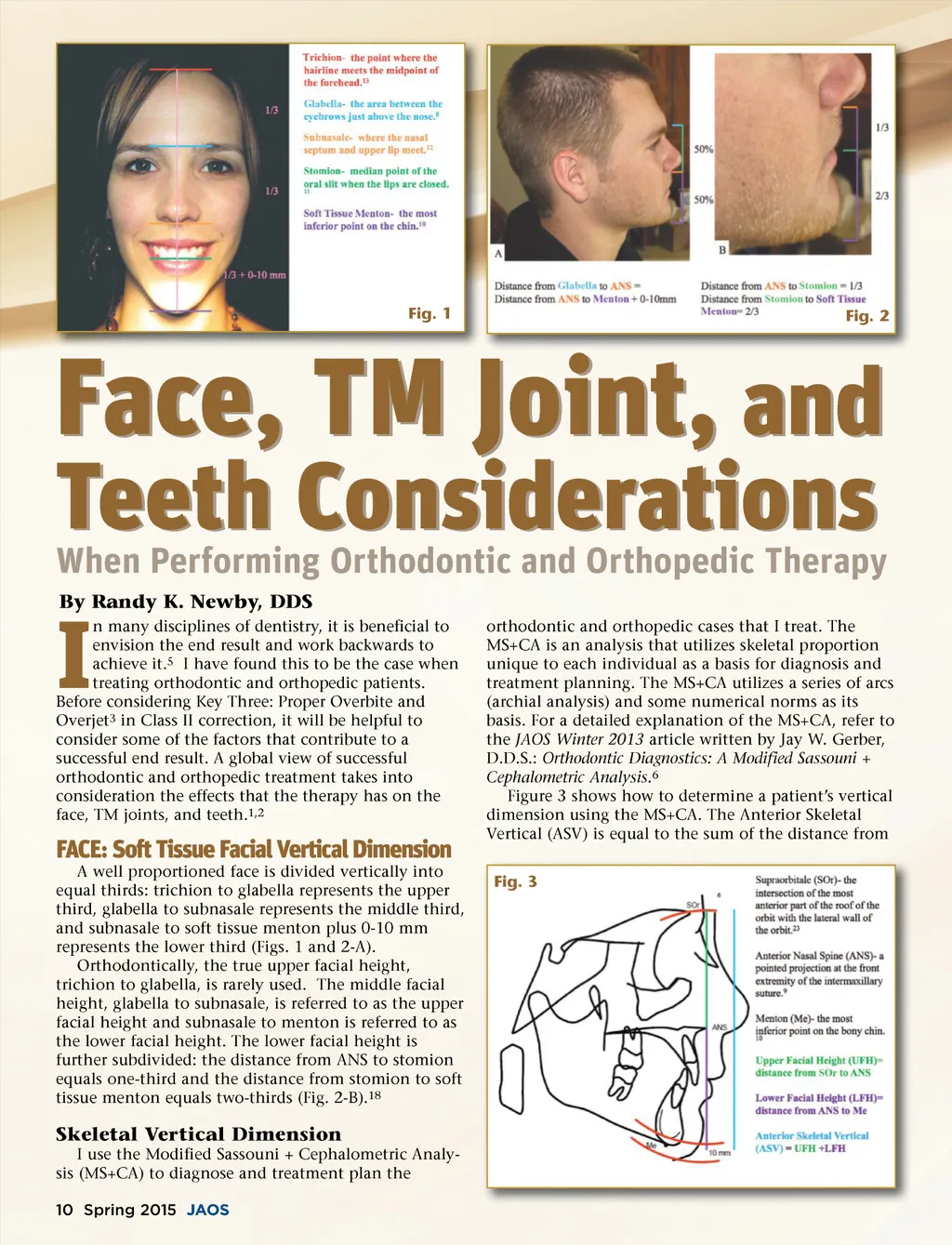
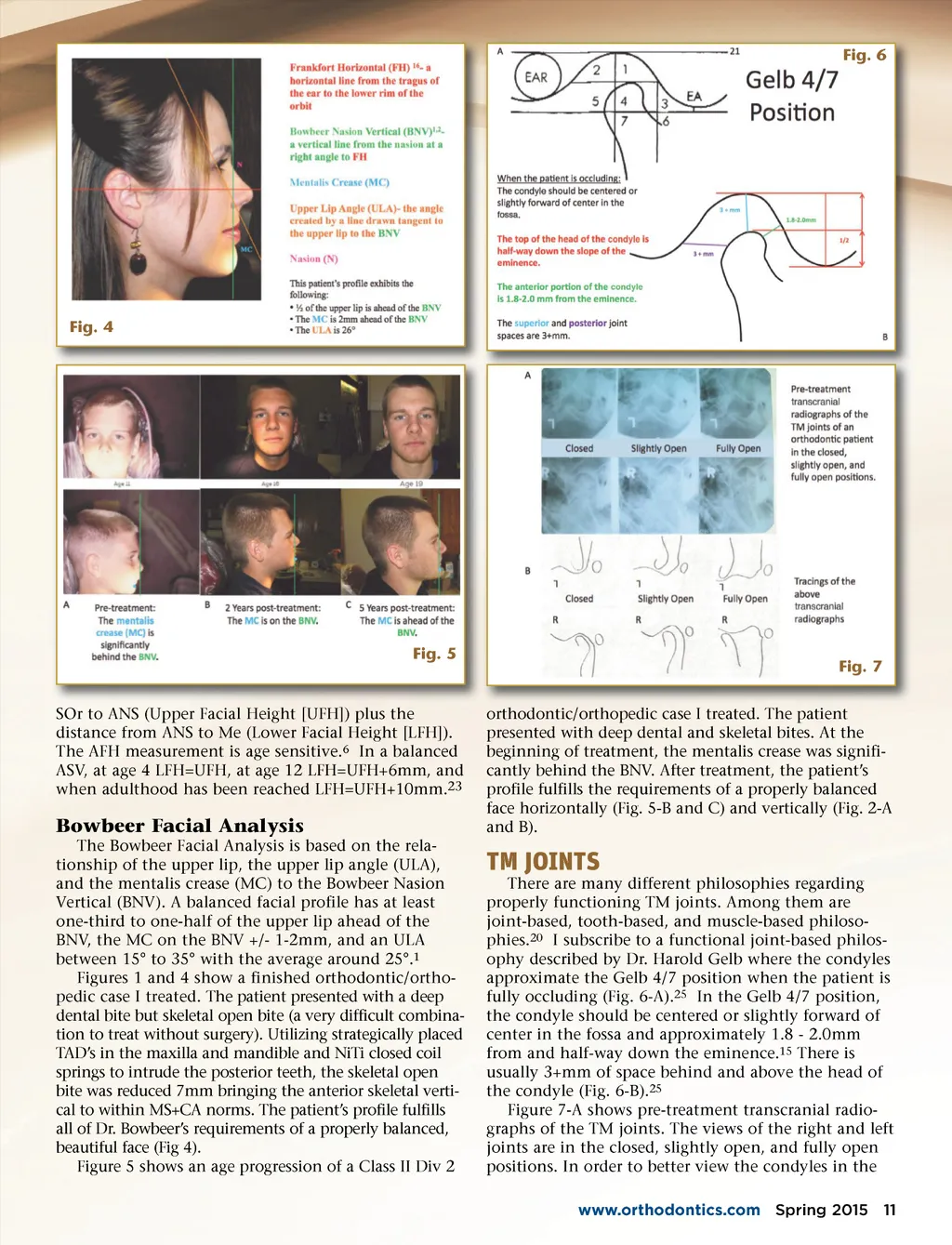
Fig. 1 Fig. 2 Face, TM Joint, and Teeth Considerations By Randy K. Newby, DDS When Performing Orthodontic and Orthopedic Therapy I n many disciplines of dentistry, it is beneficial to envision the end result and work backwards to achieve it. 5 I have found this to be the case when treating orthodontic and orthopedic patients. Before considering Key Three: Proper Overbite and Overjet 3 in Class II correction, it will be helpful to consider some of the factors that contribute to a successful end result. A global view of successful orthodontic and orthopedic treatment takes into consideration the effects that the therapy has on the face, TM joints, and teeth. 1,2 FACE: Soft Tissue Facial Vertical Dimension A well proportioned face is divided vertically into equal thirds: trichion to glabella represents the upper third, glabella to subnasale represents the middle third, and subnasale to soft tissue menton plus 0-10 mm represents the lower third (Figs. 1 and 2-A). Orthodontically, the true upper facial height, trichion to glabella, is rarely used. The middle facial height, glabella to subnasale, is referred to as the upper facial height and subnasale to menton is referred to as the lower facial height. The lower facial height is further subdivided: the distance from ANS to stomion equals one-third and the distance from stomion to soft tissue menton equals two-thirds (Fig. 2-B). 18 orthodontic and orthopedic cases that I treat. The MS+CA is an analysis that utilizes skeletal proportion unique to each individual as a basis for diagnosis and treatment planning. The MS+CA utilizes a series of arcs (archial analysis) and some numerical norms as its basis. For a detailed explanation of the MS+CA, refer to the JAOS Winter 2013 article written by Jay W. Gerber, D.D.S.: Orthodontic Diagnostics: A Modified Sassouni + Cephalometric Analysis. 6 Figure 3 shows how to determine a patient’s vertical dimension using the MS+CA. The Anterior Skeletal Vertical (ASV) is equal to the sum of the distance from Fig. 3 Skeletal Vertical Dimension I use the Modified Sassouni + Cephalometric Analy-sis (MS+CA) to diagnose and treatment plan the 10 Spring 2015 JAOS
Journal of the American Orthodontic Society Spring 2015: Page 10