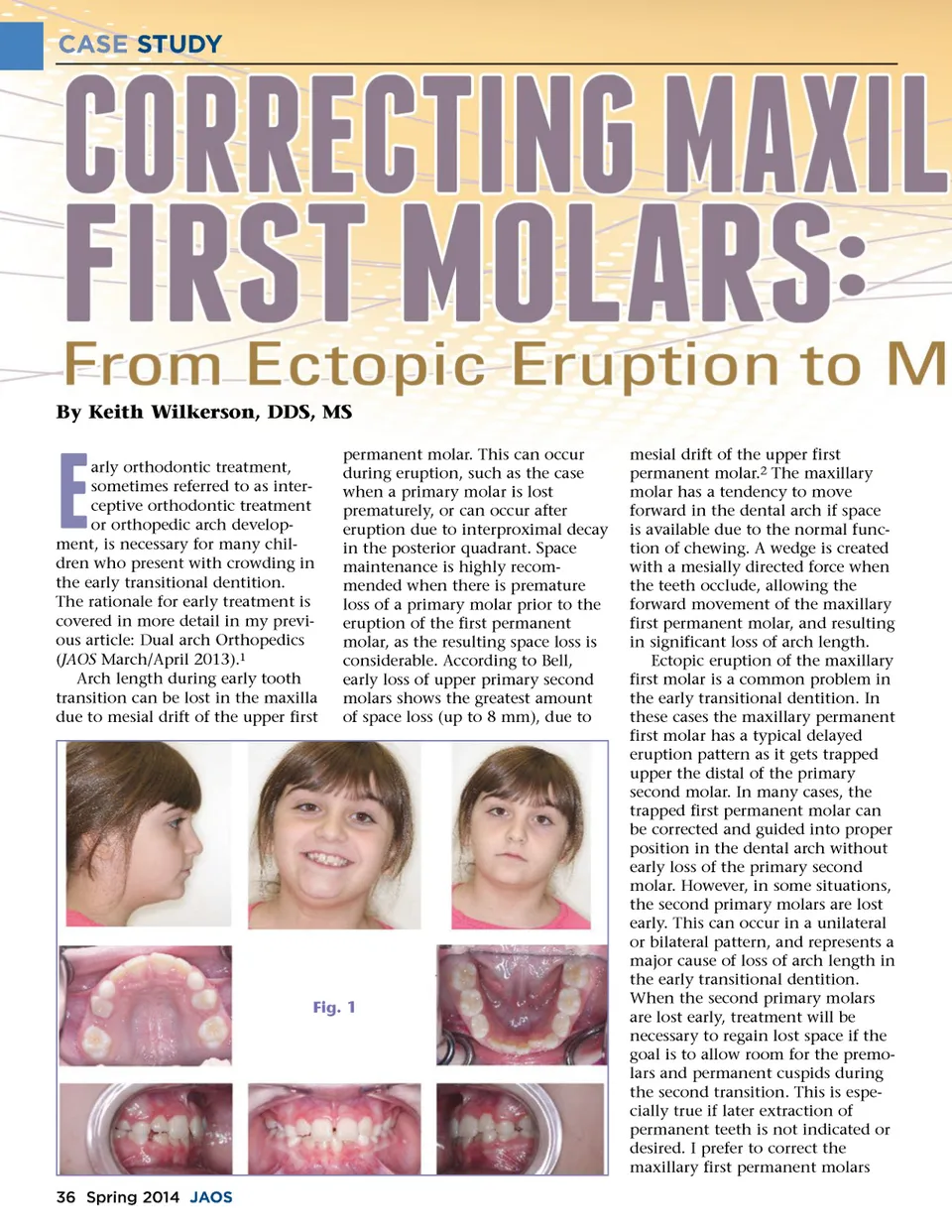
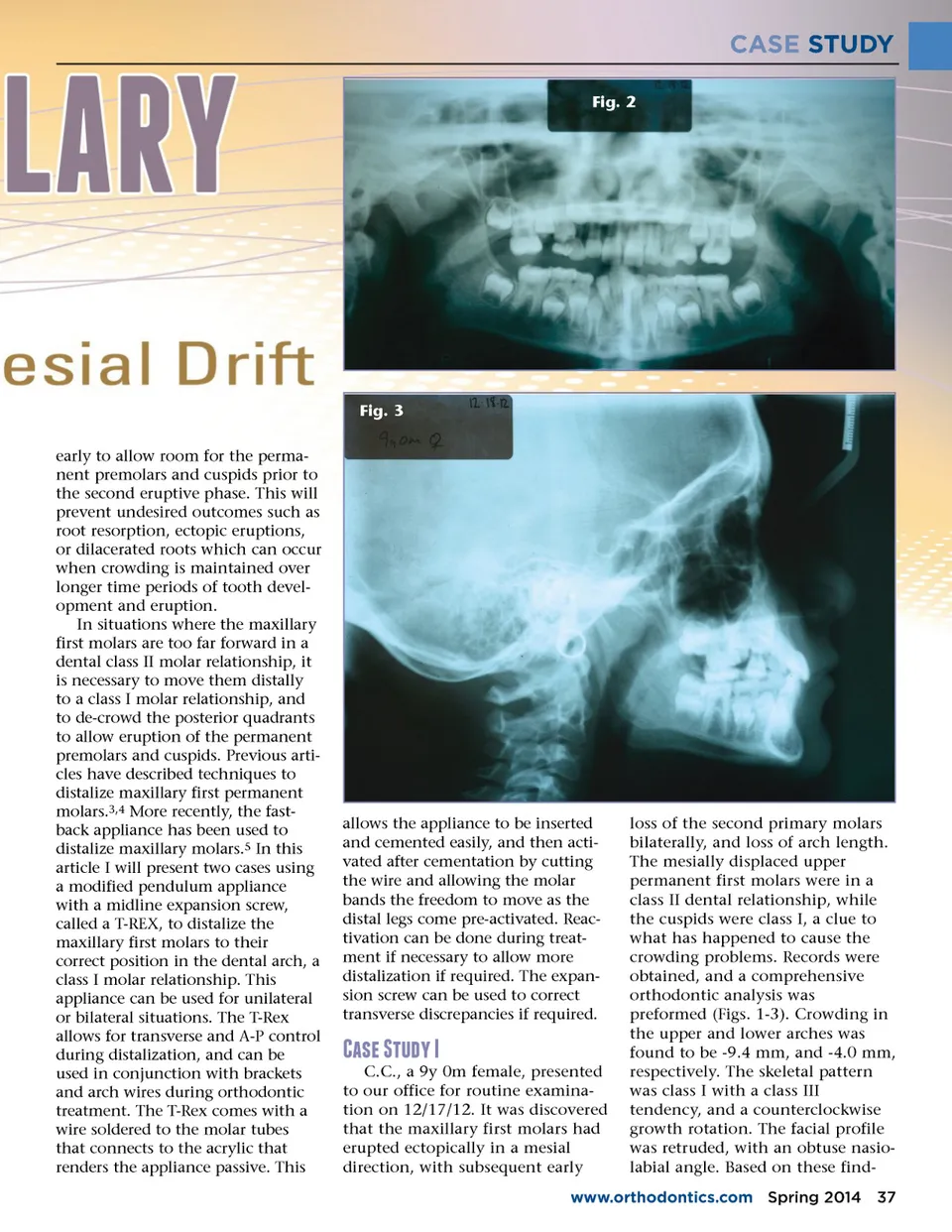
CASE STUDY Fig. 2 Fig. 3 early to allow room for the perma-nent premolars and cuspids prior to the second eruptive phase. This will prevent undesired outcomes such as root resorption, ectopic eruptions, or dilacerated roots which can occur when crowding is maintained over longer time periods of tooth devel-opment and eruption. In situations where the maxillary first molars are too far forward in a dental class II molar relationship, it is necessary to move them distally to a class I molar relationship, and to de-crowd the posterior quadrants to allow eruption of the permanent premolars and cuspids. Previous arti-cles have described techniques to distalize maxillary first permanent molars. 3,4 More recently, the fast-back appliance has been used to distalize maxillary molars. 5 In this article I will present two cases using a modified pendulum appliance with a midline expansion screw, called a T-REX, to distalize the maxillary first molars to their correct position in the dental arch, a class I molar relationship. This appliance can be used for unilateral or bilateral situations. The T-Rex allows for transverse and A-P control during distalization, and can be used in conjunction with brackets and arch wires during orthodontic treatment. The T-Rex comes with a wire soldered to the molar tubes that connects to the acrylic that renders the appliance passive. This allows the appliance to be inserted and cemented easily, and then acti-vated after cementation by cutting the wire and allowing the molar bands the freedom to move as the distal legs come pre-activated. Reac-tivation can be done during treat-ment if necessary to allow more distalization if required. The expan-sion screw can be used to correct transverse discrepancies if required. �d;d;a; !�b;f;�e;�f;!�c; C.C., a 9y 0m female, presented to our office for routine examina-tion on 12/17/12. It was discovered that the maxillary first molars had erupted ectopically in a mesial direction, with subsequent early loss of the second primary molars bilaterally, and loss of arch length. The mesially displaced upper permanent first molars were in a class II dental relationship, while the cuspids were class I, a clue to what has happened to cause the crowding problems. Records were obtained, and a comprehensive orthodontic analysis was preformed (Figs. 1-3). Crowding in the upper and lower arches was found to be -9.4 mm, and -4.0 mm, respectively. The skeletal pattern was class I with a class III tendency, and a counterclockwise growth rotation. The facial profile was retruded, with an obtuse nasio-labial angle. Based on these find-www.orthodontics.com Spring 2014 37
Journal of the American Orthodontic Society Spring 2014: Page 37