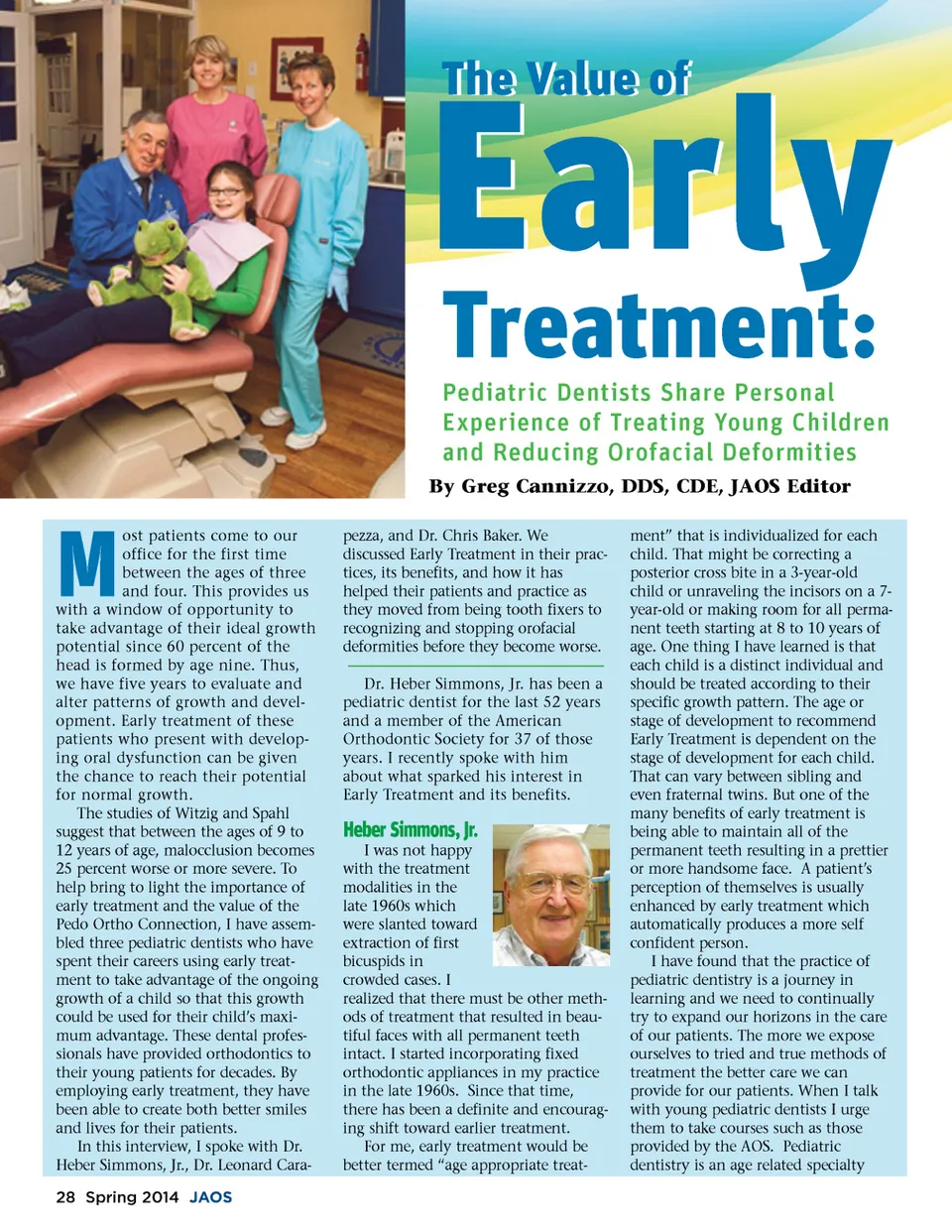
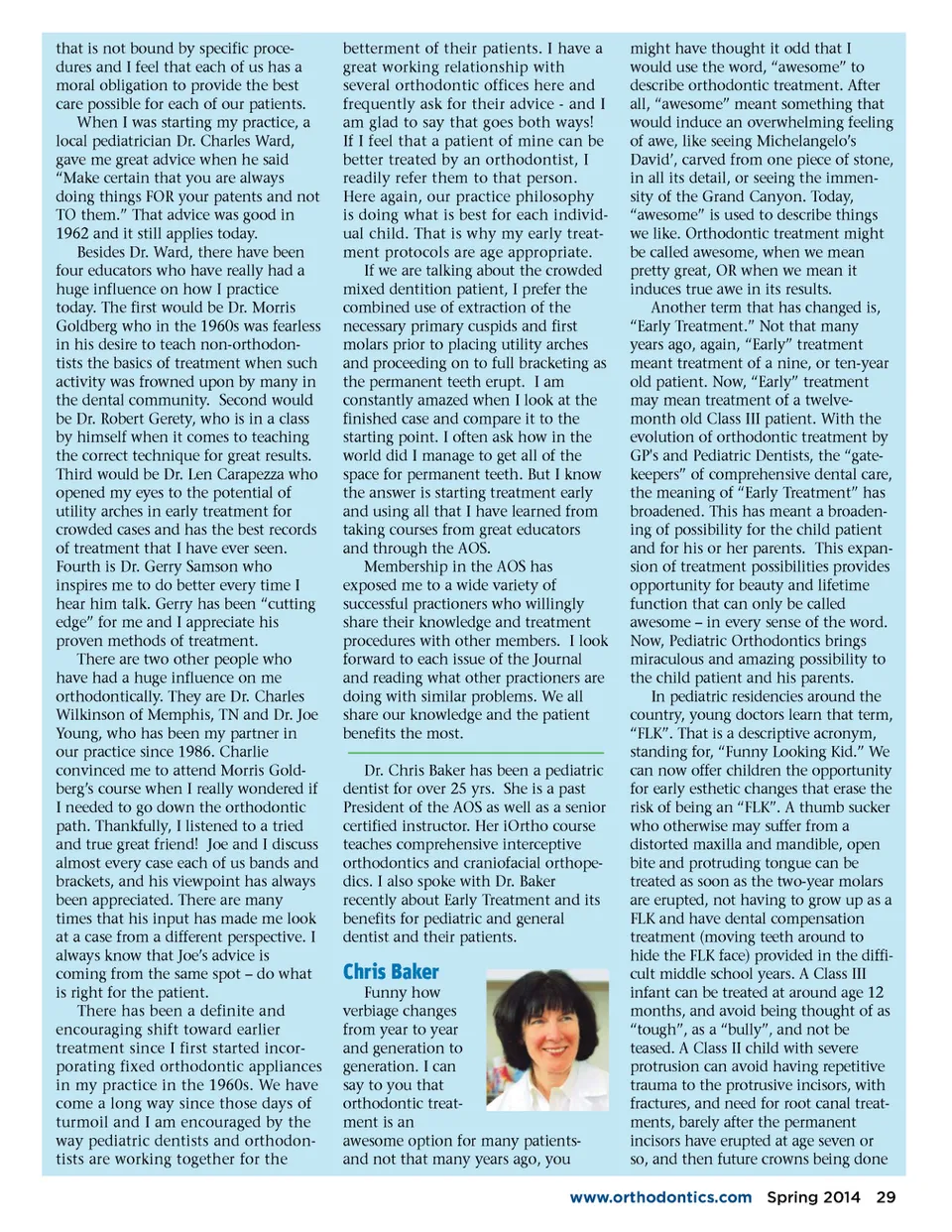
that is not bound by specific proce-dures and I feel that each of us has a moral obligation to provide the best care possible for each of our patients. When I was starting my practice, a local pediatrician Dr. Charles Ward, gave me great advice when he said “Make certain that you are always doing things FOR your patents and not TO them.” That advice was good in 1962 and it still applies today. Besides Dr. Ward, there have been four educators who have really had a huge influence on how I practice today. The first would be Dr. Morris Goldberg who in the 1960s was fearless in his desire to teach non-orthodon-tists the basics of treatment when such activity was frowned upon by many in the dental community. Second would be Dr. Robert Gerety, who is in a class by himself when it comes to teaching the correct technique for great results. Third would be Dr. Len Carapezza who opened my eyes to the potential of utility arches in early treatment for crowded cases and has the best records of treatment that I have ever seen. Fourth is Dr. Gerry Samson who inspires me to do better every time I hear him talk. Gerry has been “cutting edge” for me and I appreciate his proven methods of treatment. There are two other people who have had a huge influence on me orthodontically. They are Dr. Charles Wilkinson of Memphis, TN and Dr. Joe Young, who has been my partner in our practice since 1986. Charlie convinced me to attend Morris Gold-berg’s course when I really wondered if I needed to go down the orthodontic path. Thankfully, I listened to a tried and true great friend! Joe and I discuss almost every case each of us bands and brackets, and his viewpoint has always been appreciated. There are many times that his input has made me look at a case from a different perspective. I always know that Joe’s advice is coming from the same spot – do what is right for the patient. There has been a definite and encouraging shift toward earlier treatment since I first started incor-porating fixed orthodontic appliances in my practice in the 1960s. We have come a long way since those days of turmoil and I am encouraged by the way pediatric dentists and orthodon-tists are working together for the betterment of their patients. I have a great working relationship with several orthodontic offices here and frequently ask for their advice -and I am glad to say that goes both ways! If I feel that a patient of mine can be better treated by an orthodontist, I readily refer them to that person. Here again, our practice philosophy is doing what is best for each individ-ual child. That is why my early treat-ment protocols are age appropriate. If we are talking about the crowded mixed dentition patient, I prefer the combined use of extraction of the necessary primary cuspids and first molars prior to placing utility arches and proceeding on to full bracketing as the permanent teeth erupt. I am constantly amazed when I look at the finished case and compare it to the starting point. I often ask how in the world did I manage to get all of the space for permanent teeth. But I know the answer is starting treatment early and using all that I have learned from taking courses from great educators and through the AOS. Membership in the AOS has exposed me to a wide variety of successful practioners who willingly share their knowledge and treatment procedures with other members. I look forward to each issue of the Journal and reading what other practioners are doing with similar problems. We all share our knowledge and the patient benefits the most. Dr. Chris Baker has been a pediatric dentist for over 25 yrs. She is a past President of the AOS as well as a senior certified instructor. Her iOrtho course teaches comprehensive interceptive orthodontics and craniofacial orthope-dics. I also spoke with Dr. Baker recently about Early Treatment and its benefits for pediatric and general dentist and their patients. Chris Baker Funny how verbiage changes from year to year and generation to generation. I can say to you that orthodontic treat-ment is an awesome option for many patients-and not that many years ago, you might have thought it odd that I would use the word, “awesome” to describe orthodontic treatment. After all, “awesome” meant something that would induce an overwhelming feeling of awe, like seeing Michelangelo’s David’, carved from one piece of stone, in all its detail, or seeing the immen-sity of the Grand Canyon. Today, “awesome” is used to describe things we like. Orthodontic treatment might be called awesome, when we mean pretty great, OR when we mean it induces true awe in its results. Another term that has changed is, “Early Treatment.” Not that many years ago, again, “Early” treatment meant treatment of a nine, or ten-year old patient. Now, “Early” treatment may mean treatment of a twelve-month old Class III patient. With the evolution of orthodontic treatment by GP's and Pediatric Dentists, the “gate-keepers” of comprehensive dental care, the meaning of “Early Treatment” has broadened. This has meant a broaden-ing of possibility for the child patient and for his or her parents. This expan-sion of treatment possibilities provides opportunity for beauty and lifetime function that can only be called awesome – in every sense of the word. Now, Pediatric Orthodontics brings miraculous and amazing possibility to the child patient and his parents. In pediatric residencies around the country, young doctors learn that term, “FLK”. That is a descriptive acronym, standing for, “Funny Looking Kid.” We can now offer children the opportunity for early esthetic changes that erase the risk of being an “FLK”. A thumb sucker who otherwise may suffer from a distorted maxilla and mandible, open bite and protruding tongue can be treated as soon as the two-year molars are erupted, not having to grow up as a FLK and have dental compensation treatment (moving teeth around to hide the FLK face) provided in the diffi-cult middle school years. A Class III infant can be treated at around age 12 months, and avoid being thought of as “tough”, as a “bully”, and not be teased. A Class II child with severe protrusion can avoid having repetitive trauma to the protrusive incisors, with fractures, and need for root canal treat-ments, barely after the permanent incisors have erupted at age seven or so, and then future crowns being done www.orthodontics.com Spring 2014 29
Journal of the American Orthodontic Society Spring 2014: Page 29