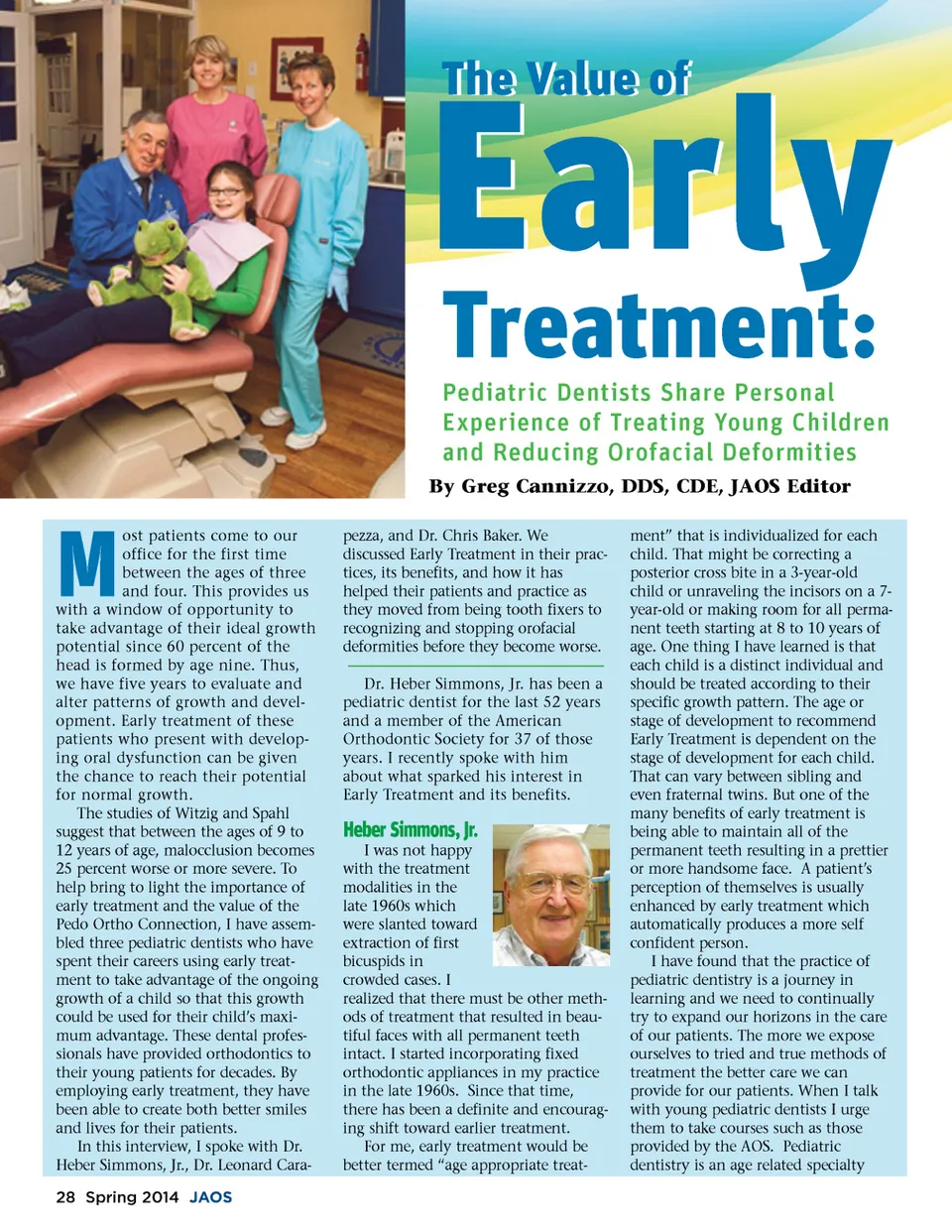
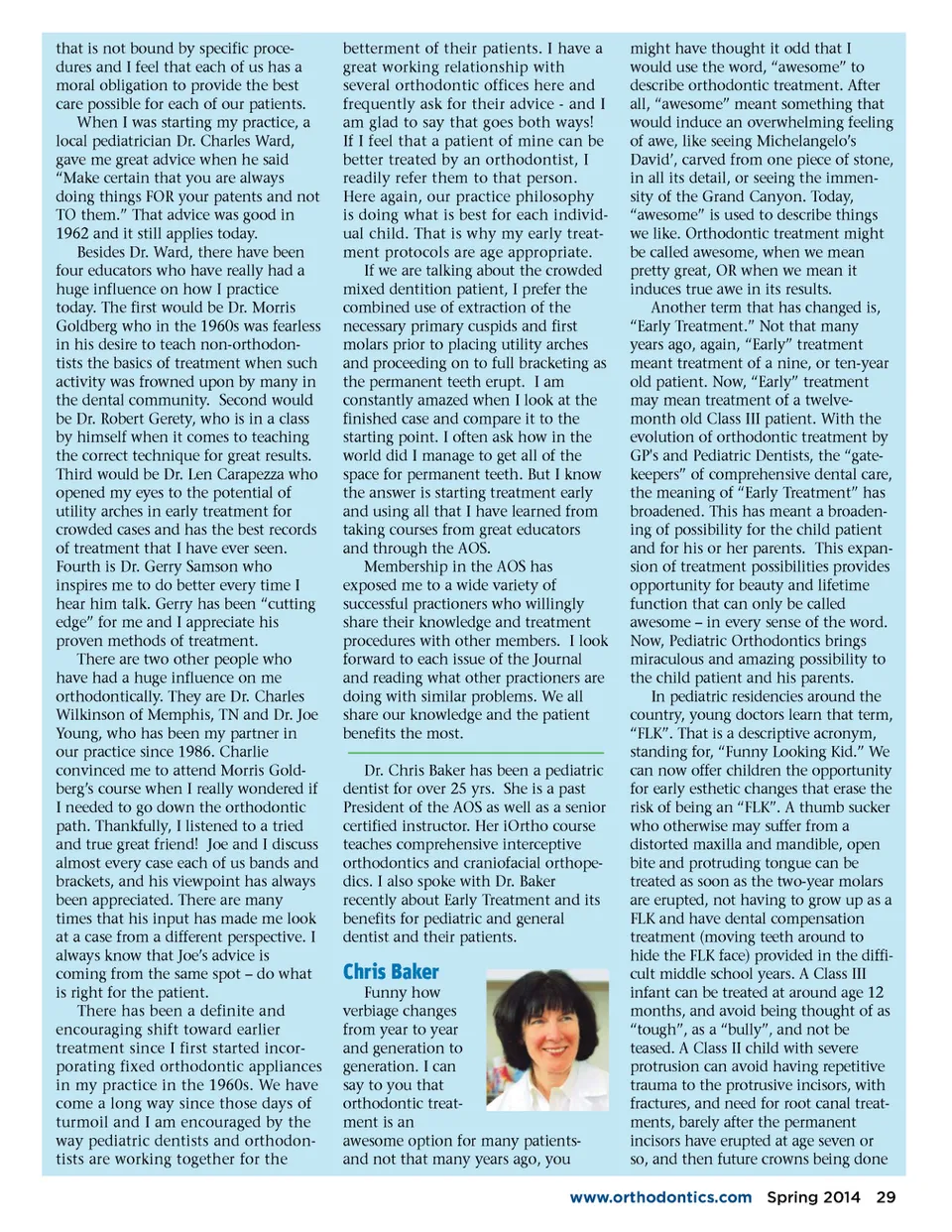
Early Treatment: Treatment: Pediatric Dentists Share Personal Experience of Treating Young Children and Reducing Orofacial Deformities By Greg Cannizzo, DDS, CDE, JAOS Editor The Value of M ost patients come to our office for the first time between the ages of three and four. This provides us with a window of opportunity to take advantage of their ideal growth potential since 60 percent of the head is formed by age nine. Thus, we have five years to evaluate and alter patterns of growth and devel-opment. Early treatment of these patients who present with develop-ing oral dysfunction can be given the chance to reach their potential for normal growth. The studies of Witzig and Spahl suggest that between the ages of 9 to 12 years of age, malocclusion becomes 25 percent worse or more severe. To help bring to light the importance of early treatment and the value of the Pedo Ortho Connection, I have assem-bled three pediatric dentists who have spent their careers using early treat-ment to take advantage of the ongoing growth of a child so that this growth could be used for their child’s maxi-mum advantage. These dental profes-sionals have provided orthodontics to their young patients for decades. By employing early treatment, they have been able to create both better smiles and lives for their patients. In this interview, I spoke with Dr. Heber Simmons, Jr., Dr. Leonard Cara-pezza, and Dr. Chris Baker. We discussed Early Treatment in their prac-tices, its benefits, and how it has helped their patients and practice as they moved from being tooth fixers to recognizing and stopping orofacial deformities before they become worse. Dr. Heber Simmons, Jr. has been a pediatric dentist for the last 52 years and a member of the American Orthodontic Society for 37 of those years. I recently spoke with him about what sparked his interest in Early Treatment and its benefits. Heber Simmons, Jr. I was not happy with the treatment modalities in the late 1960s which were slanted toward extraction of first bicuspids in crowded cases. I realized that there must be other meth-ods of treatment that resulted in beau-tiful faces with all permanent teeth intact. I started incorporating fixed orthodontic appliances in my practice in the late 1960s. Since that time, there has been a definite and encourag-ing shift toward earlier treatment. For me, early treatment would be better termed “age appropriate treat-ment” that is individualized for each child. That might be correcting a posterior cross bite in a 3-year-old child or unraveling the incisors on a 7-year-old or making room for all perma-nent teeth starting at 8 to 10 years of age. One thing I have learned is that each child is a distinct individual and should be treated according to their specific growth pattern. The age or stage of development to recommend Early Treatment is dependent on the stage of development for each child. That can vary between sibling and even fraternal twins. But one of the many benefits of early treatment is being able to maintain all of the permanent teeth resulting in a prettier or more handsome face. A patient’s perception of themselves is usually enhanced by early treatment which automatically produces a more self confident person. I have found that the practice of pediatric dentistry is a journey in learning and we need to continually try to expand our horizons in the care of our patients. The more we expose ourselves to tried and true methods of treatment the better care we can provide for our patients. When I talk with young pediatric dentists I urge them to take courses such as those provided by the AOS. Pediatric dentistry is an age related specialty 28 Spring 2014 JAOS
Journal of the American Orthodontic Society Spring 2014: Page 28