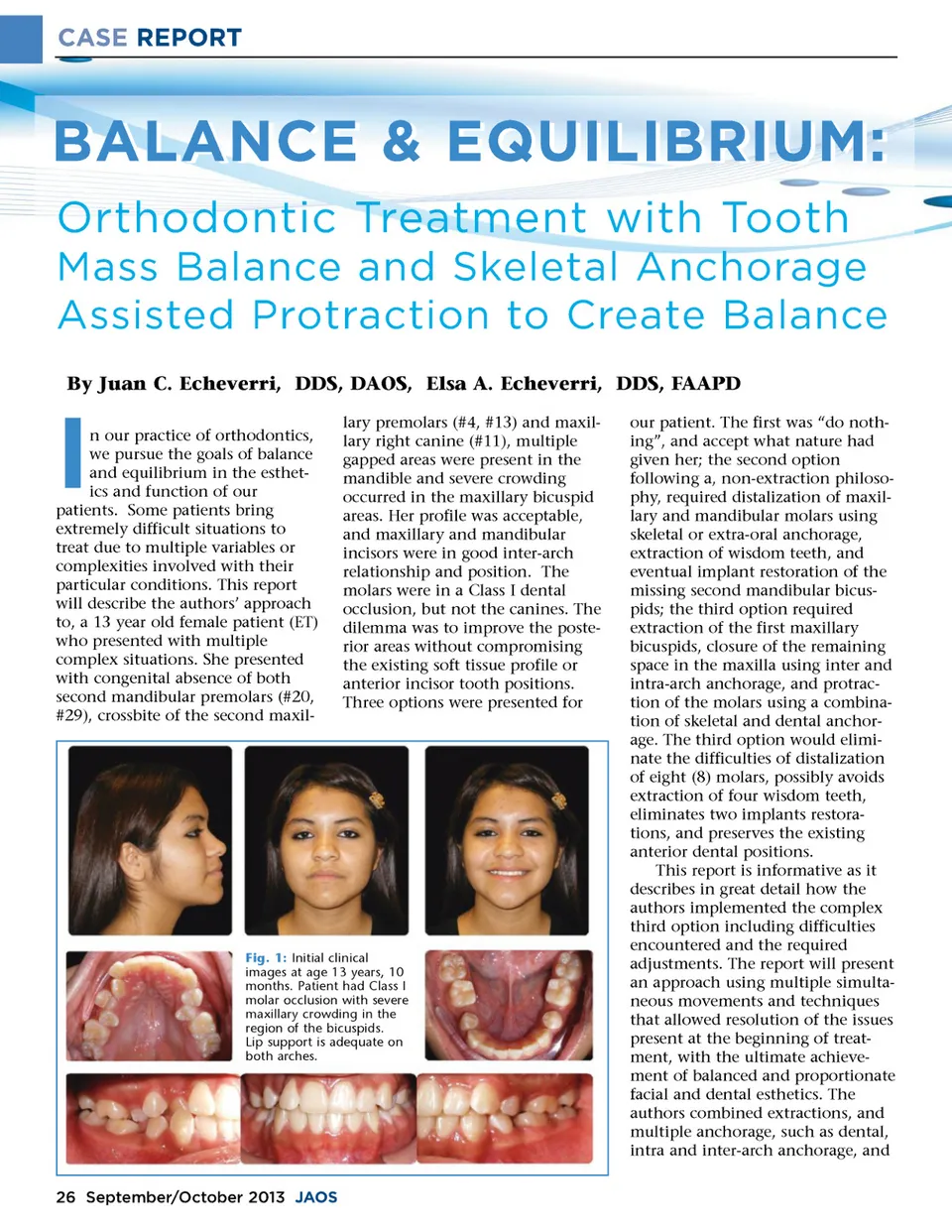
CASE REPORT BALANCE & EQUILIBRIUM: Orthodontic Treatment with Tooth Mass Balance and Skeletal Anchorage Assisted Protraction to Create Balance By Juan C. Echeverri, DDS, DAOS, Elsa A. Echeverri, DDS, FAAPD I n our practice of orthodontics, we pursue the goals of balance and equilibrium in the esthet-ics and function of our patients. Some patients bring extremely difficult situations to treat due to multiple variables or complexities involved with their particular conditions. This report will describe the authors’ approach to, a 13 year old female patient (ET) who presented with multiple complex situations. She presented with congenital absence of both second mandibular premolars (#20, #29), crossbite of the second maxil-lary premolars (#4, #13) and maxil-lary right canine (#11), multiple gapped areas were present in the mandible and severe crowding occurred in the maxillary bicuspid areas. Her profile was acceptable, and maxillary and mandibular incisors were in good inter-arch relationship and position. The molars were in a Class I dental occlusion, but not the canines. The dilemma was to improve the poste-rior areas without compromising the existing soft tissue profile or anterior incisor tooth positions. Three options were presented for Fig. 1: Initial clinical images at age 13 years, 10 months. Patient had Class I molar occlusion with severe maxillary crowding in the region of the bicuspids. Lip support is adequate on both arches. our patient. The first was “do noth-ing”, and accept what nature had given her; the second option following a, non-extraction philoso-phy, required distalization of maxil-lary and mandibular molars using skeletal or extra-oral anchorage, extraction of wisdom teeth, and eventual implant restoration of the missing second mandibular bicus-pids; the third option required extraction of the first maxillary bicuspids, closure of the remaining space in the maxilla using inter and intra-arch anchorage, and protrac-tion of the molars using a combina-tion of skeletal and dental anchor-age. The third option would elimi-nate the difficulties of distalization of eight (8) molars, possibly avoids extraction of four wisdom teeth, eliminates two implants restora-tions, and preserves the existing anterior dental positions. This report is informative as it describes in great detail how the authors implemented the complex third option including difficulties encountered and the required adjustments. The report will present an approach using multiple simulta-neous movements and techniques that allowed resolution of the issues present at the beginning of treat-ment, with the ultimate achieve-ment of balanced and proportionate facial and dental esthetics. The authors combined extractions, and multiple anchorage, such as dental, intra and inter-arch anchorage, and 26 September/October 2013 JAOS
Journal of the American Orthodontic Society September-October 2013: Page 26