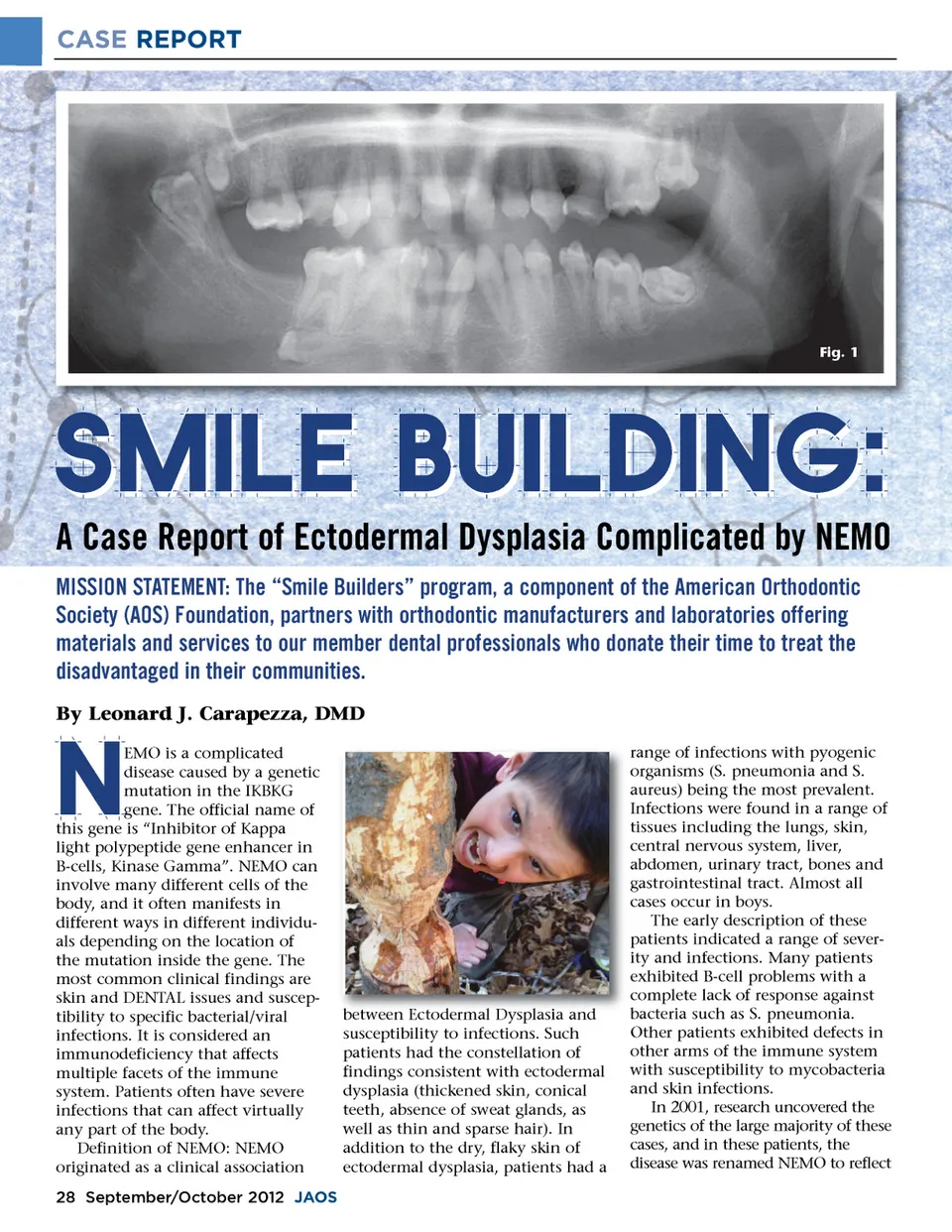
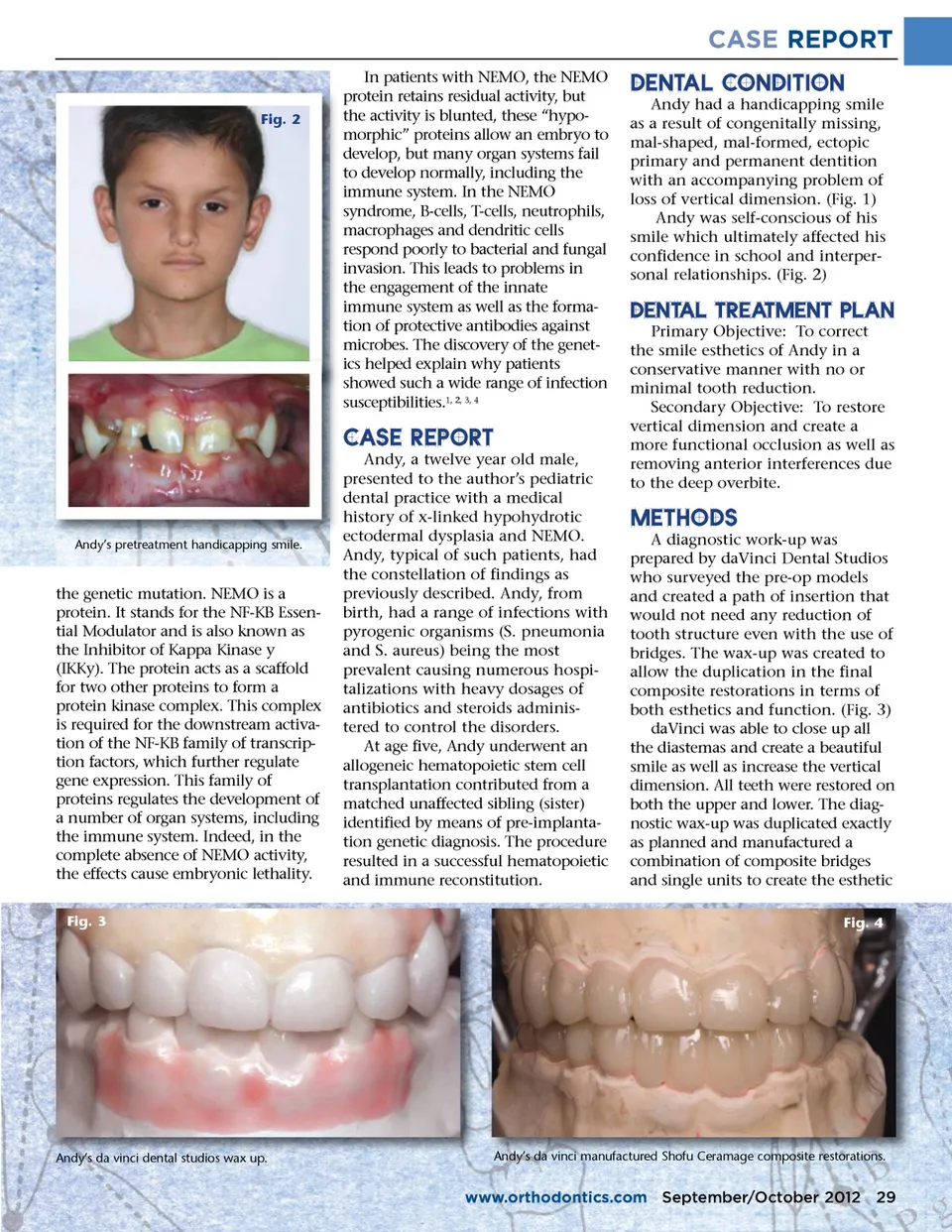
CASE REPORT Fig. 2 In patients with NEMO, the NEMO protein retains residual activity, but the activity is blunted, these “hypo-morphic” proteins allow an embryo to develop, but many organ systems fail to develop normally, including the immune system. In the NEMO syndrome, B-cells, T-cells, neutrophils, macrophages and dendritic cells respond poorly to bacterial and fungal invasion. This leads to problems in the engagement of the innate immune system as well as the forma-tion of protective antibodies against microbes. The discovery of the genet-ics helped explain why patients showed such a wide range of infection susceptibilities. 1, 2, 3, 4 DENTAL CONDITION Andy had a handicapping smile as a result of congenitally missing, mal-shaped, mal-formed, ectopic primary and permanent dentition with an accompanying problem of loss of vertical dimension. (Fig. 1) Andy was self-conscious of his smile which ultimately affected his confidence in school and interper-sonal relationships. (Fig. 2) DENTAL TREATMENT PLAN CASE REPORT Andy’s pretreatment handicapping smile. the genetic mutation. NEMO is a protein. It stands for the NF-KB Essen-tial Modulator and is also known as the Inhibitor of Kappa Kinase y (IKKy). The protein acts as a scaffold for two other proteins to form a protein kinase complex. This complex is required for the downstream activa-tion of the NF-KB family of transcrip-tion factors, which further regulate gene expression. This family of proteins regulates the development of a number of organ systems, including the immune system. Indeed, in the complete absence of NEMO activity, the effects cause embryonic lethality. Fig. 3 Andy, a twelve year old male, presented to the author’s pediatric dental practice with a medical history of x-linked hypohydrotic ectodermal dysplasia and NEMO. Andy, typical of such patients, had the constellation of findings as previously described. Andy, from birth, had a range of infections with pyrogenic organisms (S. pneumonia and S. aureus) being the most prevalent causing numerous hospi-talizations with heavy dosages of antibiotics and steroids adminis-tered to control the disorders. At age five, Andy underwent an allogeneic hematopoietic stem cell transplantation contributed from a matched unaffected sibling (sister) identified by means of pre-implanta-tion genetic diagnosis. The procedure resulted in a successful hematopoietic and immune reconstitution. Primary Objective: To correct the smile esthetics of Andy in a conservative manner with no or minimal tooth reduction. Secondary Objective: To restore vertical dimension and create a more functional occlusion as well as removing anterior interferences due to the deep overbite. METHODS A diagnostic work-up was prepared by daVinci Dental Studios who surveyed the pre-op models and created a path of insertion that would not need any reduction of tooth structure even with the use of bridges. The wax-up was created to allow the duplication in the final composite restorations in terms of both esthetics and function. (Fig. 3) daVinci was able to close up all the diastemas and create a beautiful smile as well as increase the vertical dimension. All teeth were restored on both the upper and lower. The diag-nostic wax-up was duplicated exactly as planned and manufactured a combination of composite bridges and single units to create the esthetic Fig. 4 Andy’s da vinci dental studios wax up. Andy’s da vinci manufactured Shofu Ceramage composite restorations. www.orthodontics.com September/October 2012 29
Journal of the American Orthodontic Society September-October 2012: Page 29