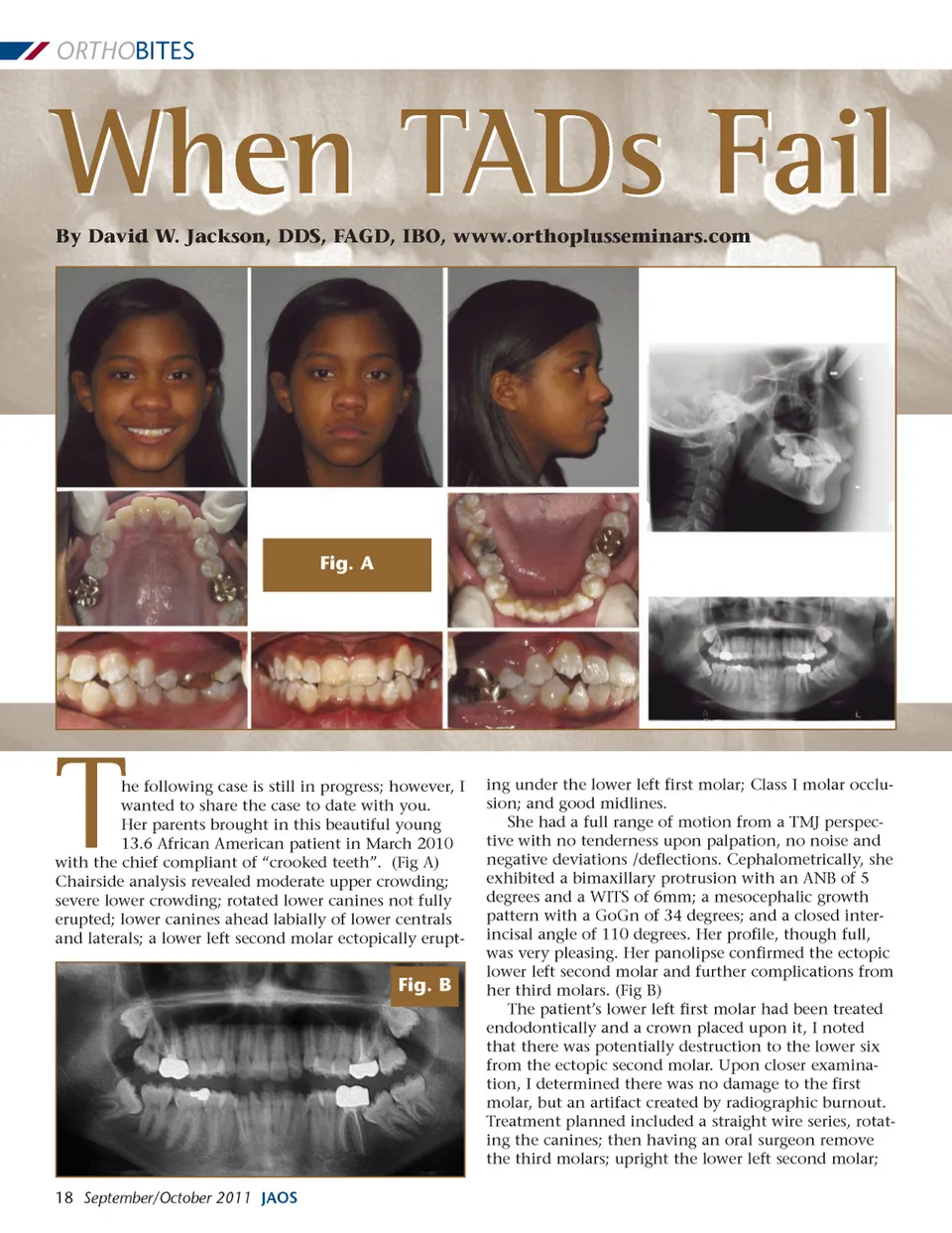
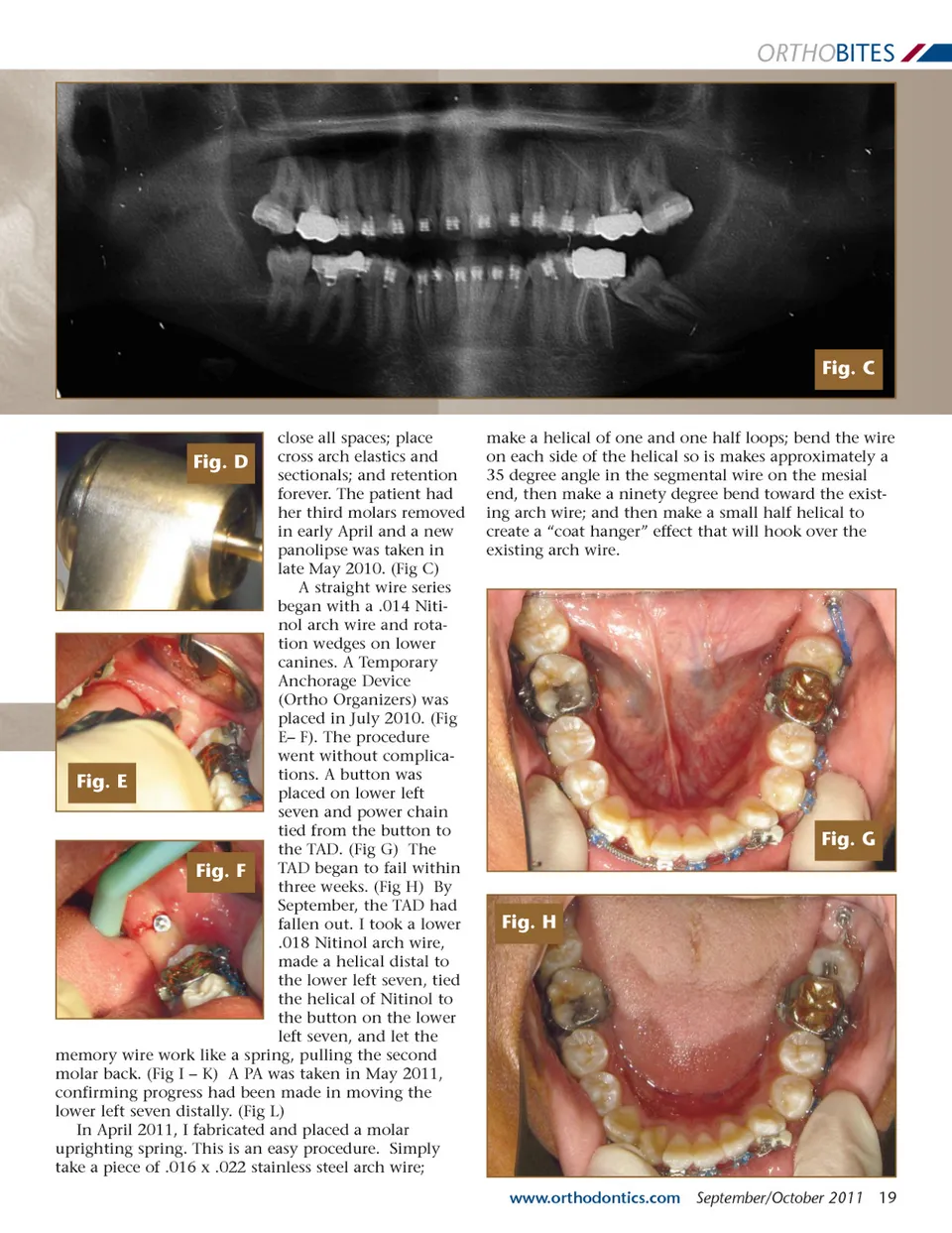
ORTHO BITES Fig. C close all spaces; place cross arch elastics and Fig. D sectionals; and retention forever. The patient had her third molars removed in early April and a new panolipse was taken in late May 2010. (Fig C) A straight wire series began with a .014 Niti-nol arch wire and rota-tion wedges on lower canines. A Temporary Anchorage Device (Ortho Organizers) was placed in July 2010. (Fig E– F). The procedure went without complica-tions. A button was Fig. E placed on lower left seven and power chain tied from the button to the TAD. (Fig G) The TAD began to fail within Fig. F three weeks. (Fig H) By September, the TAD had fallen out. I took a lower .018 Nitinol arch wire, made a helical distal to the lower left seven, tied the helical of Nitinol to the button on the lower left seven, and let the memory wire work like a spring, pulling the second molar back. (Fig I – K) A PA was taken in May 2011, confirming progress had been made in moving the lower left seven distally. (Fig L) In April 2011, I fabricated and placed a molar uprighting spring. This is an easy procedure. Simply take a piece of .016 x .022 stainless steel arch wire; make a helical of one and one half loops; bend the wire on each side of the helical so is makes approximately a 35 degree angle in the segmental wire on the mesial end, then make a ninety degree bend toward the exist-ing arch wire; and then make a small half helical to create a “coat hanger” effect that will hook over the existing arch wire. Fig. G Fig. H www.orthodontics.com September/October 2011 19
Journal of the American Orthodontic Society September-October 2011: Page 19