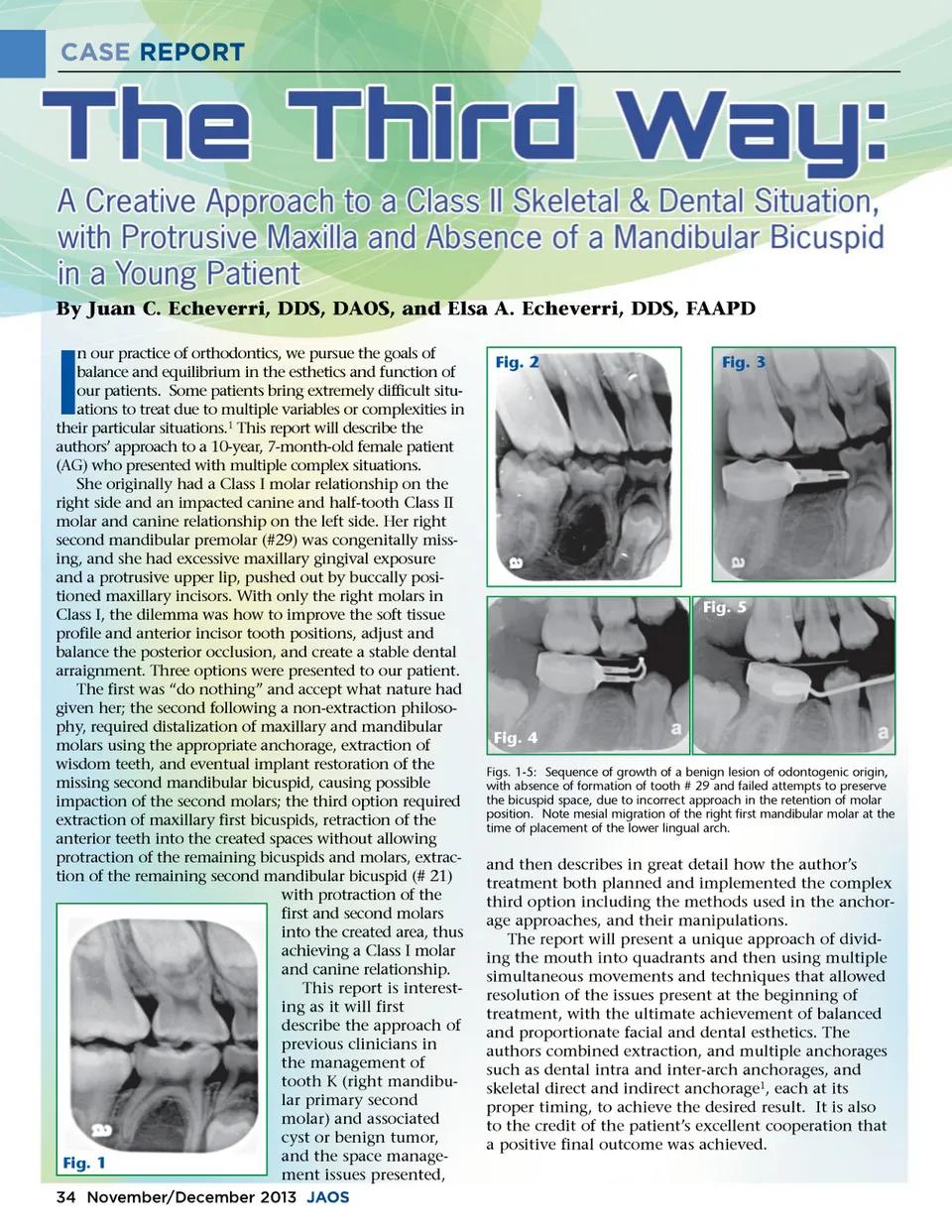
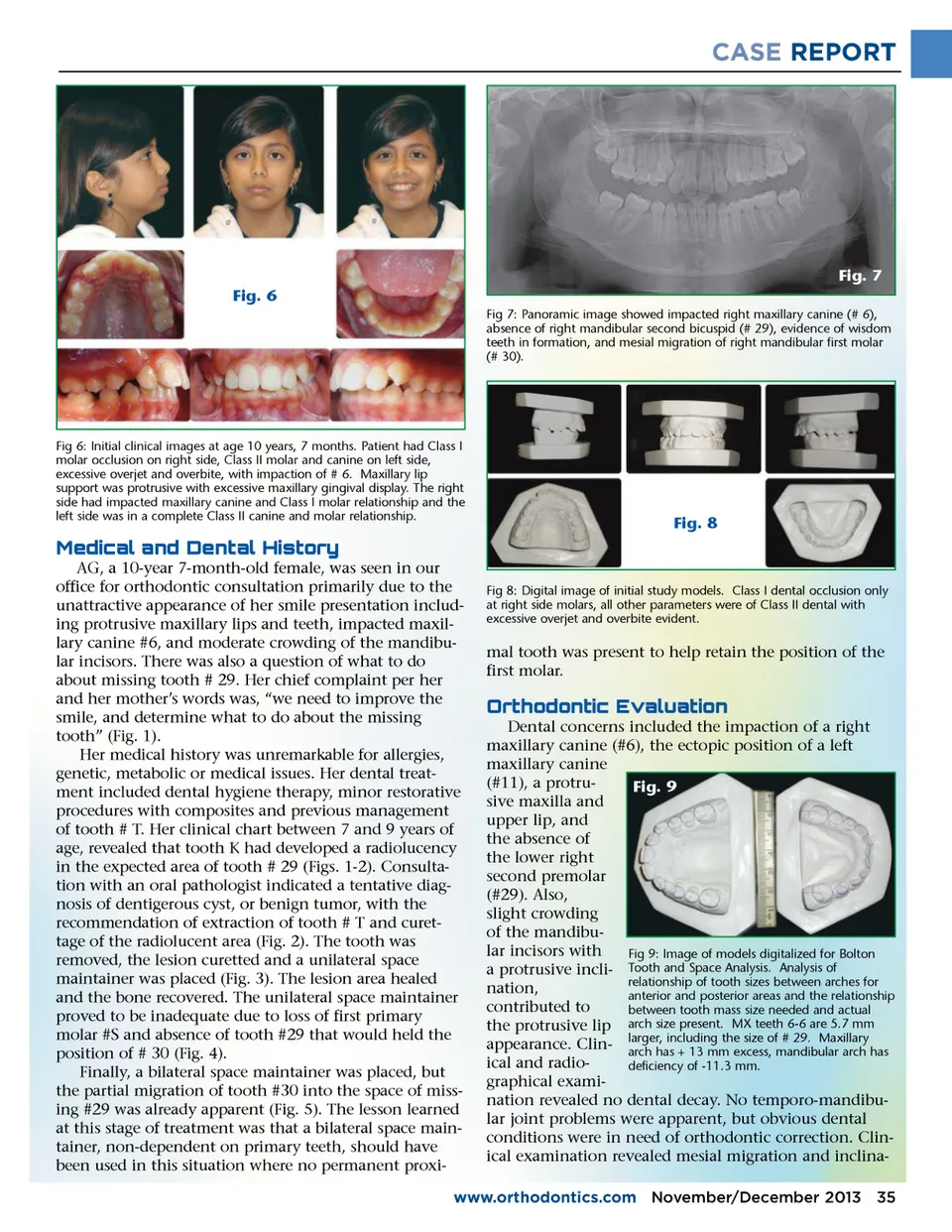
CASE REPORT By Juan C. Echeverri, DDS, DAOS, and Elsa A. Echeverri, DDS, FAAPD n our practice of orthodontics, we pursue the goals of balance and equilibrium in the esthetics and function of our patients. Some patients bring extremely difficult situ-ations to treat due to multiple variables or complexities in their particular situations. 1 This report will describe the authors’ approach to a 10-year, 7-month-old female patient (AG) who presented with multiple complex situations. She originally had a Class I molar relationship on the right side and an impacted canine and half-tooth Class II molar and canine relationship on the left side. Her right second mandibular premolar (#29) was congenitally miss-ing, and she had excessive maxillary gingival exposure and a protrusive upper lip, pushed out by buccally posi-tioned maxillary incisors. With only the right molars in Class I, the dilemma was how to improve the soft tissue profile and anterior incisor tooth positions, adjust and balance the posterior occlusion, and create a stable dental arraignment. Three options were presented to our patient. The first was “do nothing” and accept what nature had given her; the second following a non-extraction philoso-phy, required distalization of maxillary and mandibular molars using the appropriate anchorage, extraction of wisdom teeth, and eventual implant restoration of the missing second mandibular bicuspid, causing possible impaction of the second molars; the third option required extraction of maxillary first bicuspids, retraction of the anterior teeth into the created spaces without allowing protraction of the remaining bicuspids and molars, extrac-tion of the remaining second mandibular bicuspid (# 21) with protraction of the first and second molars into the created area, thus achieving a Class I molar and canine relationship. This report is interest-ing as it will first describe the approach of previous clinicians in the management of tooth K (right mandibu-lar primary second molar) and associated cyst or benign tumor, and the space manage-Fig. 1 ment issues presented, 34 November/December 2013 JAOS  Fig. 2 Fig. 3 Fig. 5 Fig. 4 Figs. 1-5: Sequence of growth of a benign lesion of odontogenic origin, with absence of formation of tooth # 29 and failed attempts to preserve the bicuspid space, due to incorrect approach in the retention of molar position. Note mesial migration of the right first mandibular molar at the time of placement of the lower lingual arch. and then describes in great detail how the author’s treatment both planned and implemented the complex third option including the methods used in the anchor-age approaches, and their manipulations. The report will present a unique approach of divid-ing the mouth into quadrants and then using multiple simultaneous movements and techniques that allowed resolution of the issues present at the beginning of treatment, with the ultimate achievement of balanced and proportionate facial and dental esthetics. The authors combined extraction, and multiple anchorages such as dental intra and inter-arch anchorages, and skeletal direct and indirect anchorage 1 , each at its proper timing, to achieve the desired result. It is also to the credit of the patient’s excellent cooperation that a positive final outcome was achieved.
Journal of the American Orthodontic Society November-December 2013: Page 34