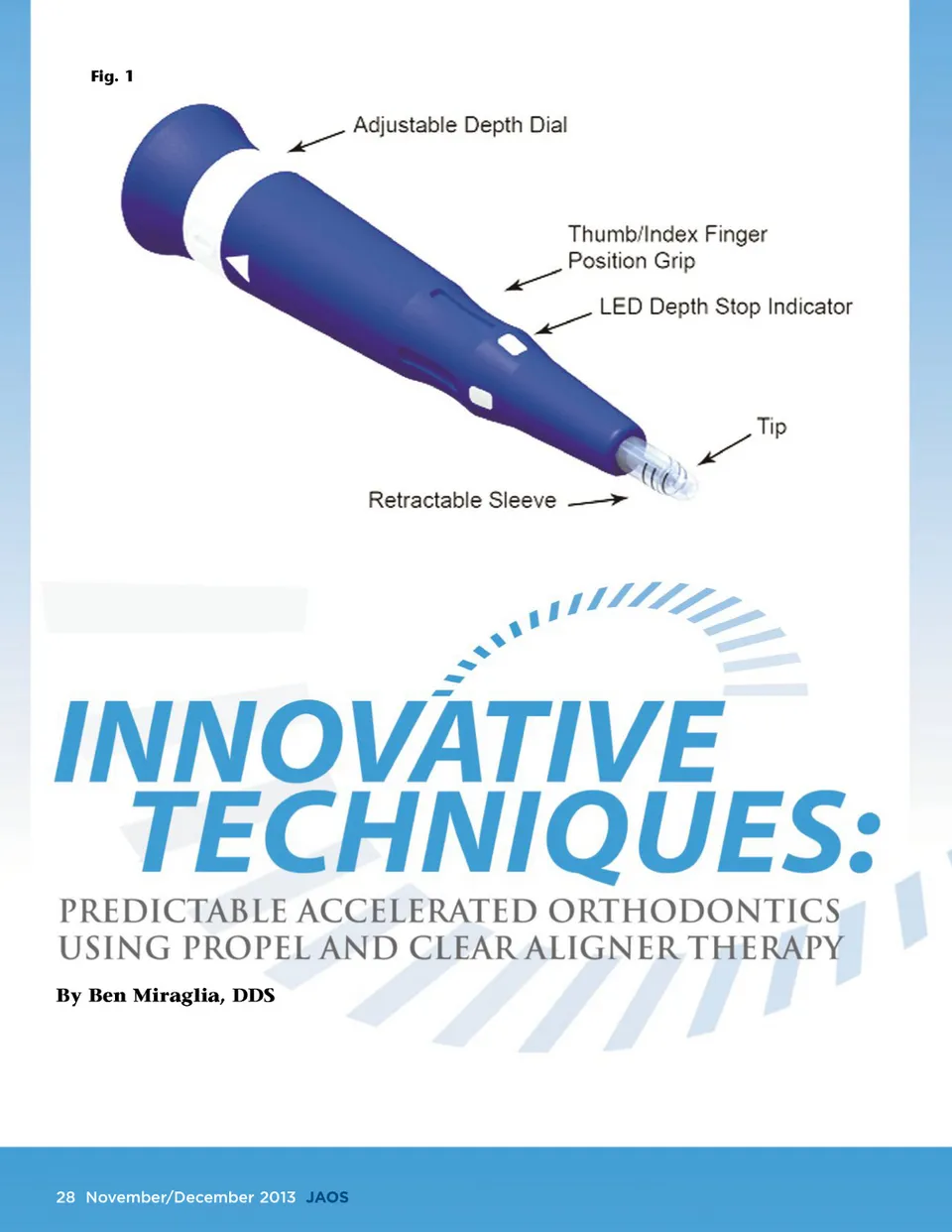
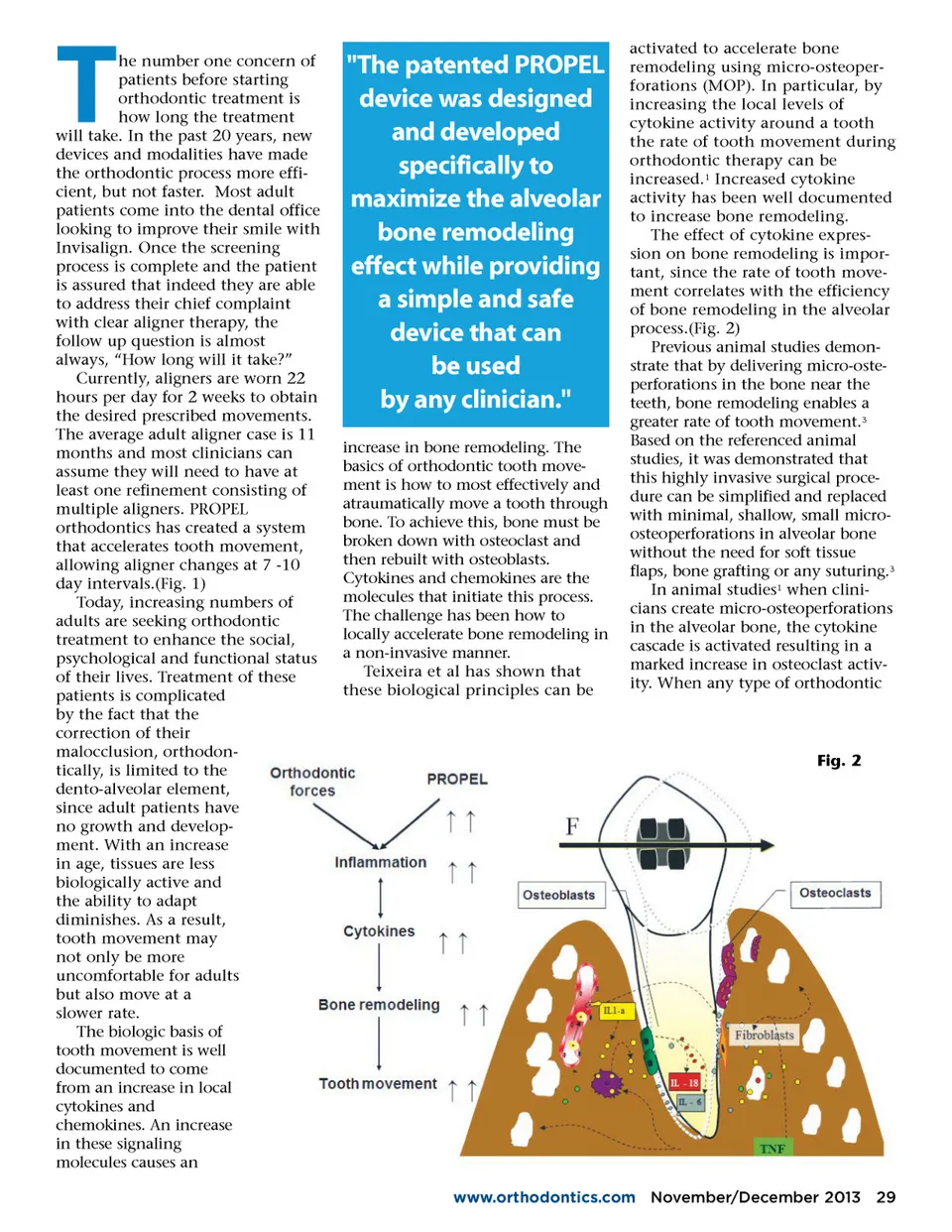
he number one concern of patients before starting orthodontic treatment is how long the treatment will take. In the past 20 years, new devices and modalities have made the orthodontic process more effi-cient, but not faster. Most adult patients come into the dental office looking to improve their smile with Invisalign. Once the screening process is complete and the patient is assured that indeed they are able to address their chief complaint with clear aligner therapy, the follow up question is almost always, “How long will it take?” Currently, aligners are worn 22 hours per day for 2 weeks to obtain the desired prescribed movements. The average adult aligner case is 11 months and most clinicians can assume they will need to have at least one refinement consisting of multiple aligners. PROPEL orthodontics has created a system that accelerates tooth movement, allowing aligner changes at 7 -10 day intervals.(Fig. 1) Today, increasing numbers of adults are seeking orthodontic treatment to enhance the social, psychological and functional status of their lives. Treatment of these patients is complicated by the fact that the correction of their malocclusion, orthodon-tically, is limited to the dento-alveolar element, since adult patients have no growth and develop-ment. With an increase in age, tissues are less biologically active and the ability to adapt diminishes. As a result, tooth movement may not only be more uncomfortable for adults but also move at a slower rate. The biologic basis of tooth movement is well documented to come from an increase in local cytokines and chemokines. An increase in these signaling molecules causes an T "The patented PROPEL device was designed and developed specifically to maximize the alveolar bone remodeling effect while providing a simple and safe device that can be used by any clinician." increase in bone remodeling. The basics of orthodontic tooth move-ment is how to most effectively and atraumatically move a tooth through bone. To achieve this, bone must be broken down with osteoclast and then rebuilt with osteoblasts. Cytokines and chemokines are the molecules that initiate this process. The challenge has been how to locally accelerate bone remodeling in a non-invasive manner. Teixeira et al has shown that these biological principles can be activated to accelerate bone remodeling using micro-osteoper-forations (MOP). In particular, by increasing the local levels of cytokine activity around a tooth the rate of tooth movement during orthodontic therapy can be increased. 1 Increased cytokine activity has been well documented to increase bone remodeling. The effect of cytokine expres-sion on bone remodeling is impor-tant, since the rate of tooth move-ment correlates with the efficiency of bone remodeling in the alveolar process.(Fig. 2) Previous animal studies demon-strate that by delivering micro-oste-perforations in the bone near the teeth, bone remodeling enables a greater rate of tooth movement. 3 Based on the referenced animal studies, it was demonstrated that this highly invasive surgical proce-dure can be simplified and replaced with minimal, shallow, small micro-osteoperforations in alveolar bone without the need for soft tissue flaps, bone grafting or any suturing. 3 In animal studies 1 when clini-cians create micro-osteoperforations in the alveolar bone, the cytokine cascade is activated resulting in a marked increase in osteoclast activ-ity. When any type of orthodontic Fig. 2 www.orthodontics.com November/December 2013 29
Journal of the American Orthodontic Society November-December 2013: Page 29