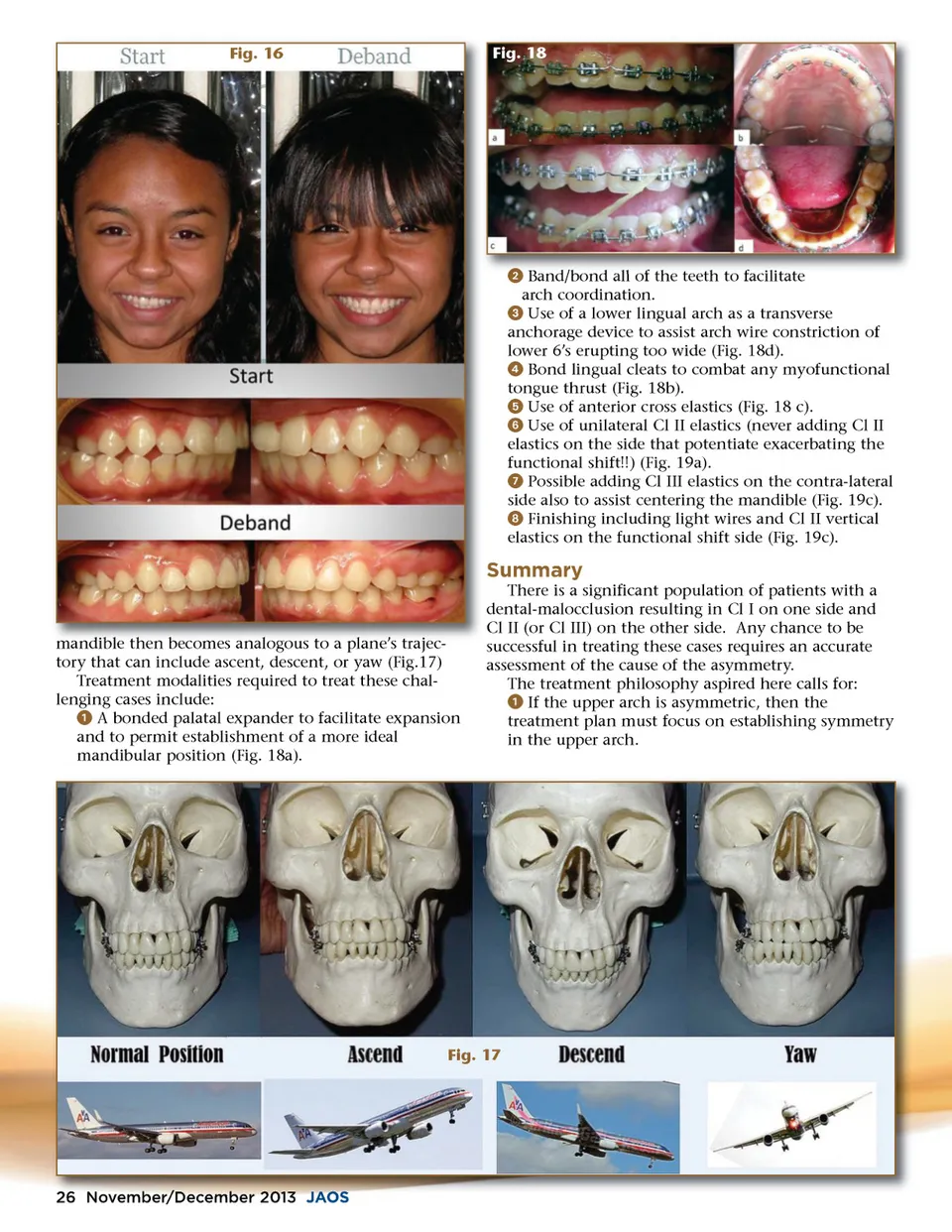
ᕢ If the lower arch is asymmetric, then the treatment plan must focus on establishing symmetry in the lower arch ᕣ Establish a symmetrical position of the mandible relative to the cranial base ᕤ If there are multiple asymmetric problems, then each must be addressed independently to have the case come together esthetically and functionally. Fig. 19 References 1. Miller EL, Bodden WR Jr, Jamison HC. A study of the relationship of the dental midline to the facial median line. J Prosthet Dent 1979;41(6):657–60. 2. Chan RW, Ker AJ, Fields HW, Beck FM, Rosenstiel SF, Johnston W. 0366 Esthetics and smile characteristics from the patient’s perspective, part II. Retrieved from: http://iadr.confex.com/iadr/2008Dallas/techprogram/abstract_100 215.htm. 3. Scanavini PE, Paranhos LR, Torres FC, Vasconcelos MHF, Jóias RP, Scanavini MA. Evaluation of the dental arch asymmetry in natural normal occlusion and Class II malocclusion individuals. Dental Press J Orthod. 2012 Jan-Feb;17(1):125-37. 4. Gill DS, Lee RT, Tredwin CJ. Treatment planning for the loss of first permanent molars. Dent Update 2001; 28(6):304–8. 5. Hallett GEM, Burke PH. Symmetrical extraction of first permanent molars. Factors controlling results in the lower arch. Trans Eur Orthod Soc 1961; 238–255. 6. Chia, M.S.Y., F.B. Naini and D.S. Gill, 2008. The Aetiology, Diag-nosis and Management of Mandibular Asymmetry. Ortho Update, 1: 44-52. 7. Maurice TJ, Kula K. Dental arch asymmetry in the mixed denti-tion. Angle Orthod 1998;68:37-44. 8. Proffit WR. Contemporary orthodontics. St. Louis: Mosby Year Book, 1993:154. www.orthodontics.com November/December 2013 27
Journal of the American Orthodontic Society November-December 2013: Page 27