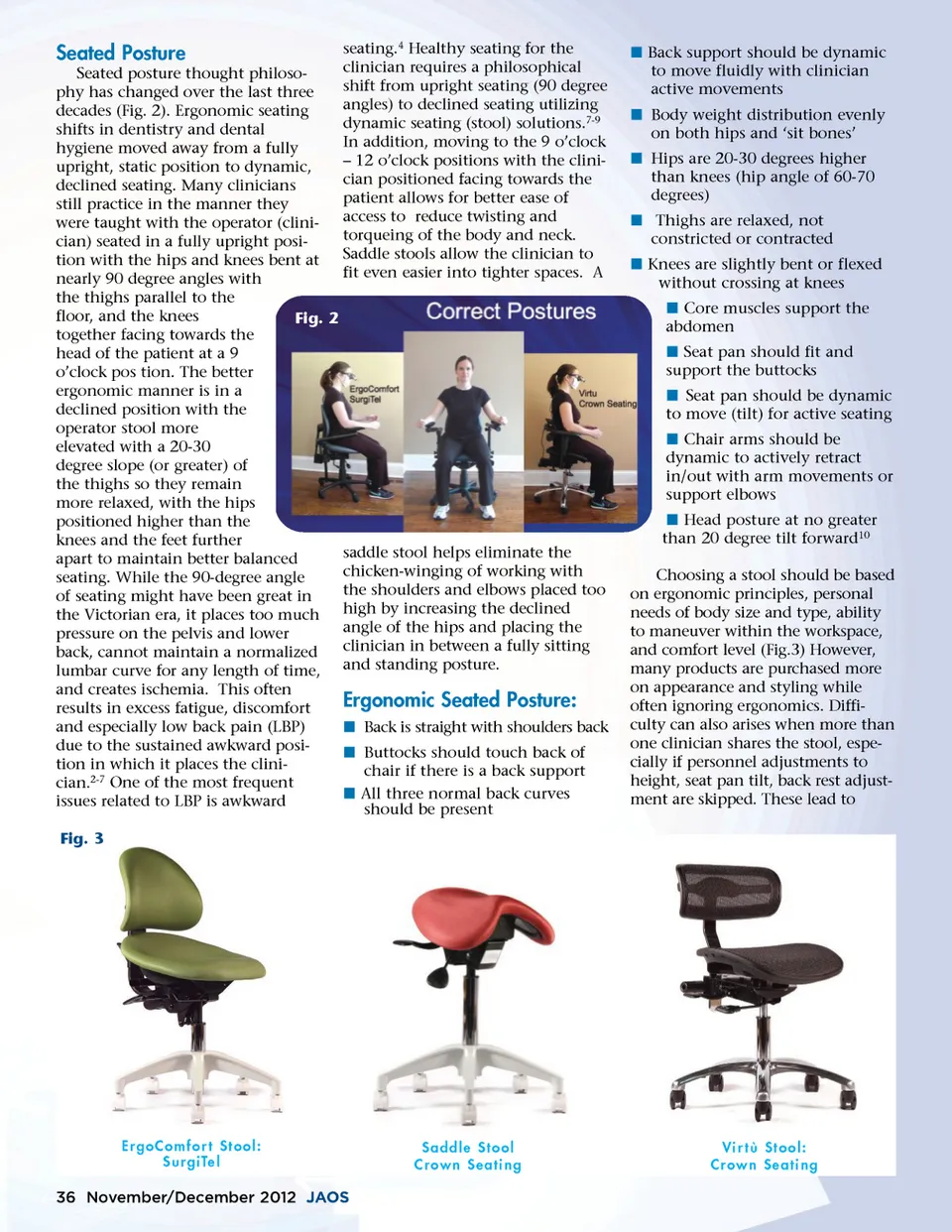
Seated Posture Seated posture thought philoso-phy has changed over the last three decades (Fig. 2). Ergonomic seating shifts in dentistry and dental hygiene moved away from a fully upright, static position to dynamic, declined seating. Many clinicians still practice in the manner they were taught with the operator (clini-cian) seated in a fully upright posi-tion with the hips and knees bent at nearly 90 degree angles with the thighs parallel to the floor, and the knees Fig. 2 together facing towards the head of the patient at a 9 o’clock pos tion. The better ergonomic manner is in a declined position with the operator stool more elevated with a 20-30 degree slope (or greater) of the thighs so they remain more relaxed, with the hips positioned higher than the knees and the feet further saddle stool helps eliminate the apart to maintain better balanced chicken-winging of working with seating. While the 90-degree angle the shoulders and elbows placed too of seating might have been great in high by increasing the declined the Victorian era, it places too much angle of the hips and placing the pressure on the pelvis and lower clinician in between a fully sitting back, cannot maintain a normalized lumbar curve for any length of time, and standing posture. and creates ischemia. This often Ergonomic Seated Posture: results in excess fatigue, discomfort and especially low back pain (LBP) í Back is straight with shoulders back due to the sustained awkward posi-í Buttocks should touch back of tion in which it places the clini-chair if there is a back support cian. 2-7 One of the most frequent í All three normal back curves issues related to LBP is awkward should be present Fig. 3 seating. 4 Healthy seating for the clinician requires a philosophical shift from upright seating (90 degree angles) to declined seating utilizing dynamic seating (stool) solutions. 7-9 In addition, moving to the 9 o’clock – 12 o’clock positions with the clini-cian positioned facing towards the patient allows for better ease of access to reduce twisting and torqueing of the body and neck. Saddle stools allow the clinician to fit even easier into tighter spaces. A í Back support should be dynamic to move fluidly with clinician active movements í Body weight distribution evenly on both hips and ‘sit bones’ í Hips are 20-30 degrees higher than knees (hip angle of 60-70 degrees) í Thighs are relaxed, not constricted or contracted í Knees are slightly bent or flexed without crossing at knees í Core muscles support the abdomen í Seat pan should fit and support the buttocks í Seat pan should be dynamic to move (tilt) for active seating í Chair arms should be dynamic to actively retract in/out with arm movements or support elbows í Head posture at no greater than 20 degree tilt forward 10 Choosing a stool should be based on ergonomic principles, personal needs of body size and type, ability to maneuver within the workspace, and comfort level (Fig.3) However, many products are purchased more on appearance and styling while often ignoring ergonomics. Diffi-culty can also arises when more than one clinician shares the stool, espe-cially if personnel adjustments to height, seat pan tilt, back rest adjust-ment are skipped. These lead to ErgoComfor t Stool: SurgiTel Saddle Stool Crown Seating Vir t ù Stool: Crown Seating 36 November/December 2012 JAOS
Journal of the American Orthodontic Society November-December 2012: Page 36