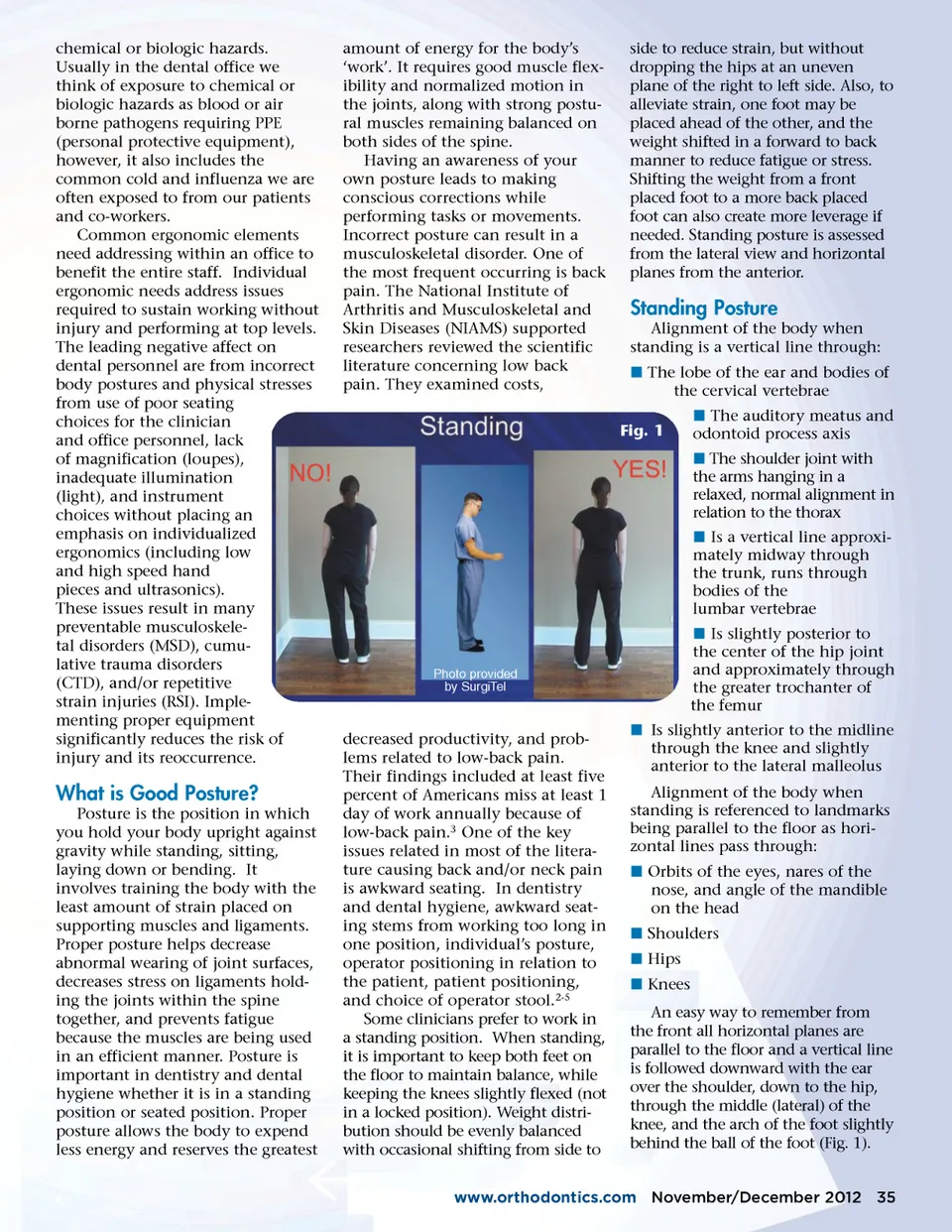
chemical or biologic hazards. Usually in the dental office we think of exposure to chemical or biologic hazards as blood or air borne pathogens requiring PPE (personal protective equipment), however, it also includes the common cold and influenza we are often exposed to from our patients and co-workers. Common ergonomic elements need addressing within an office to benefit the entire staff. Individual ergonomic needs address issues required to sustain working without injury and performing at top levels. The leading negative affect on dental personnel are from incorrect body postures and physical stresses from use of poor seating choices for the clinician and office personnel, lack of magnification (loupes), inadequate illumination (light), and instrument choices without placing an emphasis on individualized ergonomics (including low and high speed hand pieces and ultrasonics). These issues result in many preventable musculoskele-tal disorders (MSD), cumu-lative trauma disorders (CTD), and/or repetitive strain injuries (RSI). Imple-menting proper equipment significantly reduces the risk of injury and its reoccurrence. amount of energy for the body’s ‘work’. It requires good muscle flex-ibility and normalized motion in the joints, along with strong postu-ral muscles remaining balanced on both sides of the spine. Having an awareness of your own posture leads to making conscious corrections while performing tasks or movements. Incorrect posture can result in a musculoskeletal disorder. One of the most frequent occurring is back pain. The National Institute of Arthritis and Musculoskeletal and Skin Diseases (NIAMS) supported researchers reviewed the scientific literature concerning low back pain. They examined costs, side to reduce strain, but without dropping the hips at an uneven plane of the right to left side. Also, to alleviate strain, one foot may be placed ahead of the other, and the weight shifted in a forward to back manner to reduce fatigue or stress. Shifting the weight from a front placed foot to a more back placed foot can also create more leverage if needed. Standing posture is assessed from the lateral view and horizontal planes from the anterior. Standing Posture Alignment of the body when standing is a vertical line through: í The lobe of the ear and bodies of the cervical vertebrae Fig. 1 í The auditory meatus and odontoid process axis í The shoulder joint with the arms hanging in a relaxed, normal alignment in relation to the thorax í Is a vertical line approxi-mately midway through the trunk, runs through bodies of the lumbar vertebrae í Is slightly posterior to the center of the hip joint and approximately through the greater trochanter of the femur í Is slightly anterior to the midline through the knee and slightly anterior to the lateral malleolus Alignment of the body when standing is referenced to landmarks being parallel to the floor as hori-zontal lines pass through: í Orbits of the eyes, nares of the nose, and angle of the mandible on the head í Shoulders í Hips í Knees An easy way to remember from the front all horizontal planes are parallel to the floor and a vertical line is followed downward with the ear over the shoulder, down to the hip, through the middle (lateral) of the knee, and the arch of the foot slightly behind the ball of the foot (Fig. 1). Photo provided by SurgiTel What is Good Posture? Posture is the position in which you hold your body upright against gravity while standing, sitting, laying down or bending. It involves training the body with the least amount of strain placed on supporting muscles and ligaments. Proper posture helps decrease abnormal wearing of joint surfaces, decreases stress on ligaments hold-ing the joints within the spine together, and prevents fatigue because the muscles are being used in an efficient manner. Posture is important in dentistry and dental hygiene whether it is in a standing position or seated position. Proper posture allows the body to expend less energy and reserves the greatest decreased productivity, and prob-lems related to low-back pain. Their findings included at least five percent of Americans miss at least 1 day of work annually because of low-back pain. 3 One of the key issues related in most of the litera-ture causing back and/or neck pain is awkward seating. In dentistry and dental hygiene, awkward seat-ing stems from working too long in one position, individual’s posture, operator positioning in relation to the patient, patient positioning, and choice of operator stool. 2-5 Some clinicians prefer to work in a standing position. When standing, it is important to keep both feet on the floor to maintain balance, while keeping the knees slightly flexed (not in a locked position). Weight distri-bution should be evenly balanced with occasional shifting from side to www.orthodontics.com November/December 2012 35
Journal of the American Orthodontic Society November-December 2012: Page 35