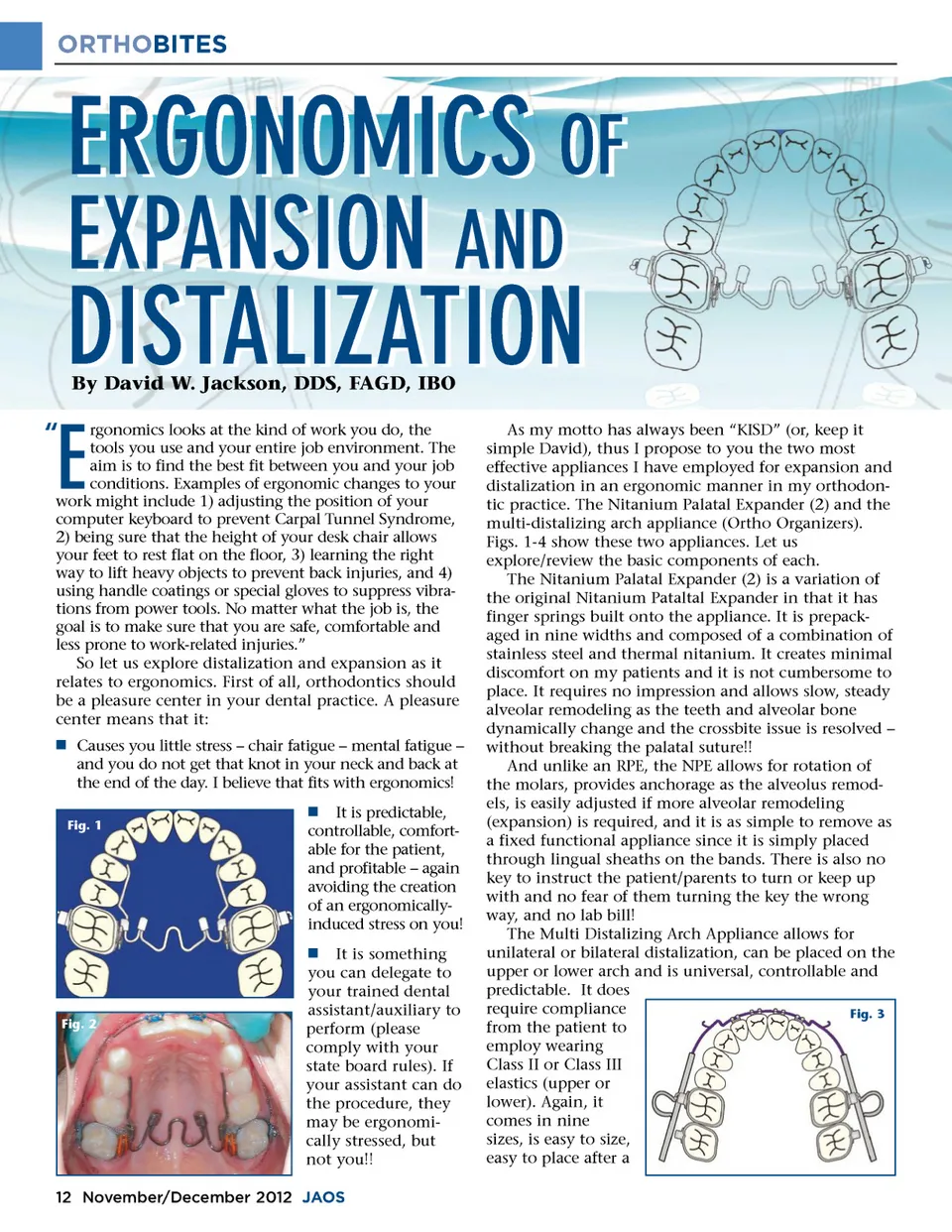
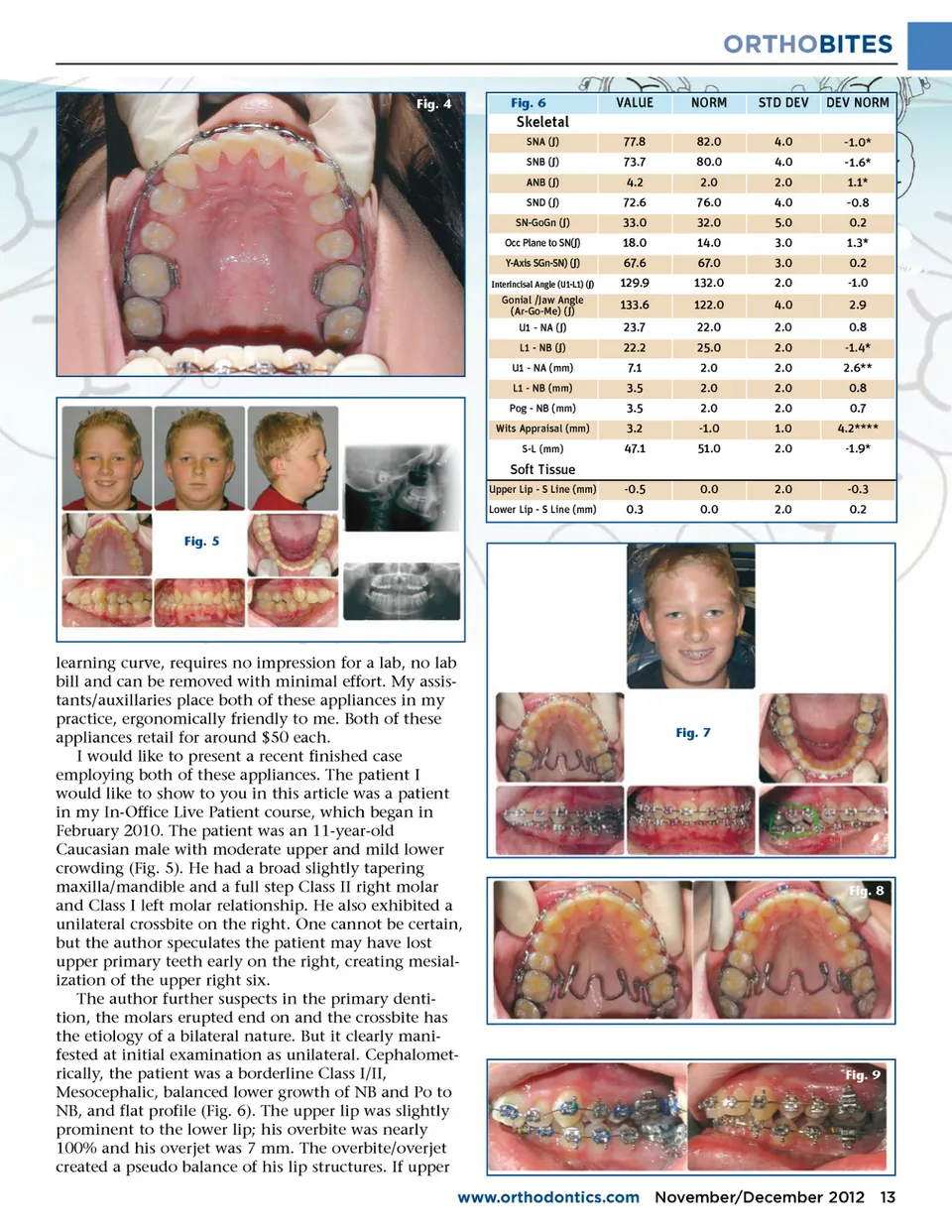
ORTHOBITES EXPANSION AND By David W. Jackson, DDS, FAGD, IBO ERGONOMICS OF As my motto has always been “KISD” (or, keep it simple David), thus I propose to you the two most effective appliances I have employed for expansion and distalization in an ergonomic manner in my orthodon-tic practice. The Nitanium Palatal Expander (2) and the multi-distalizing arch appliance (Ortho Organizers). Figs. 1-4 show these two appliances. Let us explore/review the basic components of each. The Nitanium Palatal Expander (2) is a variation of the original Nitanium Pataltal Expander in that it has finger springs built onto the appliance. It is prepack-aged in nine widths and composed of a combination of stainless steel and thermal nitanium. It creates minimal discomfort on my patients and it is not cumbersome to place. It requires no impression and allows slow, steady alveolar remodeling as the teeth and alveolar bone dynamically change and the crossbite issue is resolved – without breaking the palatal suture!! And unlike an RPE, the NPE allows for rotation of the molars, provides anchorage as the alveolus remod-els, is easily adjusted if more alveolar remodeling (expansion) is required, and it is as simple to remove as a fixed functional appliance since it is simply placed through lingual sheaths on the bands. There is also no key to instruct the patient/parents to turn or keep up with and no fear of them turning the key the wrong way, and no lab bill! The Multi Distalizing Arch Appliance allows for unilateral or bilateral distalization, can be placed on the upper or lower arch and is universal, controllable and predictable. It does require compliance Fig. 3 from the patient to employ wearing Class II or Class III elastics (upper or lower). Again, it comes in nine sizes, is easy to size, easy to place after a DISTALIZATION “ E rgonomics looks at the kind of work you do, the tools you use and your entire job environment. The aim is to find the best fit between you and your job conditions. Examples of ergonomic changes to your work might include 1) adjusting the position of your computer keyboard to prevent Carpal Tunnel Syndrome, 2) being sure that the height of your desk chair allows your feet to rest flat on the floor, 3) learning the right way to lift heavy objects to prevent back injuries, and 4) using handle coatings or special gloves to suppress vibra-tions from power tools. No matter what the job is, the goal is to make sure that you are safe, comfortable and less prone to work-related injuries.” So let us explore distalization and expansion as it relates to ergonomics. First of all, orthodontics should be a pleasure center in your dental practice. A pleasure center means that it: Causes you little stress – chair fatigue – mental fatigue – and you do not get that knot in your neck and back at the end of the day. I believe that fits with ergonomics! Fig. 1 It is predictable, controllable, comfort-able for the patient, and profitable – again avoiding the creation of an ergonomically-induced stress on you! It is something you can delegate to your trained dental assistant/auxiliary to perform (please comply with your state board rules). If your assistant can do the procedure, they may be ergonomi-cally stressed, but not you!! Fig. 2 12 November/December 2012 JAOS
Journal of the American Orthodontic Society November-December 2012: Page 12