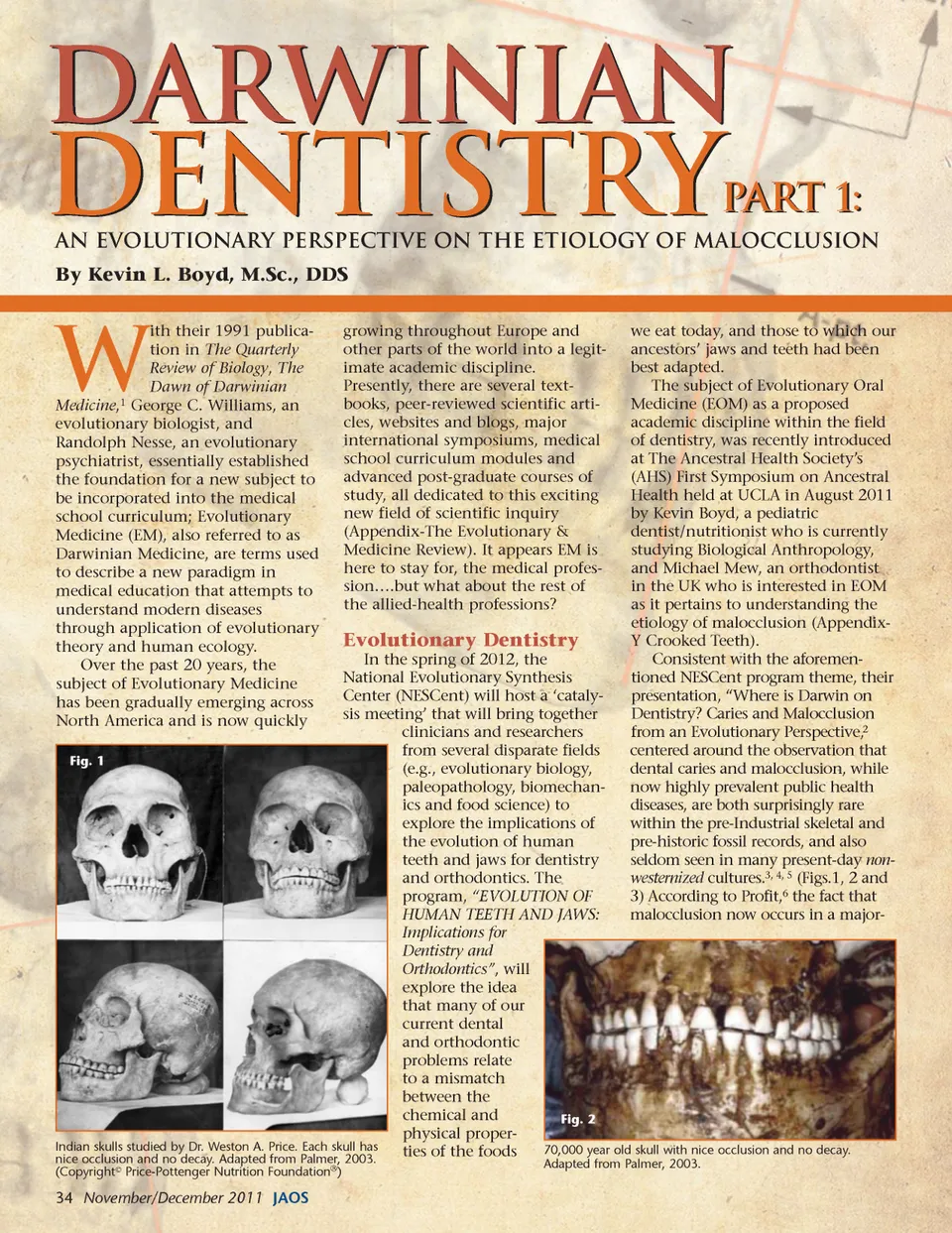
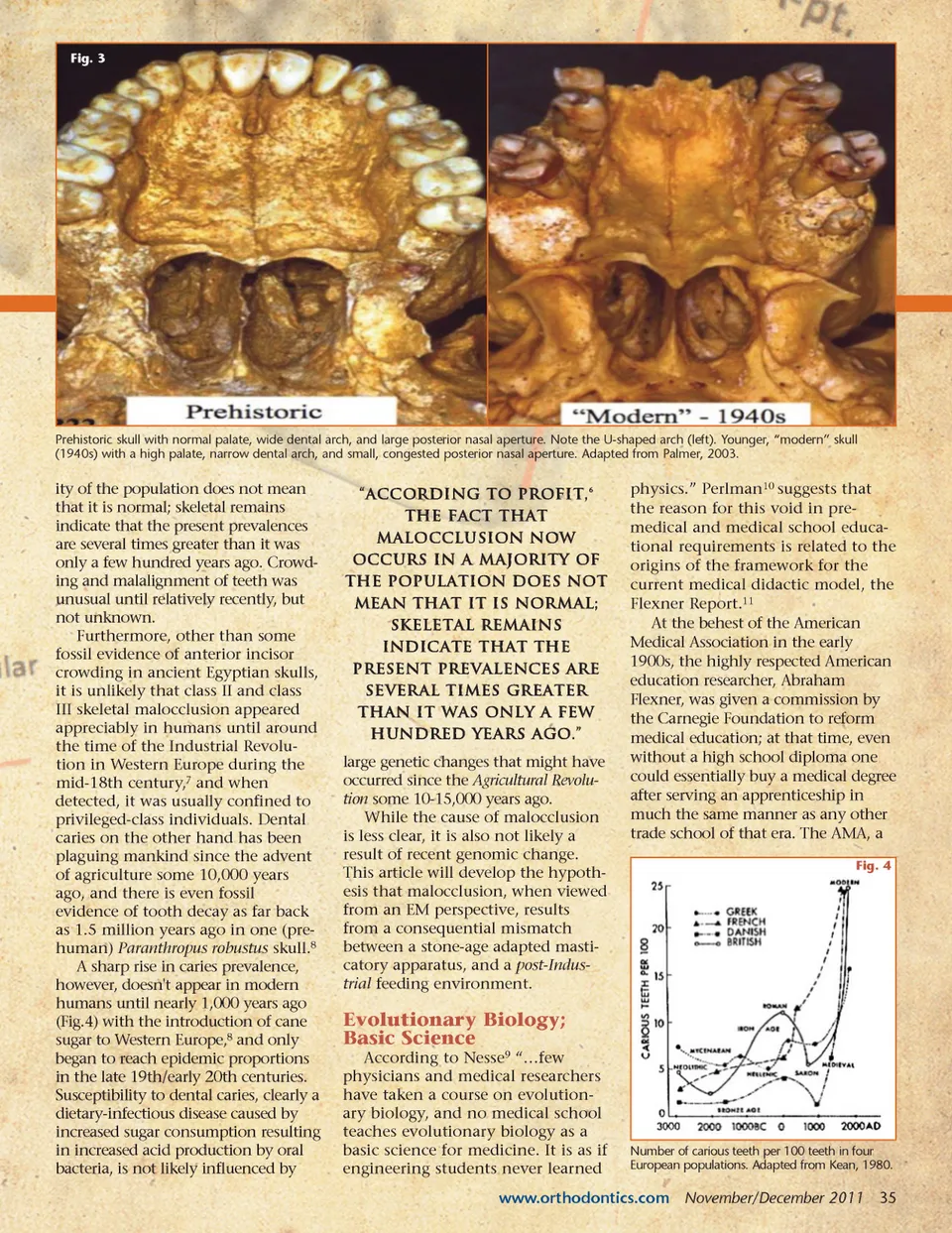
DARWINIAN DENTISTRY By Kevin L. Boyd, M.Sc., DDS PART 1: An Evolutionary Perspective on the Etiology of Malocclusion W In the spring of 2012, the National Evolutionary Synthesis Center (NESCent) will host a ‘cataly-sis meeting’ that will bring together clinicians and researchers from several disparate fields Fig. 1 (e.g., evolutionary biology, paleopathology, biomechan-ics and food science) to explore the implications of the evolution of human teeth and jaws for dentistry and orthodontics. The program, “EVOLUTION OF HUMAN TEETH AND JAWS: Implications for Dentistry and Orthodontics” , will explore the idea that many of our current dental and orthodontic problems relate to a mismatch between the chemical and Fig. 2 physical proper-Indian skulls studied by Dr. Weston A. Price. Each skull has 70,000 year old skull with nice occlusion and no decay. ties of the foods nice occlusion and no decay. Adapted from Palmer, 2003. (Copyright © Price-Pottenger Nutrition Foundation ® ) Adapted from Palmer, 2003. ith their 1991 publica-tion in The Quarterly Review of Biology , The Dawn of Darwinian Medicine , 1 George C. Williams, an evolutionary biologist, and Randolph Nesse, an evolutionary psychiatrist, essentially established the foundation for a new subject to be incorporated into the medical school curriculum; Evolutionary Medicine (EM), also referred to as Darwinian Medicine, are terms used to describe a new paradigm in medical education that attempts to understand modern diseases through application of evolutionary theory and human ecology. Over the past 20 years, the subject of Evolutionary Medicine has been gradually emerging across North America and is now quickly growing throughout Europe and other parts of the world into a legit-imate academic discipline. Presently, there are several text-books, peer-reviewed scientific arti-cles, websites and blogs, major international symposiums, medical school curriculum modules and advanced post-graduate courses of study, all dedicated to this exciting new field of scientific inquiry (Appendix-The Evolutionary & Medicine Review). It appears EM is here to stay for, the medical profes-sion….but what about the rest of the allied-health professions? Evolutionary Dentistry we eat today, and those to which our ancestors’ jaws and teeth had been best adapted. The subject of Evolutionary Oral Medicine (EOM) as a proposed academic discipline within the field of dentistry, was recently introduced at The Ancestral Health Society’s (AHS) First Symposium on Ancestral Health held at UCLA in August 2011 by Kevin Boyd, a pediatric dentist/nutritionist who is currently studying Biological Anthropology, and Michael Mew, an orthodontist in the UK who is interested in EOM as it pertains to understanding the etiology of malocclusion (Appendix-Y Crooked Teeth). Consistent with the aforemen-tioned NESCent program theme, their presentation, “Where is Darwin on Dentistry? Caries and Malocclusion from an Evolutionary Perspective, 2 centered around the observation that dental caries and malocclusion, while now highly prevalent public health diseases, are both surprisingly rare within the pre-Industrial skeletal and pre-historic fossil records, and also seldom seen in many present-day non-westernized cultures. 3, 4, 5 (Figs.1, 2 and 3) According to Profit, 6 the fact that malocclusion now occurs in a major-34 November/December 2011 JAOS
Journal of the American Orthodontic Society November-December 2011: Page 34