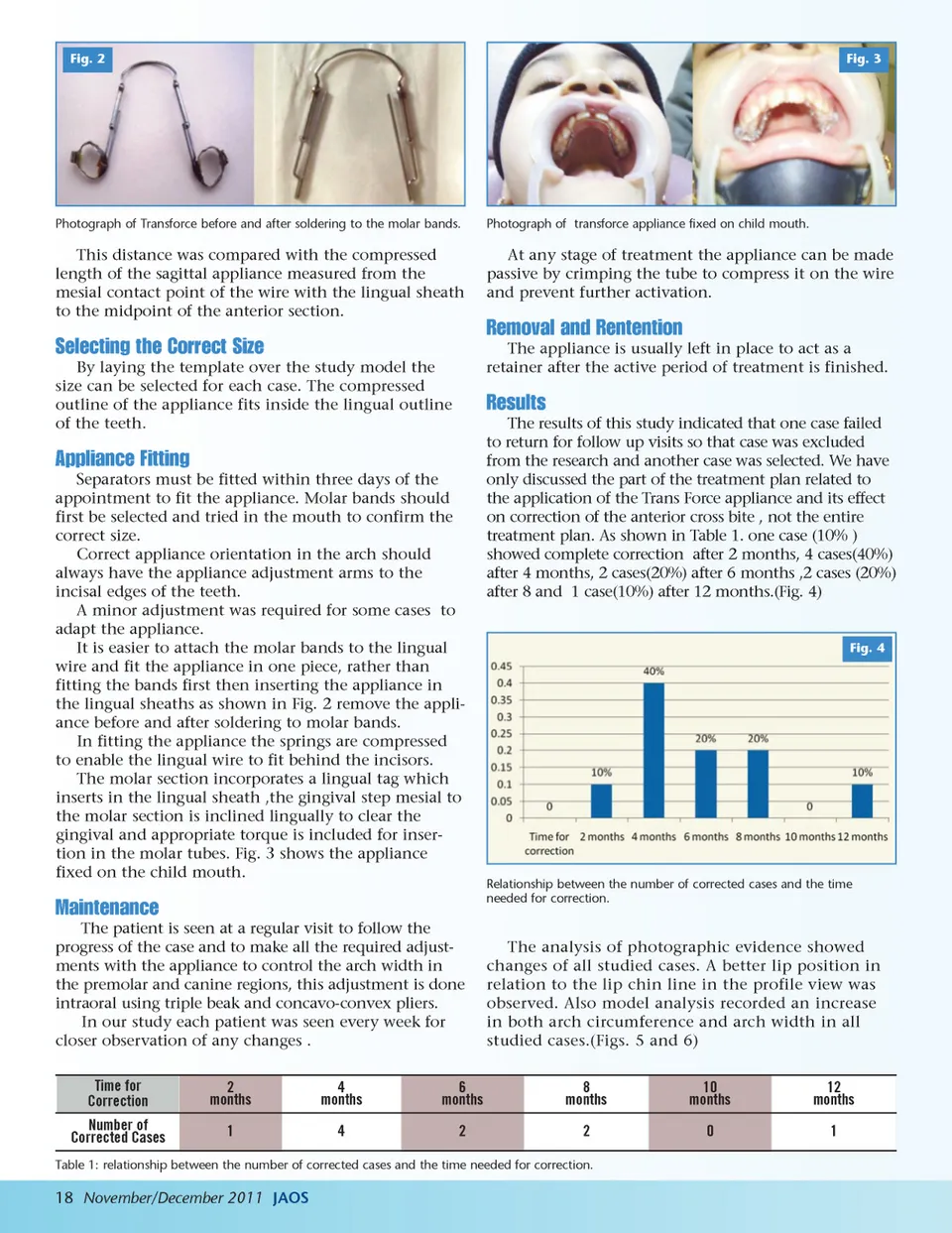
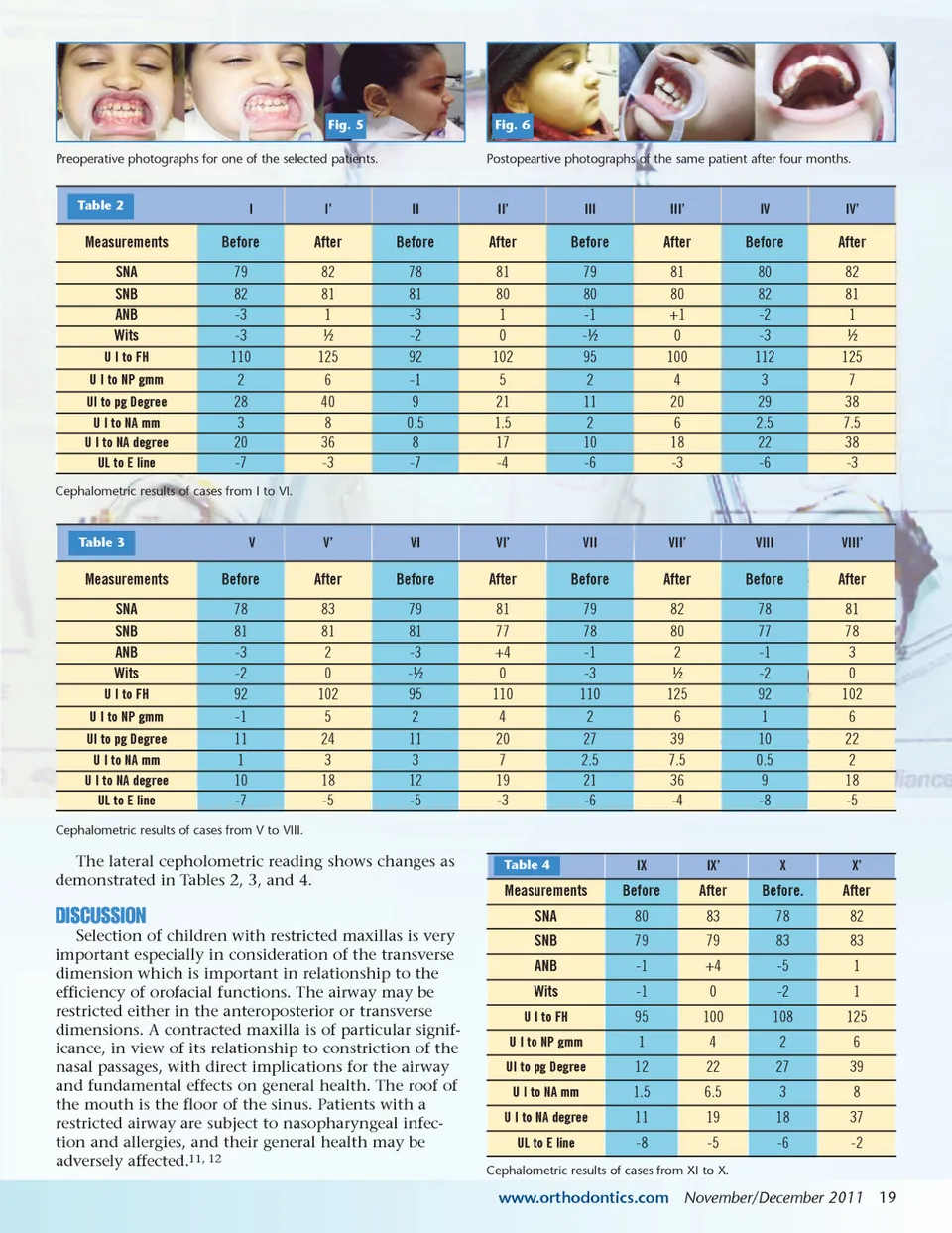
Fig. 2 Fig. 3 Photograph of Transforce before and after soldering to the molar bands. Photograph of transforce appliance fixed on child mouth. This distance was compared with the compressed length of the sagittal appliance measured from the mesial contact point of the wire with the lingual sheath to the midpoint of the anterior section. At any stage of treatment the appliance can be made passive by crimping the tube to compress it on the wire and prevent further activation. Removal and Rentention The appliance is usually left in place to act as a retainer after the active period of treatment is finished. Selecting the Correct Size By laying the template over the study model the size can be selected for each case. The compressed outline of the appliance fits inside the lingual outline of the teeth. Results The results of this study indicated that one case failed to return for follow up visits so that case was excluded from the research and another case was selected. We have only discussed the part of the treatment plan related to the application of the Trans Force appliance and its effect on correction of the anterior cross bite , not the entire treatment plan. As shown in Table 1. one case (10% ) showed complete correction after 2 months, 4 cases(40%) after 4 months, 2 cases(20%) after 6 months ,2 cases (20%) after 8 and 1 case(10%) after 12 months.(Fig. 4) Appliance Fitting Separators must be fitted within three days of the appointment to fit the appliance. Molar bands should first be selected and tried in the mouth to confirm the correct size. Correct appliance orientation in the arch should always have the appliance adjustment arms to the incisal edges of the teeth. A minor adjustment was required for some cases to adapt the appliance. It is easier to attach the molar bands to the lingual wire and fit the appliance in one piece, rather than fitting the bands first then inserting the appliance in the lingual sheaths as shown in Fig. 2 remove the appli-ance before and after soldering to molar bands. In fitting the appliance the springs are compressed to enable the lingual wire to fit behind the incisors. The molar section incorporates a lingual tag which inserts in the lingual sheath ,the gingival step mesial to the molar section is inclined lingually to clear the gingival and appropriate torque is included for inser-tion in the molar tubes. Fig. 3 shows the appliance fixed on the child mouth. Fig. 4 Maintenance The patient is seen at a regular visit to follow the progress of the case and to make all the required adjust-ments with the appliance to control the arch width in the premolar and canine regions, this adjustment is done intraoral using triple beak and concavo-convex pliers. In our study each patient was seen every week for closer observation of any changes . Time for Correction Number of Corrected Cases 2 months 1 4 months 4 6 months 2 Relationship between the number of corrected cases and the time needed for correction. The analysis of photographic evidence showed changes of all studied cases. A better lip position in relation to the lip chin line in the profile view was observed. Also model analysis recorded an increase in both arch circumference and arch width in all studied cases.(Figs. 5 and 6) 8 months 2 10 months 0 12 months 1 Table 1: relationship between the number of corrected cases and the time needed for correction. 18 November/December 2011 JAOS
Journal of the American Orthodontic Society November-December 2011: Page 18