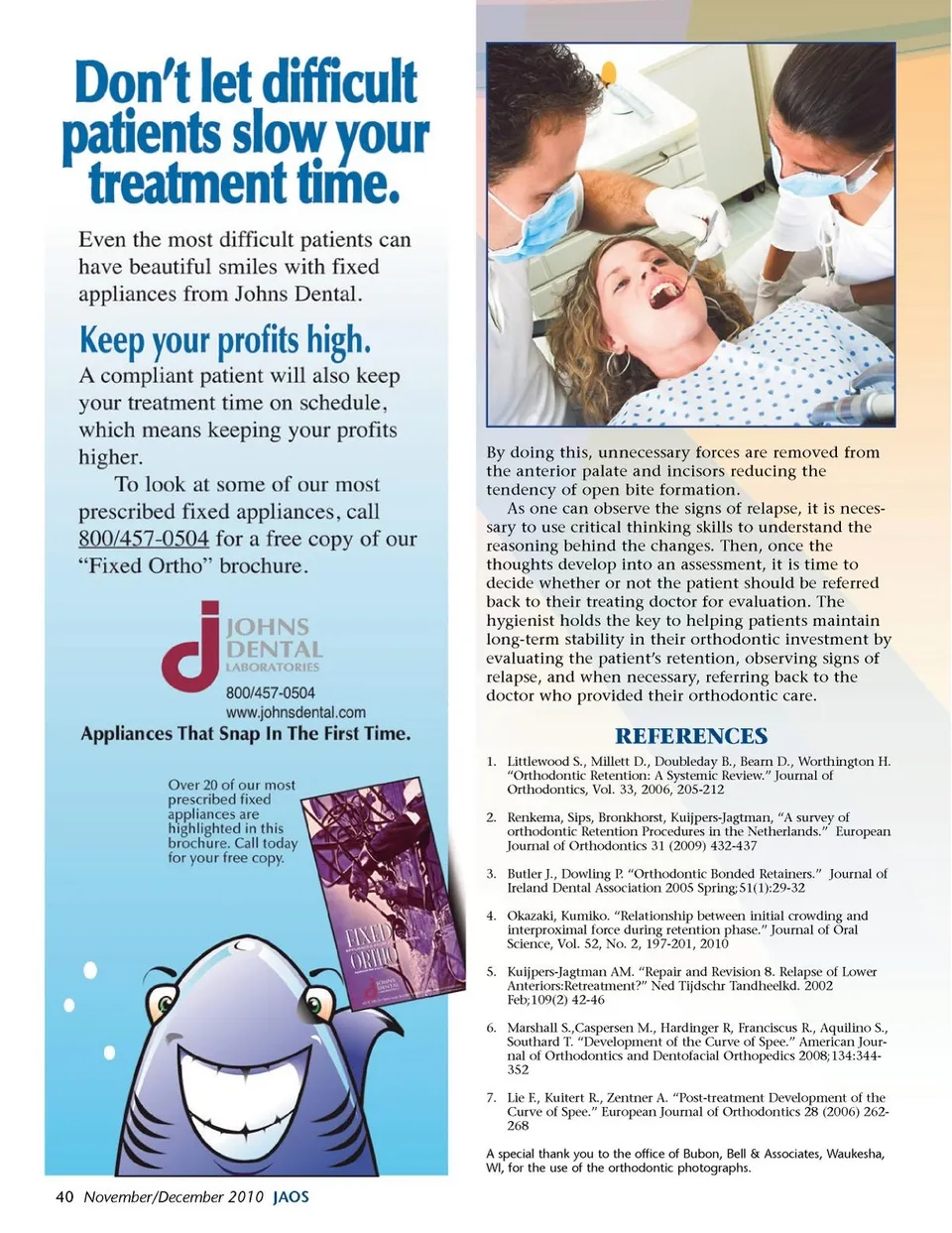
By doing this, unnecessary forces are removed from the anterior palate and incisors reducing the tendency of open bite formation. As one can observe the signs of relapse, it is neces-sary to use critical thinking skills to understand the reasoning behind the changes. Then, once the thoughts develop into an assessment, it is time to decide whether or not the patient should be referred back to their treating doctor for evaluation. The hygienist holds the key to helping patients maintain long-term stability in their orthodontic investment by evaluating the patient’s retention, observing signs of relapse, and when necessary, referring back to the doctor who provided their orthodontic care. REFERENCES 1. Littlewood S., Millett D., Doubleday B., Bearn D., Worthington H. “Orthodontic Retention: A Systemic Review.” Journal of Orthodontics, Vol. 33, 2006, 205-212 2. Renkema, Sips, Bronkhorst, Kuijpers-Jagtman, “A survey of orthodontic Retention Procedures in the Netherlands.” European Journal of Orthodontics 31 (2009) 432-437 3. Butler J., Dowling P. “Orthodontic Bonded Retainers.” Journal of Ireland Dental Association 2005 Spring;51(1):29-32 4. Okazaki, Kumiko. “Relationship between initial crowding and interproximal force during retention phase.” Journal of Oral Science, Vol. 52, No. 2, 197-201, 2010 5. Kuijpers-Jagtman AM. “Repair and Revision 8. Relapse of Lower Anteriors:Retreatment?” Ned Tijdschr Tandheelkd. 2002 Feb;109(2) 42-46 6. Marshall S.,Caspersen M., Hardinger R, Franciscus R., Aquilino S., Southard T. “Development of the Curve of Spee.” American Jour-nal of Orthodontics and Dentofacial Orthopedics 2008;134:344-352 7. Lie F., Kuitert R., Zentner A. “Post-treatment Development of the Curve of Spee.” European Journal of Orthodontics 28 (2006) 262-268 A special thank you to the office of Bubon, Bell & Associates, Waukesha, WI, for the use of the orthodontic photographs. 40 November/December 2010 JAOS
Journal of the American Orthodontic Society November-December 2010: Page 40