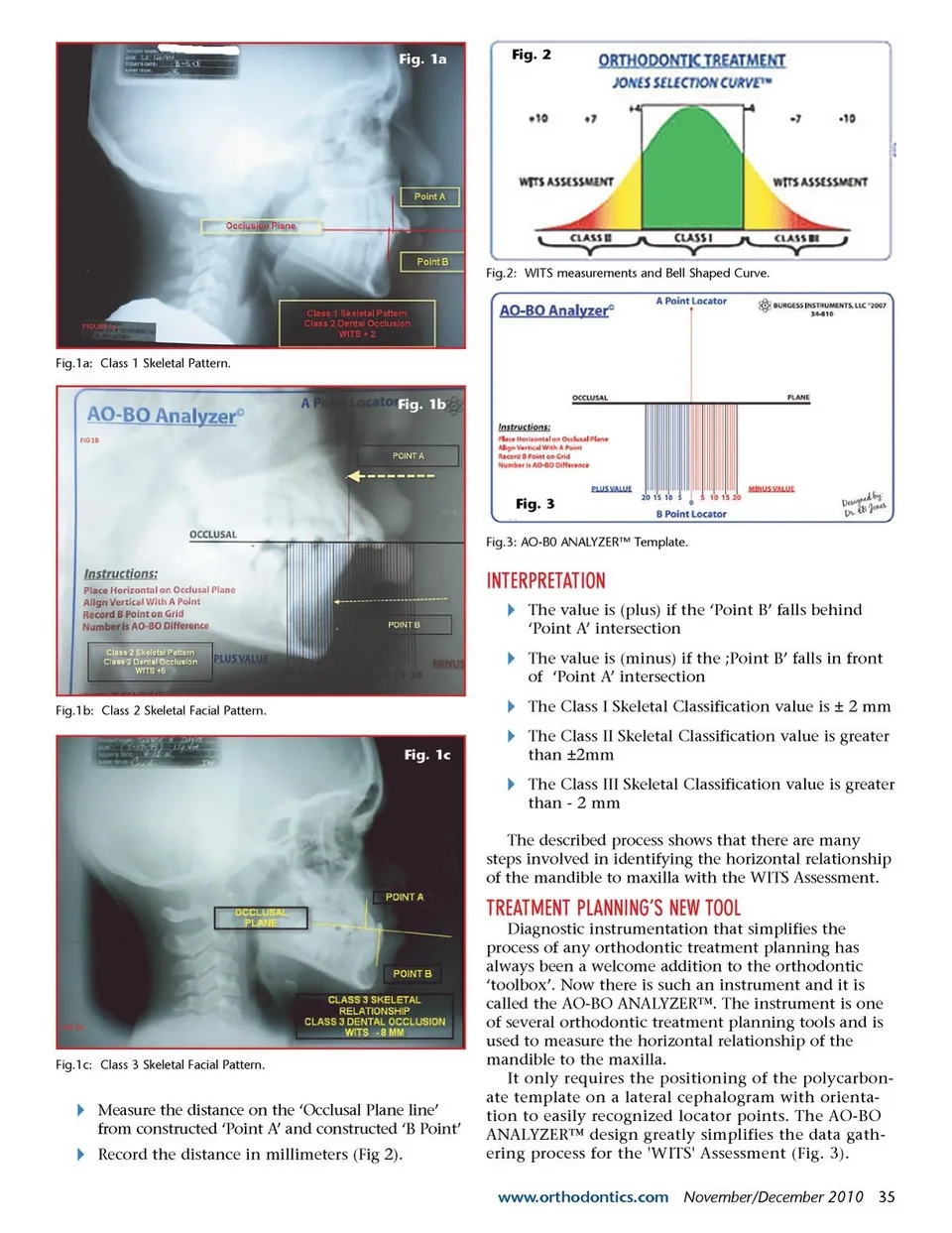
WITS Analysis AO-BO Analyzer ™ Simplifies Visualizing Skeletal Dysplasia By Edward Burgess Jones, DDS, FAGD, FADI, FPFA, DAAPM, DABFE, FRSH, BCFE REDUCES PROCESS TO TWO EASY STEPS n important element of orthodontic treatment planning includes a strong background in human physiology and requires an understanding of facial architecture and the influences of growth. An important part of orthodontic treatment may also be orthopedic corrective measures available within the course of treatment. Also important is to understand how bones can be modified to create desirable changes with the soft tissue drape of the face. It is important to be able to measure the relationships of the bony facial sturctures and their desired changes prior to treatment. A THE ‘DEFINITIONS’ OCCLUSAL PLANE (as defined by Jacobson). Draw a line that joins the midpoint of the overlap of the mesio-buccal cusp of the first molar and the buccal cusps of the first premolars. There are several ways to measure the occlusal plane. The Occlusal Plane as defined by Jacobson is the one to follow to get the most accurate measurement. A POINT an imaginary mid-point taken in the transverse plane at the greatest concavity above the central maxillary incisors on the alveolar bone between the cervical point of the incisor and the base of the anterior nasal spine. B POINT an imaginary mid-point of the mandible in the transverse plant at the greatest concavity below the central mandibular incisors on the alveo-lar bone between the cervical point of the incisor and the pogonion point. THE ‘WITS’ ASSESSMENT WITS is a measurement protocol that is used world-wide in the field of orthodontics. It is a measuring process that identifies the horizontal spatial relationship between the lower jaw and upper jaw. WITS identifies the linear imbalance between the mandible and the maxilla and is measured in millimeters (Figs. 1a, 1b and 1c). The popularity of the WITS analysis is because of its accuracy and because it is relatively easy to locate the required measuring points. Presently, there are several popular methods that provide these measurements. For purposes of this article, we are going to address the WITS Assessment. This is one that many are familiar with and currently use in their everyday treatment design. The main drawback of the WITS Assessment is that the process involves multiple steps and requires time to set up. Once done though, an accurate repre-sentation of the relationship of the mandible to the maxilla can be easily documented. SETUP Ī Place a lateral cephalogram or tracing on the view box Ī Secure a sheet of acetate tracing paper onto the lateral cephalogram Ī Have ready a pencil, eraser, ruler, Boley gauge, recording paper MECHANICAL PROCESS Ī Establish the ‘Jacobson Occlusal Plane Line’ and draw the line on the acetate overlay Ī Locate ‘A Point’ and mark the point on the acetate paper Ī Locate ‘B Point’ and mark the point on the acetate paper Ī Draw a line from ‘A Point’ at right angles to ‘Occlusal Plane’ Ī Draw a line from ‘B Point at right angles to ‘Occlusal Plane’ THE BACKGROUND The WITS Assessment was conceived at Witwatersrand University (SA) in 1967 by Dr. Alex Jacobson. It has stood the test of time and has been universally accepted world-wide. It has proved to be very simple, highly accurate and is easy to setup. It is a linear measurement and not an analysis; per se, although variations in the occlusal plane may influence the constructed occlusal plane. It is not subjected to as much variation as angular measurements. 34 November/December 2010 JAOS
Journal of the American Orthodontic Society November-December 2010: Page 34