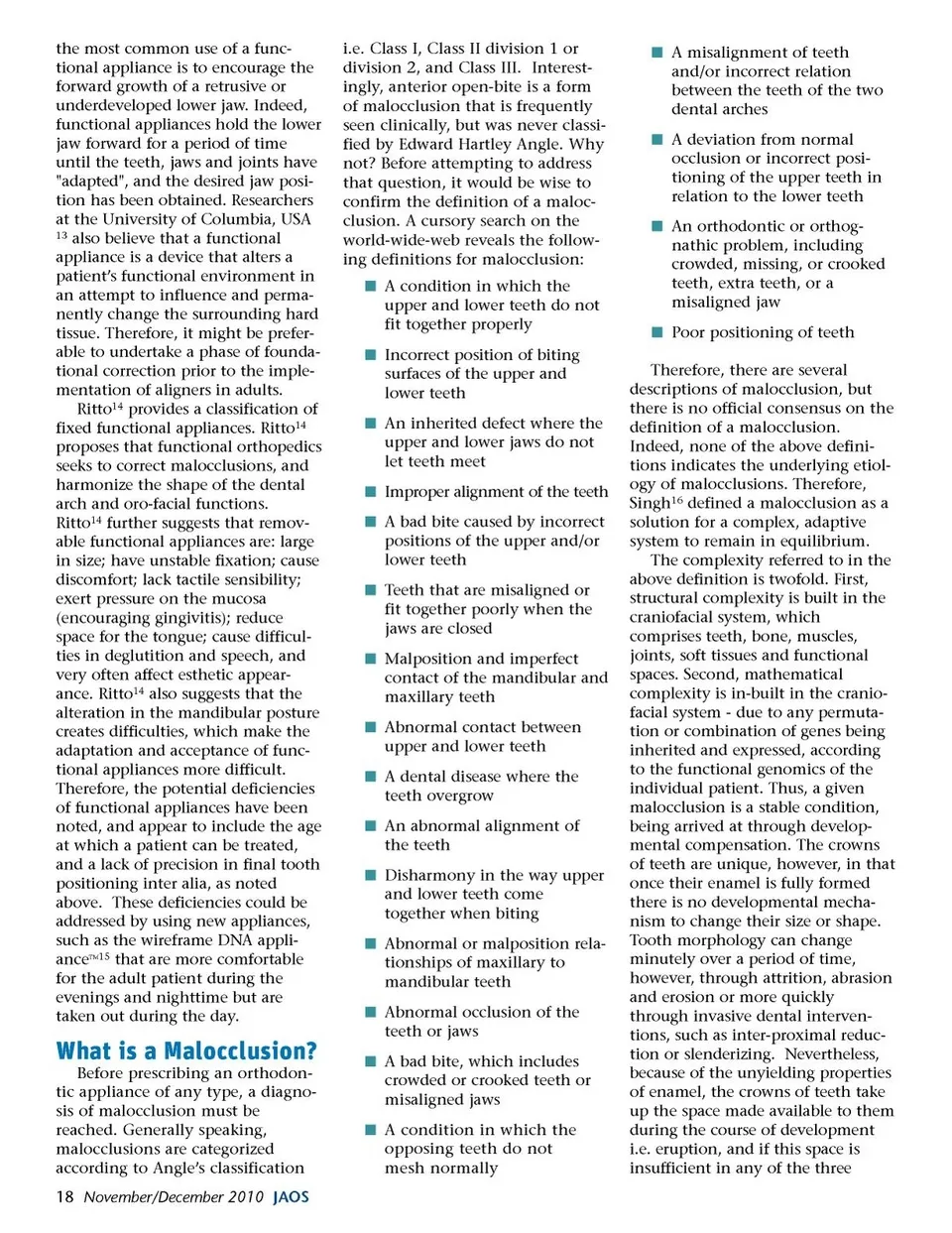
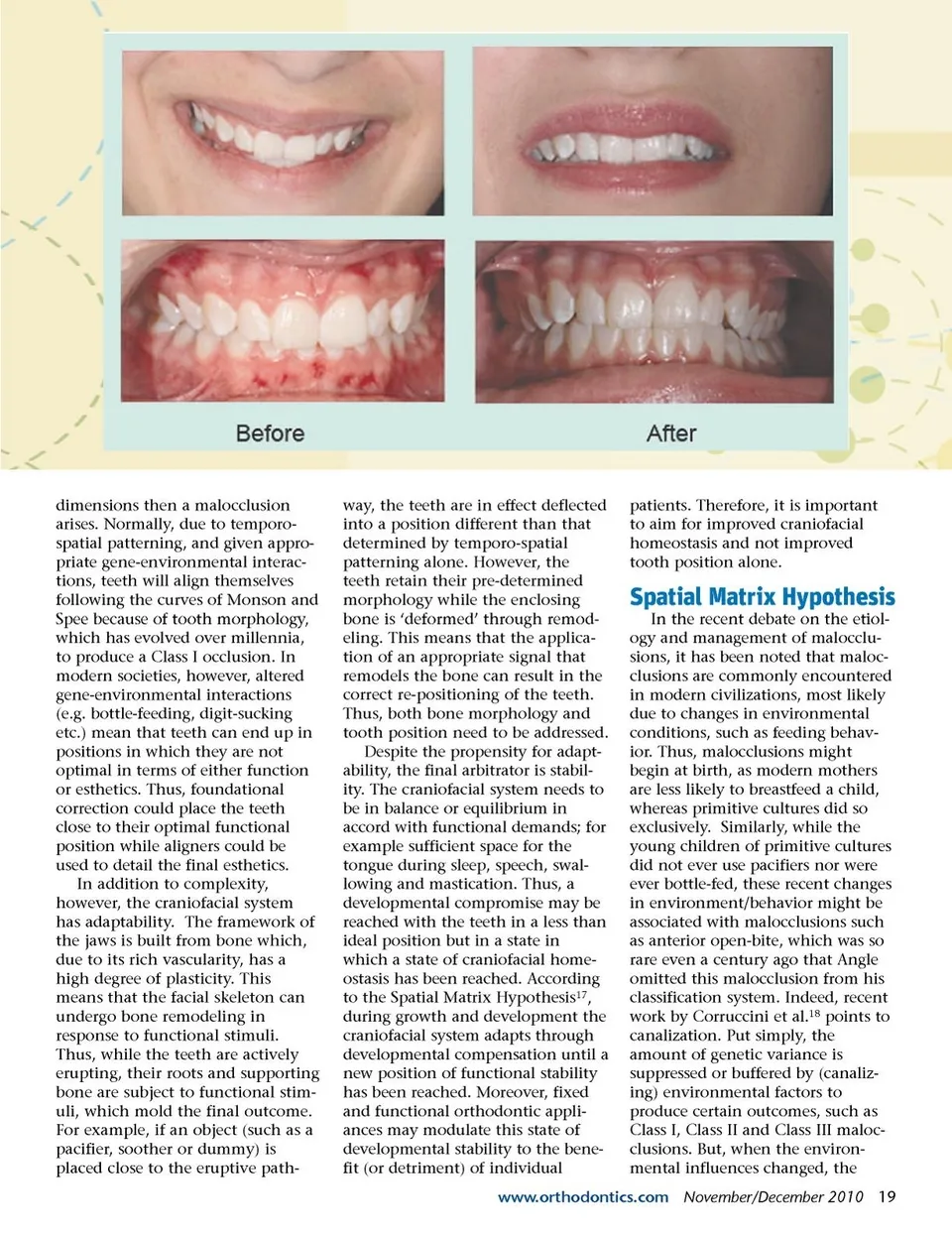
the most common use of a func-tional appliance is to encourage the forward growth of a retrusive or underdeveloped lower jaw. Indeed, functional appliances hold the lower jaw forward for a period of time until the teeth, jaws and joints have "adapted", and the desired jaw posi-tion has been obtained. Researchers at the University of Columbia, USA 13 also believe that a functional appliance is a device that alters a patient’s functional environment in an attempt to influence and perma-nently change the surrounding hard tissue. Therefore, it might be prefer-able to undertake a phase of founda-tional correction prior to the imple-mentation of aligners in adults. Ritto 14 provides a classification of fixed functional appliances. Ritto 14 proposes that functional orthopedics seeks to correct malocclusions, and harmonize the shape of the dental arch and oro-facial functions. Ritto 14 further suggests that remov-able functional appliances are: large in size; have unstable fixation; cause discomfort; lack tactile sensibility; exert pressure on the mucosa (encouraging gingivitis); reduce space for the tongue; cause difficul-ties in deglutition and speech, and very often affect esthetic appear-ance. Ritto 14 also suggests that the alteration in the mandibular posture creates difficulties, which make the adaptation and acceptance of func-tional appliances more difficult. Therefore, the potential deficiencies of functional appliances have been noted, and appear to include the age at which a patient can be treated, and a lack of precision in final tooth positioning inter alia, as noted above. These deficiencies could be addressed by using new appliances, such as the wireframe DNA appli-ance 15 that are more comfortable for the adult patient during the evenings and nighttime but are taken out during the day. TM i.e. Class I, Class II division 1 or division 2, and Class III. Interest-ingly, anterior open-bite is a form of malocclusion that is frequently seen clinically, but was never classi-fied by Edward Hartley Angle. Why not? Before attempting to address that question, it would be wise to confirm the definition of a maloc-clusion. A cursory search on the world-wide-web reveals the follow-ing definitions for malocclusion: í A condition in which the upper and lower teeth do not fit together properly í Incorrect position of biting surfaces of the upper and lower teeth í An inherited defect where the upper and lower jaws do not let teeth meet í Improper alignment of the teeth í A bad bite caused by incorrect positions of the upper and/or lower teeth í Teeth that are misaligned or fit together poorly when the jaws are closed í Malposition and imperfect contact of the mandibular and maxillary teeth í Abnormal contact between upper and lower teeth í A dental disease where the teeth overgrow í An abnormal alignment of the teeth í Disharmony in the way upper and lower teeth come together when biting í Abnormal or malposition rela-tionships of maxillary to mandibular teeth í Abnormal occlusion of the teeth or jaws í A bad bite, which includes crowded or crooked teeth or misaligned jaws í A condition in which the opposing teeth do not mesh normally í A misalignment of teeth and/or incorrect relation between the teeth of the two dental arches í A deviation from normal occlusion or incorrect posi-tioning of the upper teeth in relation to the lower teeth í An orthodontic or orthog-nathic problem, including crowded, missing, or crooked teeth, extra teeth, or a misaligned jaw í Poor positioning of teeth Therefore, there are several descriptions of malocclusion, but there is no official consensus on the definition of a malocclusion. Indeed, none of the above defini-tions indicates the underlying etiol-ogy of malocclusions. Therefore, Singh 16 defined a malocclusion as a solution for a complex, adaptive system to remain in equilibrium. The complexity referred to in the above definition is twofold. First, structural complexity is built in the craniofacial system, which comprises teeth, bone, muscles, joints, soft tissues and functional spaces. Second, mathematical complexity is in-built in the cranio-facial system -due to any permuta-tion or combination of genes being inherited and expressed, according to the functional genomics of the individual patient. Thus, a given malocclusion is a stable condition, being arrived at through develop-mental compensation. The crowns of teeth are unique, however, in that once their enamel is fully formed there is no developmental mecha-nism to change their size or shape. Tooth morphology can change minutely over a period of time, however, through attrition, abrasion and erosion or more quickly through invasive dental interven-tions, such as inter-proximal reduc-tion or slenderizing. Nevertheless, because of the unyielding properties of enamel, the crowns of teeth take up the space made available to them during the course of development i.e. eruption, and if this space is insufficient in any of the three What is a Malocclusion? Before prescribing an orthodon-tic appliance of any type, a diagno-sis of malocclusion must be reached. Generally speaking, malocclusions are categorized according to Angle’s classification 18 November/December 2010 JAOS
Journal of the American Orthodontic Society November-December 2010: Page 18