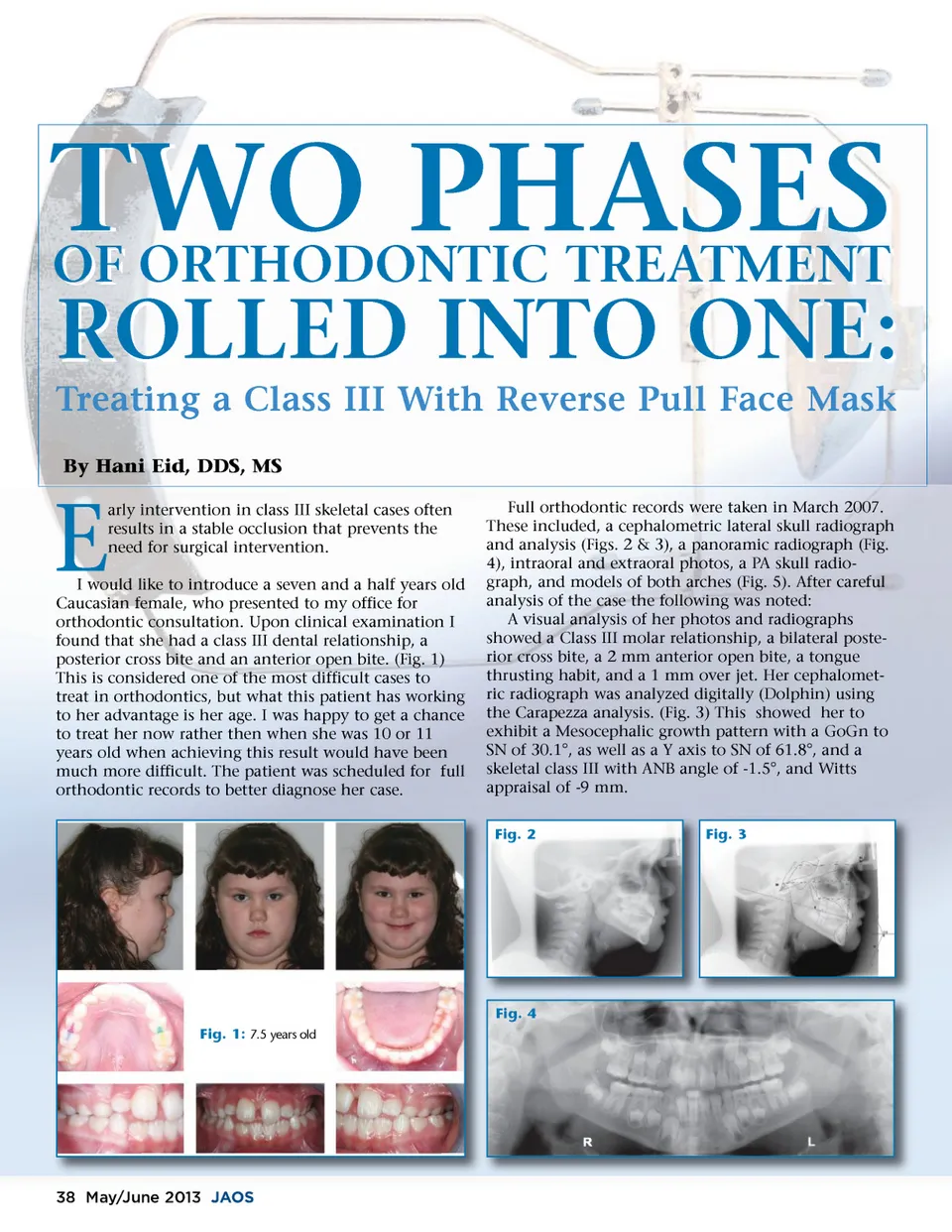
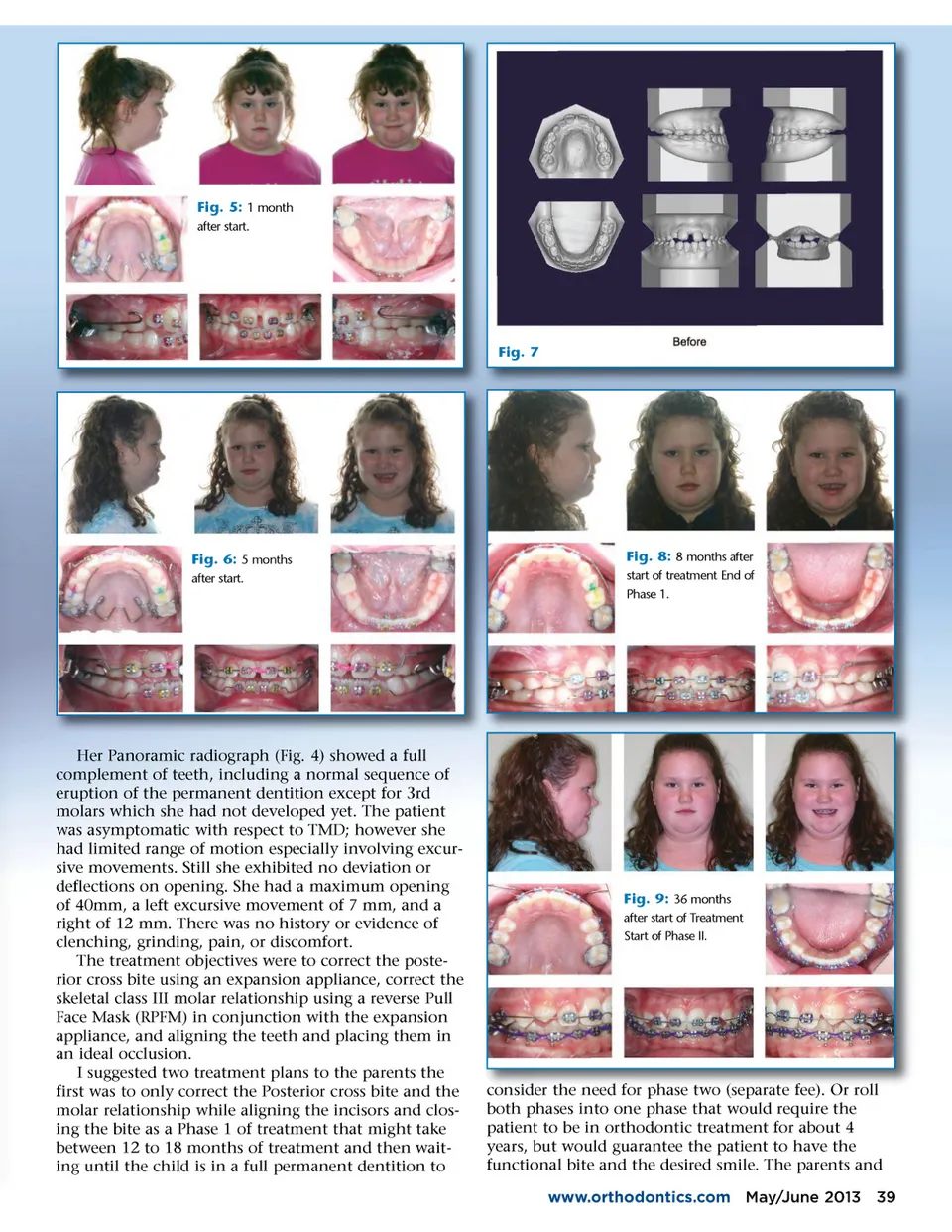
Fig. 5: 1 month after start. Fig. 7 Fig. 6: 5 months after start. Fig. 8: 8 months after start of treatment End of Phase 1. Her Panoramic radiograph (Fig. 4) showed a full complement of teeth, including a normal sequence of eruption of the permanent dentition except for 3rd molars which she had not developed yet. The patient was asymptomatic with respect to TMD; however she had limited range of motion especially involving excur-sive movements. Still she exhibited no deviation or deflections on opening. She had a maximum opening of 40mm, a left excursive movement of 7 mm, and a right of 12 mm. There was no history or evidence of clenching, grinding, pain, or discomfort. The treatment objectives were to correct the poste-rior cross bite using an expansion appliance, correct the skeletal class III molar relationship using a reverse Pull Face Mask (RPFM) in conjunction with the expansion appliance, and aligning the teeth and placing them in an ideal occlusion. I suggested two treatment plans to the parents the first was to only correct the Posterior cross bite and the molar relationship while aligning the incisors and clos-ing the bite as a Phase 1 of treatment that might take between 12 to 18 months of treatment and then wait-ing until the child is in a full permanent dentition to Fig. 9: 36 months after start of Treatment Start of Phase II. consider the need for phase two (separate fee) fee). Or roll both phases into one phase that would require the patient to be in orthodontic treatment for about 4 years, but would guarantee the patient to have the functional bite and the desired smile. The parents and www.orthodontics.com May/June 2013 39
Journal of the American Orthodontic Society May-June 2013: Page 39