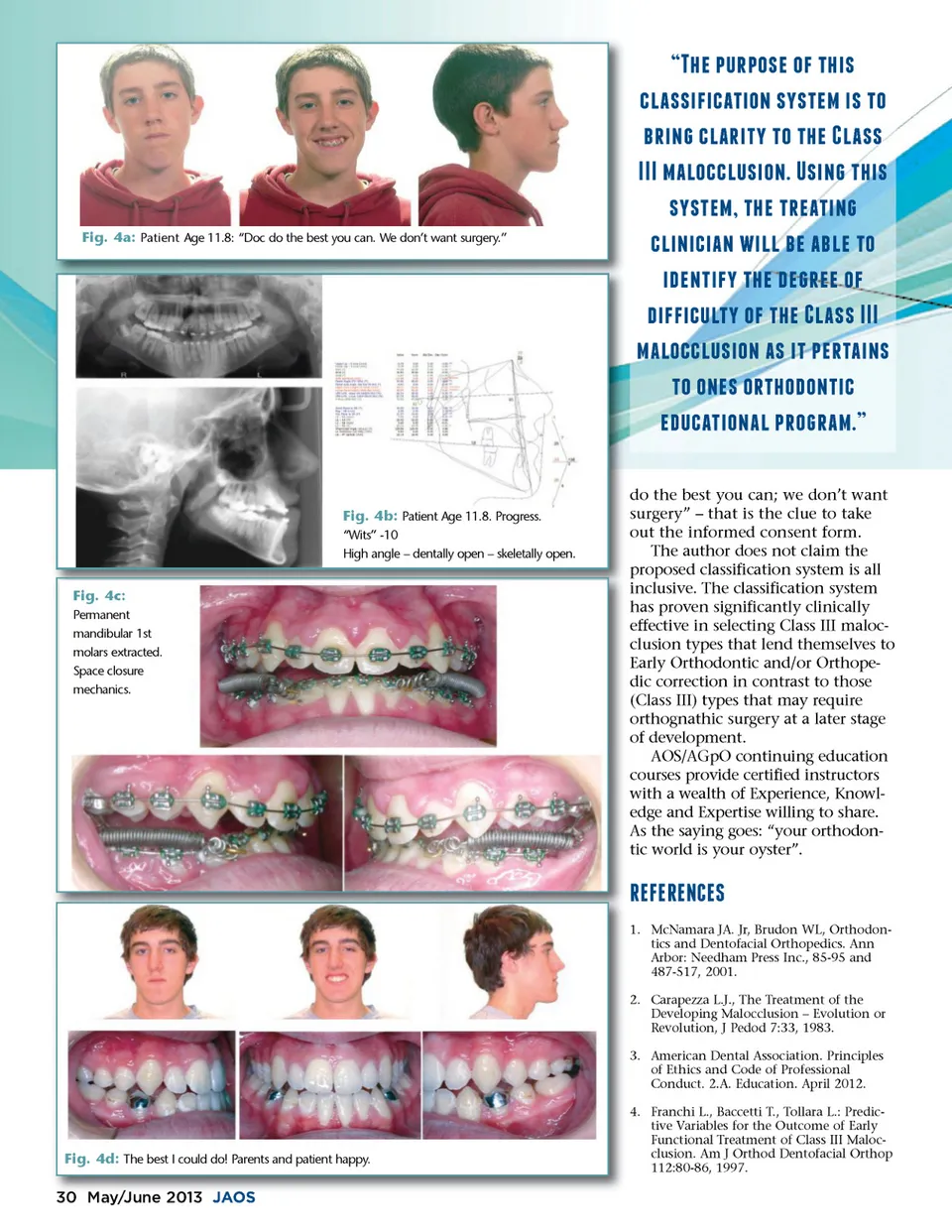
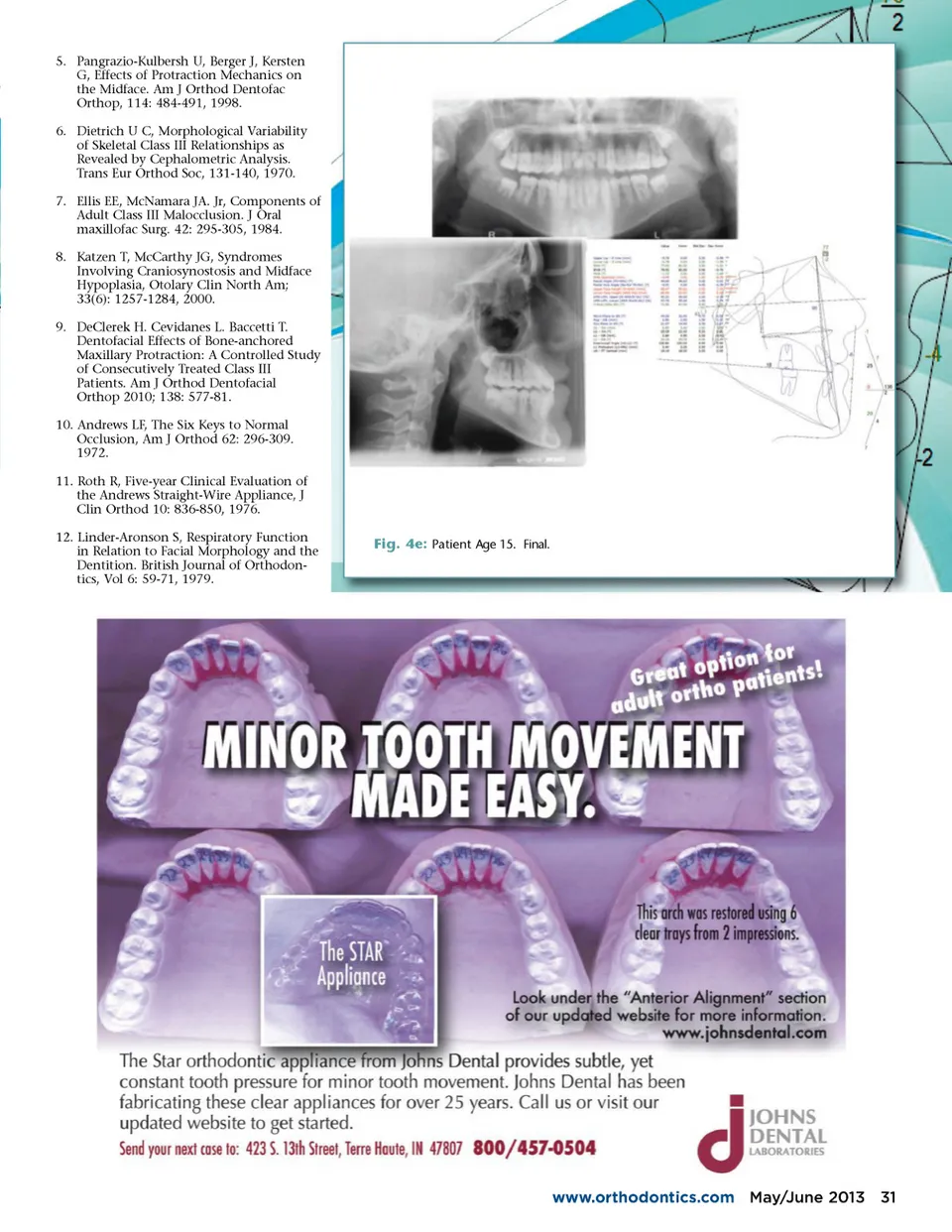
Fig. 4a: Patient Age 11.8: “Doc do the best you can. We don’t want surgery.” a;$/2"!*"-,/2-%21$0, ().,,0%0(.10-+2,f;,1/&20,21-e;*0+ 2().*01f;21-21$/2c;).,, ###2&.)-(()!,0-+2,0+ 21$0, ,f;,1/&21$/21*/.10+ ()0+0(0.+20))2e;/2.e;)/21-0'/+10%f;21$/2'/ *//2-% '0%%0(!)1f;2-%21$/2c;).,,2### &.)-(()!,0-+2.,2012"/*1.0+, 1-2-+/,2-*1$-'-+10( /'!(.10-+.)2"*-*.&�f; do the best you can; we don’t want surgery” – that is the clue to take out the informed consent form. The author does not claim the proposed classification system is all inclusive. The classification system has proven significantly clinically effective in selecting Class III maloc-clusion types that lend themselves to Early Orthodontic and/or Orthope-dic correction in contrast to those (Class III) types that may require orthognathic surgery at a later stage of development. AOS/AGpO continuing education courses provide certified instructors with a wealth of Experience, Knowl-edge and Expertise willing to share. As the saying goes: “your orthodon-tic world is your oyster”. Fig. 4b: Patient Age 11.8. Progress. “Wits” -10 High angle – dentally open – skeletally open. Fig. 4c: Permanent mandibular 1st molars extracted. Space closure mechanics. b;b;b;c;b;d; 1. McNamara JA. Jr, Brudon WL, Orthodon-tics and Dentofacial Orthopedics. Ann Arbor: Needham Press Inc., 85-95 and 487-517, 2001. 2. Carapezza L.J., The Treatment of the Developing Malocclusion – Evolution or Revolution, J Pedod 7:33, 1983. 3. American Dental Association. Principles of Ethics and Code of Professional Conduct. 2.A. Education. April 2012. 4. Franchi L., Baccetti T., Tollara L.: Predic-tive Variables for the Outcome of Early Functional Treatment of Class III Maloc-clusion. Am J Orthod Dentofacial Orthop 112:80-86, 1997. Fig. 4d: The best I could do! Parents and patient happy. 30 May/June May/ y / J une 2013 J JAOS AOS
Journal of the American Orthodontic Society May-June 2013: Page 30