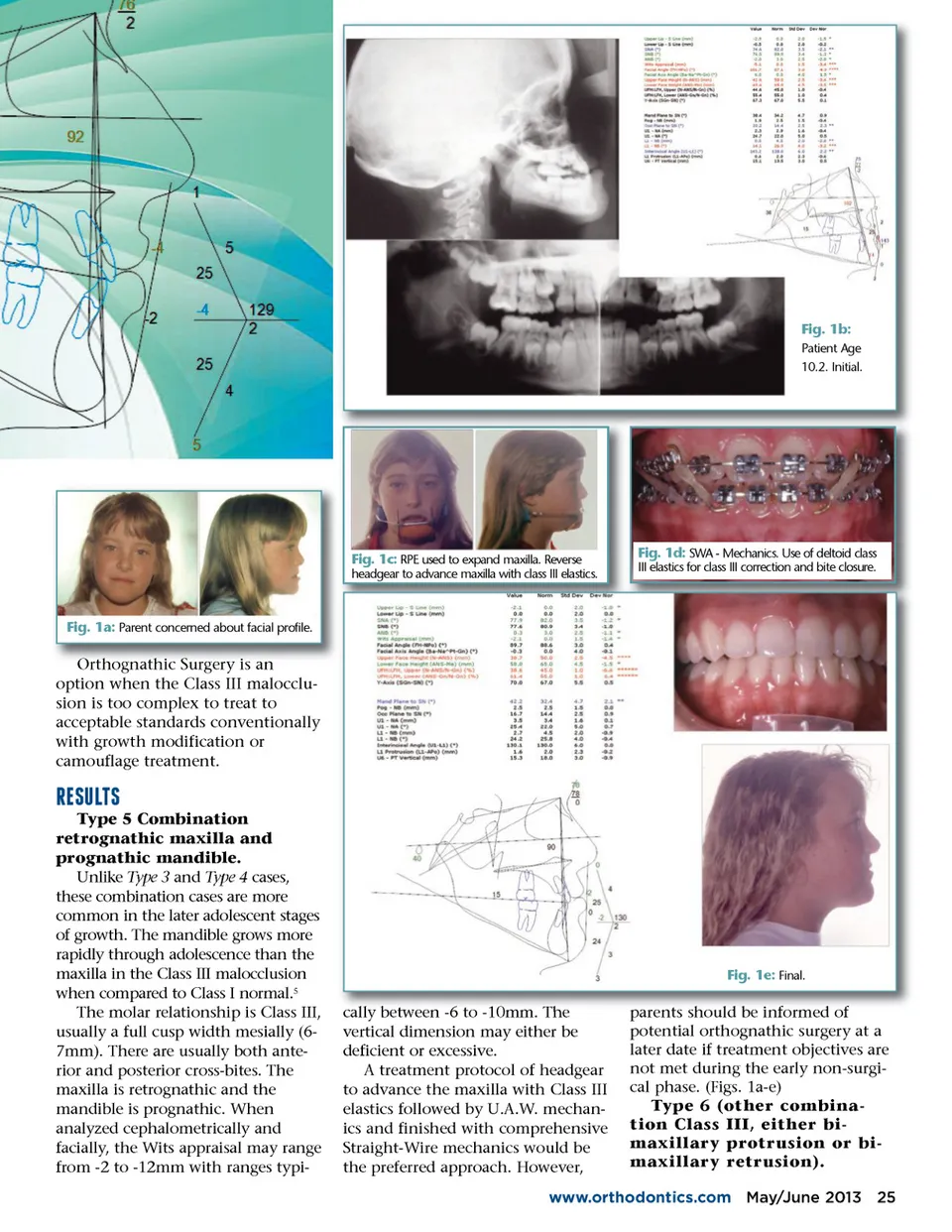
By Leonard J. Carapezza, DMD d; even out of ten children will have developed a malocclu-sion by the time they have reached peak puberty. In the US population a small percentage of these malocclusions will be Class III. The frequency of Class III maloc-clusion varies in the general popula-tion from 4% among Caucasians to upward of 14% among Asians. 1 Depending upon the ethnic popula-tion in the practice location, the private practitioner may have a significant number of Class III patients in one’s practice. In spite of the fact of the location and demo-graphics of specialists the sheer number of malocclusions prevalent in general dentistry makes it impos-sible for the orthodontic specialty to Table 1 (cont’d from Part 1) have the man power to service all of the patients in need of treatment. Specialties in dentistry have been the natural outgrowth of the enlarged and ever-widening service the profession has offered to the public in the field of dental and oral health. The council of dental educa-tion of the American Dental Associa-tion first took recognition of this condition during the years 1944-1955, and as a result of the study defined a specialty in dentistry, listed the specialties worthy of notice, indi-cated the nature of special training it deemed advisable and expressed its conviction concerning the recogni-tion of specialties. Specialties since then have been judged by the SCOPE of the service 5) Class III Type 5 (Combination Class III, Retrognathic Maxilla and Prognathic Mandible). 5a. Skeletal Closed Bite 5b. Skeletal Open Bite 6) Class III Type 6 (Other Combina-tion Class III, either Bimaxillary Protrusion or Bimaxillary Retrusion). 7) Class III Type 7 (Craniofacial Malformations Class III, i.e. Crouzon’s Syndrome, Beckwith-Weidemann Syndrome and Antley-Bixler Syndrome). they render more so than the qual-ity of the service rendered. Under this spectrum it is generally consid-ered that only 10% of the general dental population needs the special-ties of dentistry. 2 The burden then is on the ethi-cal practicing clinician to determine by his/her own experience, knowl-edge and continuing education which SCOPE of a malocclusion type to undertake. 3 The proposed treatment classification of Class III (Part 2) is a continuation of Part 1 in an attempt to bring clarity to this decision making process. (Table 1) c;�c;d;d;2###2a;b;�c;a;�d;b;a;2�d;b;a; d;2 Growth Modification requires early treatment to maximize the pre-pubertal growth potential of the child. The goal being to final-ize orthodontic treatment with a Class I dental and skeletal relation-ship. Because of the variability between patients and the uncer-tainty about growth and treatment response, the clinician may only experience a 75% success rate of the Class III malocclusion with growth modification. 4 Camouflage treatment of the Class III post-pubertal patient by compensation of the position of the teeth to mask the position of the mal-positioned jaw. Advanced Ortho Program ORTHOGNATHIC SURGERY / MICRO IMPLANT THERAPY/ CAMOUFLAGE EXTRACTION 24 May/June 2013 JAOS
Journal of the American Orthodontic Society May-June 2013: Page 24