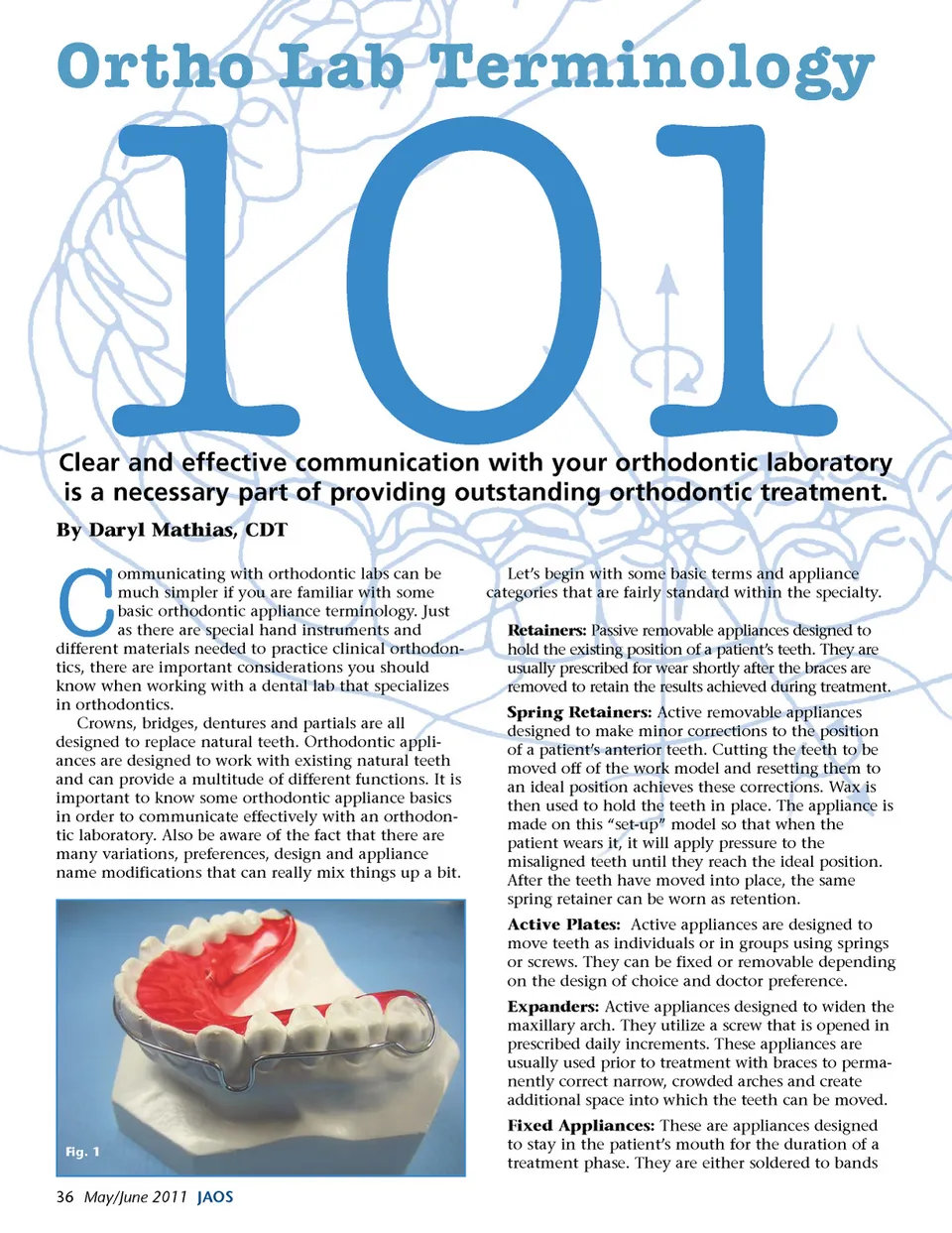
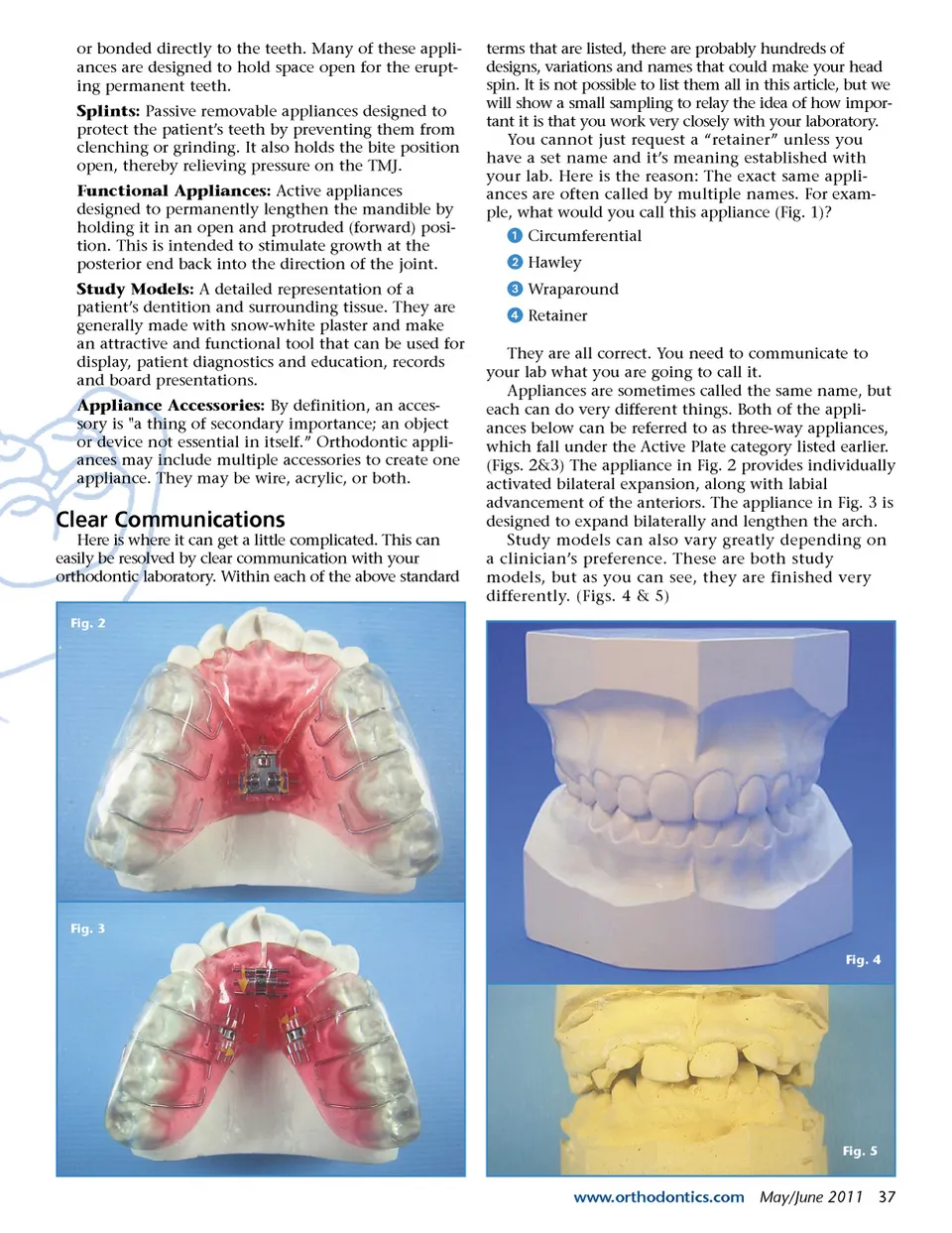
or bonded directly to the teeth. Many of these appli-ances are designed to hold space open for the erupt-ing permanent teeth. Splints: Passive removable appliances designed to protect the patient’s teeth by preventing them from clenching or grinding. It also holds the bite position open, thereby relieving pressure on the TMJ. Functional Appliances: Active appliances designed to permanently lengthen the mandible by holding it in an open and protruded (forward) posi-tion. This is intended to stimulate growth at the posterior end back into the direction of the joint. Study Models: A detailed representation of a patient’s dentition and surrounding tissue. They are generally made with snow-white plaster and make an attractive and functional tool that can be used for display, patient diagnostics and education, records and board presentations. Appliance Accessories: By definition, an acces-sory is "a thing of secondary importance; an object or device not essential in itself.” Orthodontic appli-ances may include multiple accessories to create one appliance. They may be wire, acrylic, or both. terms that are listed, there are probably hundreds of designs, variations and names that could make your head spin. It is not possible to list them all in this article, but we will show a small sampling to relay the idea of how impor-tant it is that you work very closely with your laboratory. You cannot just request a “retainer” unless you have a set name and it’s meaning established with your lab. Here is the reason: The exact same appli-ances are often called by multiple names. For exam-ple, what would you call this appliance (Fig. 1)? ᕡ Circumferential ᕢ Hawley ᕣ Wraparound ᕤ Retainer They are all correct. You need to communicate to your lab what you are going to call it. Appliances are sometimes called the same name, but each can do very different things. Both of the appli-ances below can be referred to as three-way appliances, which fall under the Active Plate category listed earlier. (Figs. 2&3) The appliance in Fig. 2 provides individually activated bilateral expansion, along with labial advancement of the anteriors. The appliance in Fig. 3 is designed to expand bilaterally and lengthen the arch. Study models can also vary greatly depending on a clinician’s preference. These are both study models, but as you can see, they are finished very differently. (Figs. 4 & 5) Clear Communications Here is where it can get a little complicated. This can easily be resolved by clear communication with your orthodontic laboratory. Within each of the above standard Fig. 2 Fig. 3 Fig. 4 Fig. 5 www.orthodontics.com May/June 2011 37
Journal of the American Orthodontic Society May-June 2011: Page 37