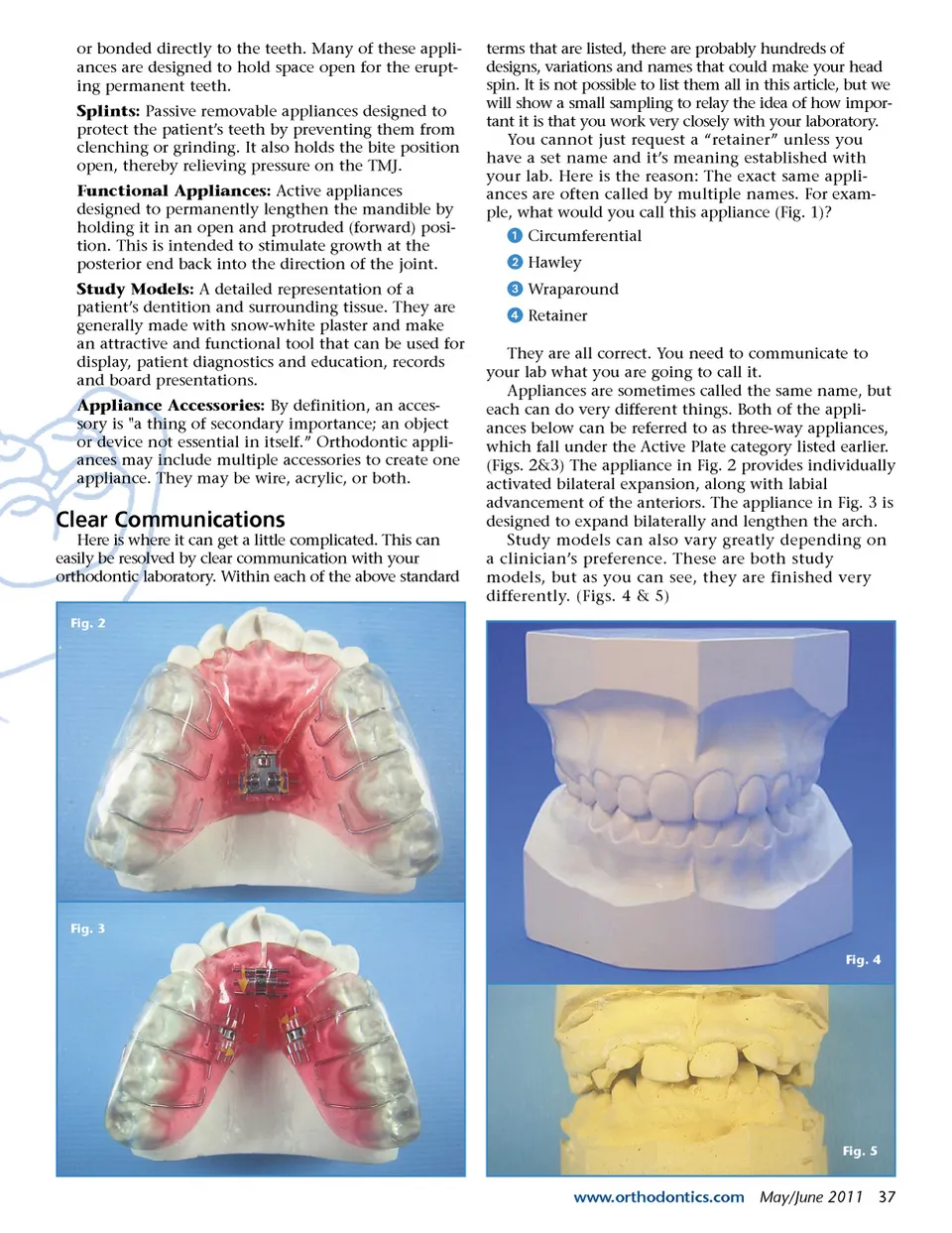
ommunicating with orthodontic labs can be much simpler if you are familiar with some basic orthodontic appliance terminology. Just as there are special hand instruments and different materials needed to practice clinical orthodon-tics, there are important considerations you should know when working with a dental lab that specializes in orthodontics. Crowns, bridges, dentures and partials are all designed to replace natural teeth. Orthodontic appli-ances are designed to work with existing natural teeth and can provide a multitude of different functions. It is important to know some orthodontic appliance basics in order to communicate effectively with an orthodon-tic laboratory. Also be aware of the fact that there are many variations, preferences, design and appliance name modifications that can really mix things up a bit. 101 Ortho Lab Terminology By Daryl Mathias, CDT Clear and effective communication with your orthodontic laboratory is a necessary part of providing outstanding orthodontic treatment. Let’s begin with some basic terms and appliance categories that are fairly standard within the specialty. C Retainers: Passive removable appliances designed to hold the existing position of a patient’s teeth. They are usually prescribed for wear shortly after the braces are removed to retain the results achieved during treatment. Spring Retainers: Active removable appliances designed to make minor corrections to the position of a patient’s anterior teeth. Cutting the teeth to be moved off of the work model and resetting them to an ideal position achieves these corrections. Wax is then used to hold the teeth in place. The appliance is made on this “set-up” model so that when the patient wears it, it will apply pressure to the misaligned teeth until they reach the ideal position. After the teeth have moved into place, the same spring retainer can be worn as retention. Active Plates: Active appliances are designed to move teeth as individuals or in groups using springs or screws. They can be fixed or removable depending on the design of choice and doctor preference. Expanders: Active appliances designed to widen the maxillary arch. They utilize a screw that is opened in prescribed daily increments. These appliances are usually used prior to treatment with braces to perma-nently correct narrow, crowded arches and create additional space into which the teeth can be moved. Fig. 1 Fixed Appliances: These are appliances designed to stay in the patient’s mouth for the duration of a treatment phase. They are either soldered to bands 36 May/June 2011 JAOS
Journal of the American Orthodontic Society May-June 2011: Page 36