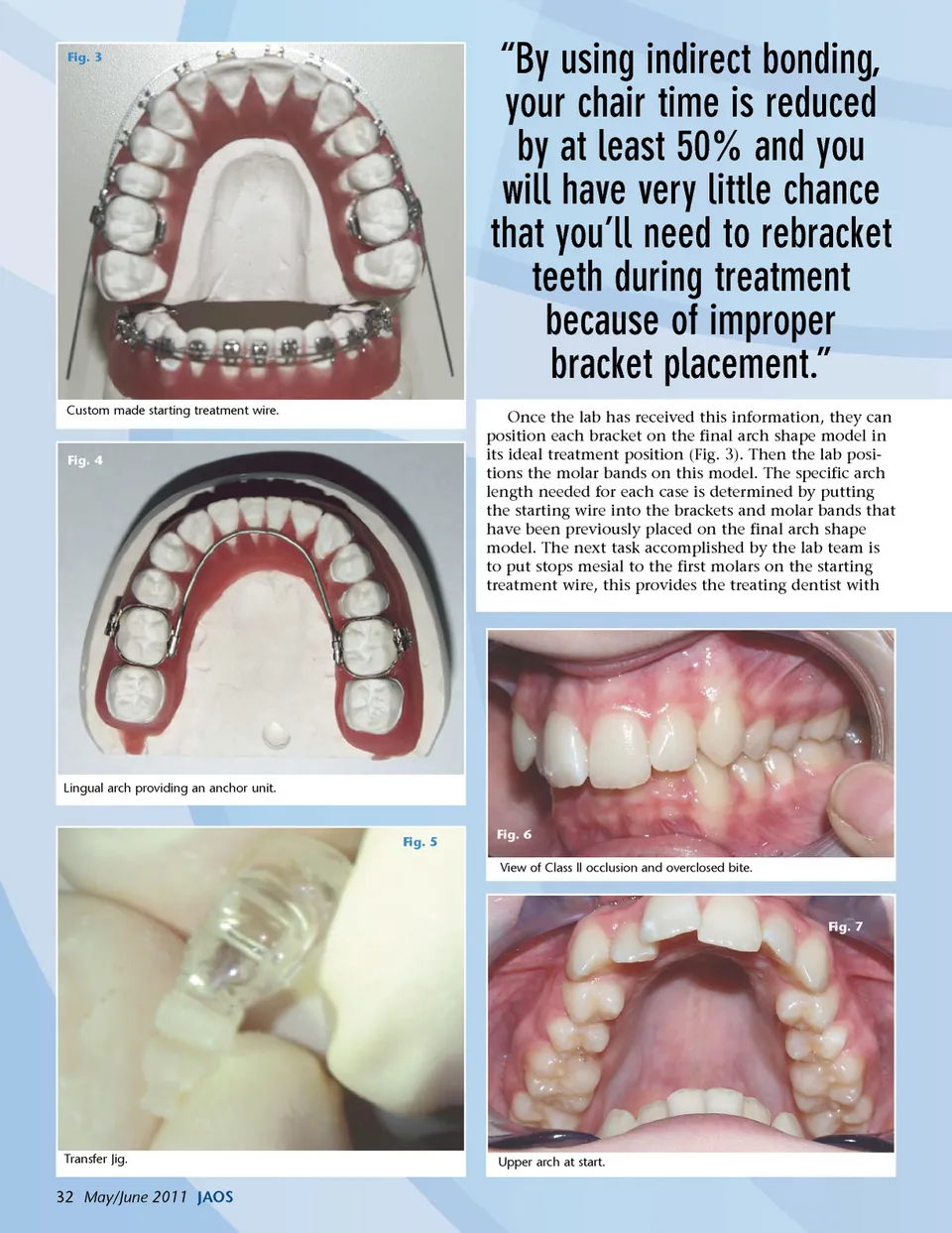
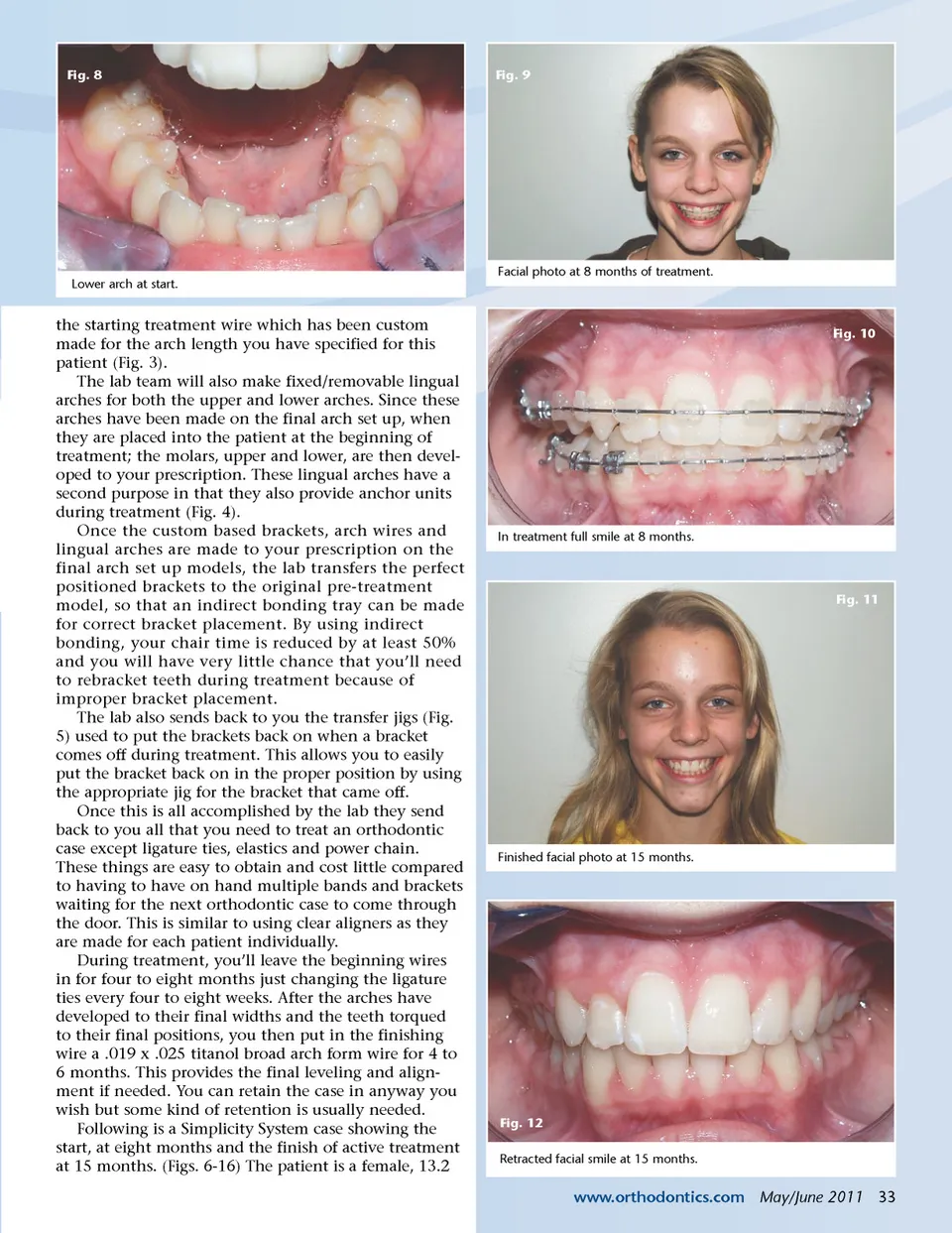
Fig. 8 Fig. 9 Facial photo at 8 months of treatment. Lower arch at start. the starting treatment wire which has been custom made for the arch length you have specified for this patient (Fig. 3). The lab team will also make fixed/removable lingual arches for both the upper and lower arches. Since these arches have been made on the final arch set up, when they are placed into the patient at the beginning of treatment; the molars, upper and lower, are then devel-oped to your prescription. These lingual arches have a second purpose in that they also provide anchor units during treatment (Fig. 4). Once the custom based brackets, arch wires and lingual arches are made to your prescription on the final arch set up models, the lab transfers the perfect positioned brackets to the original pre-treatment model, so that an indirect bonding tray can be made for correct bracket placement. By using indirect bonding, your chair time is reduced by at least 50% and you will have very little chance that you’ll need to rebracket teeth during treatment because of improper bracket placement. The lab also sends back to you the transfer jigs (Fig. 5) used to put the brackets back on when a bracket comes off during treatment. This allows you to easily put the bracket back on in the proper position by using the appropriate jig for the bracket that came off. Once this is all accomplished by the lab they send back to you all that you need to treat an orthodontic case except ligature ties, elastics and power chain. These things are easy to obtain and cost little compared to having to have on hand multiple bands and brackets waiting for the next orthodontic case to come through the door. This is similar to using clear aligners as they are made for each patient individually. During treatment, you’ll leave the beginning wires in for four to eight months just changing the ligature ties every four to eight weeks. After the arches have developed to their final widths and the teeth torqued to their final positions, you then put in the finishing wire a .019 x .025 titanol broad arch form wire for 4 to 6 months. This provides the final leveling and align-ment if needed. You can retain the case in anyway you wish but some kind of retention is usually needed. Following is a Simplicity System case showing the start, at eight months and the finish of active treatment at 15 months. (Figs. 6-16) The patient is a female, 13.2 Fig. 10 In treatment full smile at 8 months. Fig. 11 Finished facial photo at 15 months. Fig. 12 Retracted facial smile at 15 months. www.orthodontics.com May/June 2011 33
Journal of the American Orthodontic Society May-June 2011: Page 33