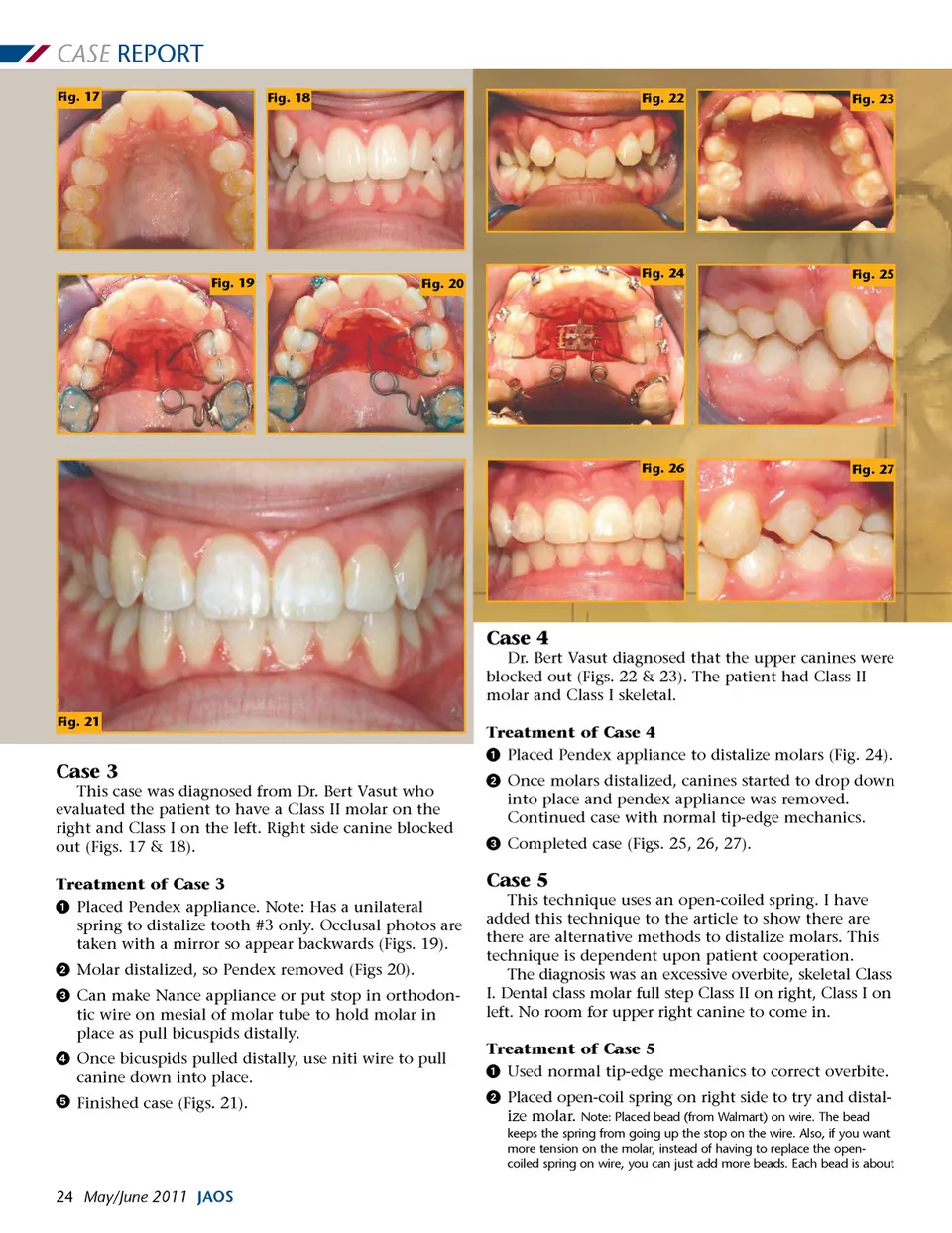
CASE REPORT Fig. 17 Fig. 18 Fig. 22 Fig. 23 Fig. 19 Fig. 20 Fig. 24 Fig. 25 Fig. 26 Fig. 27 Case 4 Dr. Bert Vasut diagnosed that the upper canines were blocked out (Figs. 22 & 23). The patient had Class II molar and Class I skeletal. Fig. 21 Treatment of Case 4 ᕡ Placed Pendex appliance to distalize molars (Fig. 24). ᕢ Once molars distalized, canines started to drop down Case 3 This case was diagnosed from Dr. Bert Vasut who evaluated the patient to have a Class II molar on the right and Class I on the left. Right side canine blocked out (Figs. 17 & 18). Treatment of Case 3 ᕡ Placed Pendex appliance. Note: Has a unilateral spring to distalize tooth #3 only. Occlusal photos are taken with a mirror so appear backwards (Figs. 19). ᕢ Molar distalized, so Pendex removed (Figs 20). ᕣ Can make Nance appliance or put stop in orthodon-into place and pendex appliance was removed. Continued case with normal tip-edge mechanics. ᕣ Completed case (Figs. 25, 26, 27). Case 5 This technique uses an open-coiled spring. I have added this technique to the article to show there are there are alternative methods to distalize molars. This technique is dependent upon patient cooperation. The diagnosis was an excessive overbite, skeletal Class I. Dental class molar full step Class II on right, Class I on left. No room for upper right canine to come in. Treatment of Case 5 ᕡ Used normal tip-edge mechanics to correct overbite. ᕢ Placed open-coil spring on right side to try and distal-tic wire on mesial of molar tube to hold molar in place as pull bicuspids distally. ᕤ Once bicuspids pulled distally, use niti wire to pull canine down into place. ᕥ Finished case (Figs. 21). ize molar. Note: Placed bead (from Walmart) on wire. The bead keeps the spring from going up the stop on the wire. Also, if you want more tension on the molar, instead of having to replace the open-coiled spring on wire, you can just add more beads. Each bead is about 24 May/June 2011 JAOS
Journal of the American Orthodontic Society May-June 2011: Page 24