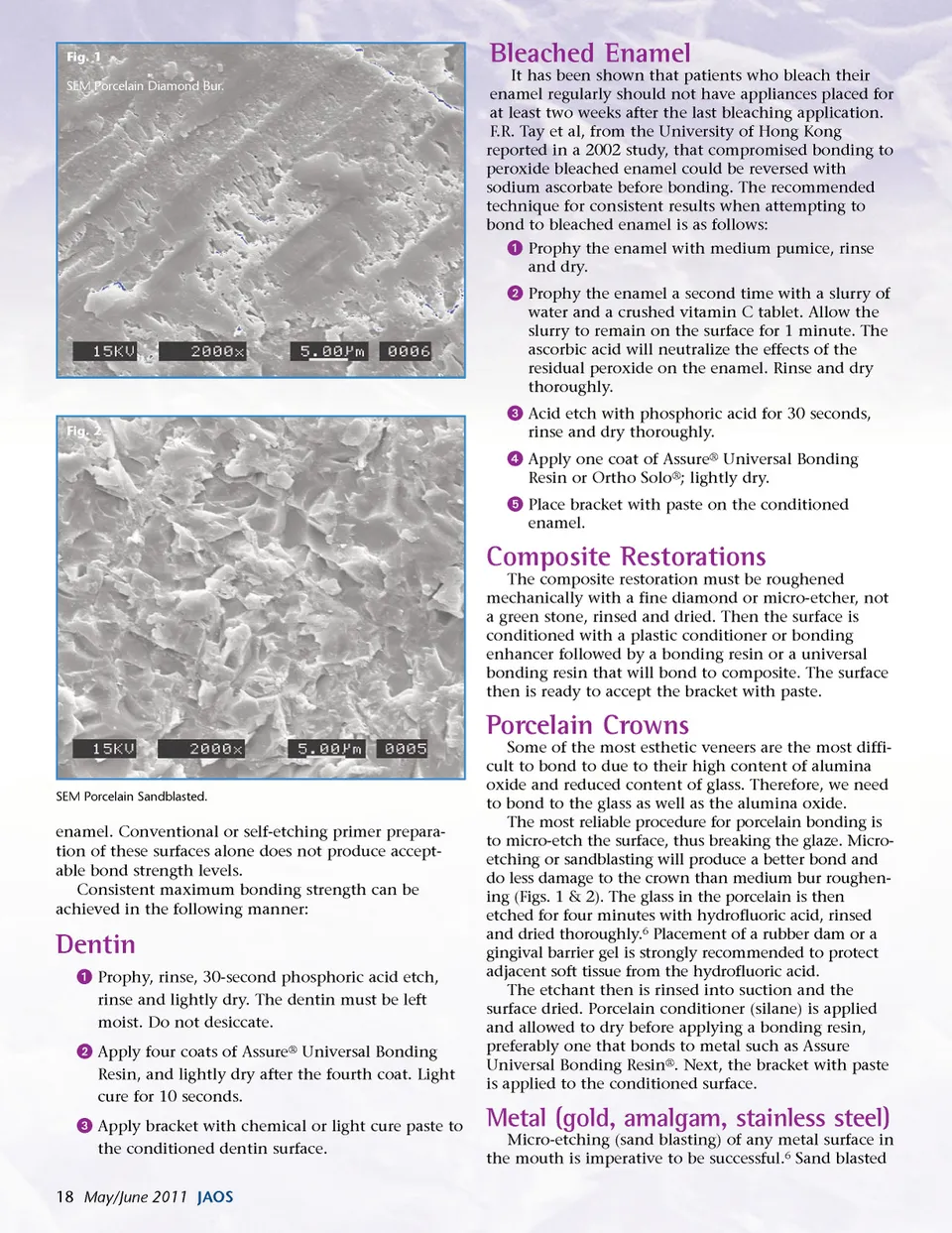
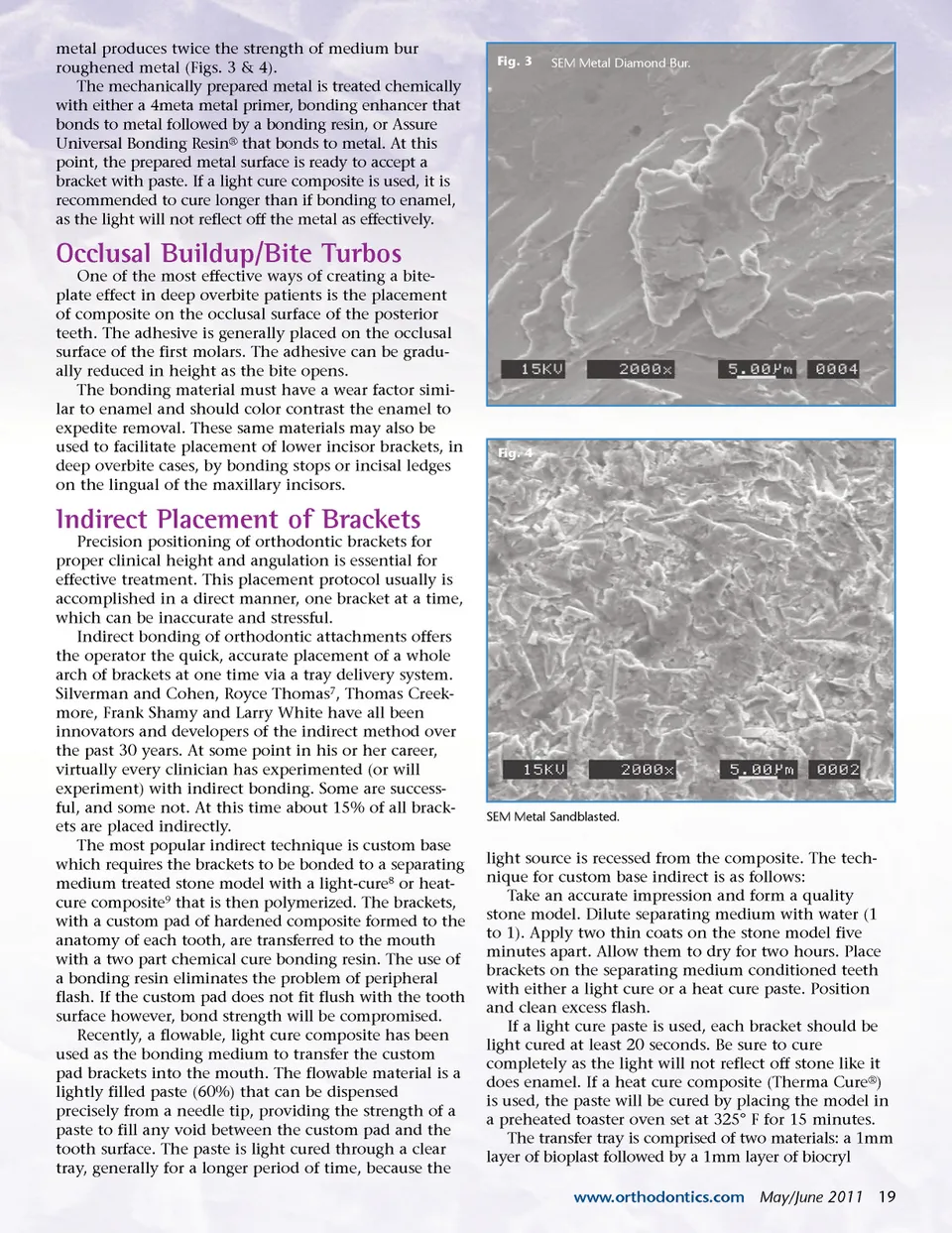
metal produces twice the strength of medium bur roughened metal (Figs. 3 & 4). The mechanically prepared metal is treated chemically with either a 4meta metal primer, bonding enhancer that bonds to metal followed by a bonding resin, or Assure Universal Bonding Resin ® that bonds to metal. At this point, the prepared metal surface is ready to accept a bracket with paste. If a light cure composite is used, it is recommended to cure longer than if bonding to enamel, as the light will not reflect off the metal as effectively. Fig. 3 SEM Metal Diamond Bur. Occlusal Buildup/Bite Turbos One of the most effective ways of creating a bite-plate effect in deep overbite patients is the placement of composite on the occlusal surface of the posterior teeth. The adhesive is generally placed on the occlusal surface of the first molars. The adhesive can be gradu-ally reduced in height as the bite opens. The bonding material must have a wear factor simi-lar to enamel and should color contrast the enamel to expedite removal. These same materials may also be used to facilitate placement of lower incisor brackets, in deep overbite cases, by bonding stops or incisal ledges on the lingual of the maxillary incisors. Fig. 4 Indirect Placement of Brackets Precision positioning of orthodontic brackets for proper clinical height and angulation is essential for effective treatment. This placement protocol usually is accomplished in a direct manner, one bracket at a time, which can be inaccurate and stressful. Indirect bonding of orthodontic attachments offers the operator the quick, accurate placement of a whole arch of brackets at one time via a tray delivery system. Silverman and Cohen, Royce Thomas 7 , Thomas Creek-more, Frank Shamy and Larry White have all been innovators and developers of the indirect method over the past 30 years. At some point in his or her career, virtually every clinician has experimented (or will experiment) with indirect bonding. Some are success-ful, and some not. At this time about 15% of all brack-ets are placed indirectly. The most popular indirect technique is custom base which requires the brackets to be bonded to a separating medium treated stone model with a light-cure 8 or heat-cure composite 9 that is then polymerized. The brackets, with a custom pad of hardened composite formed to the anatomy of each tooth, are transferred to the mouth with a two part chemical cure bonding resin. The use of a bonding resin eliminates the problem of peripheral flash. If the custom pad does not fit flush with the tooth surface however, bond strength will be compromised. Recently, a flowable, light cure composite has been used as the bonding medium to transfer the custom pad brackets into the mouth. The flowable material is a lightly filled paste (60%) that can be dispensed precisely from a needle tip, providing the strength of a paste to fill any void between the custom pad and the tooth surface. The paste is light cured through a clear tray, generally for a longer period of time, because the SEM Metal Sandblasted. light source is recessed from the composite. The tech-nique for custom base indirect is as follows: Take an accurate impression and form a quality stone model. Dilute separating medium with water (1 to 1). Apply two thin coats on the stone model five minutes apart. Allow them to dry for two hours. Place brackets on the separating medium conditioned teeth with either a light cure or a heat cure paste. Position and clean excess flash. If a light cure paste is used, each bracket should be light cured at least 20 seconds. Be sure to cure completely as the light will not reflect off stone like it does enamel. If a heat cure composite (Therma Cure ® ) is used, the paste will be cured by placing the model in a preheated toaster oven set at 325° F for 15 minutes. The transfer tray is comprised of two materials: a 1mm layer of bioplast followed by a 1mm layer of biocryl www.orthodontics.com May/June 2011 19
Journal of the American Orthodontic Society May-June 2011: Page 19